

The unbearable Andy Weir's "science teacher fiction"
Taking on the extremely annoying novel and film 'Project Hail Mary'


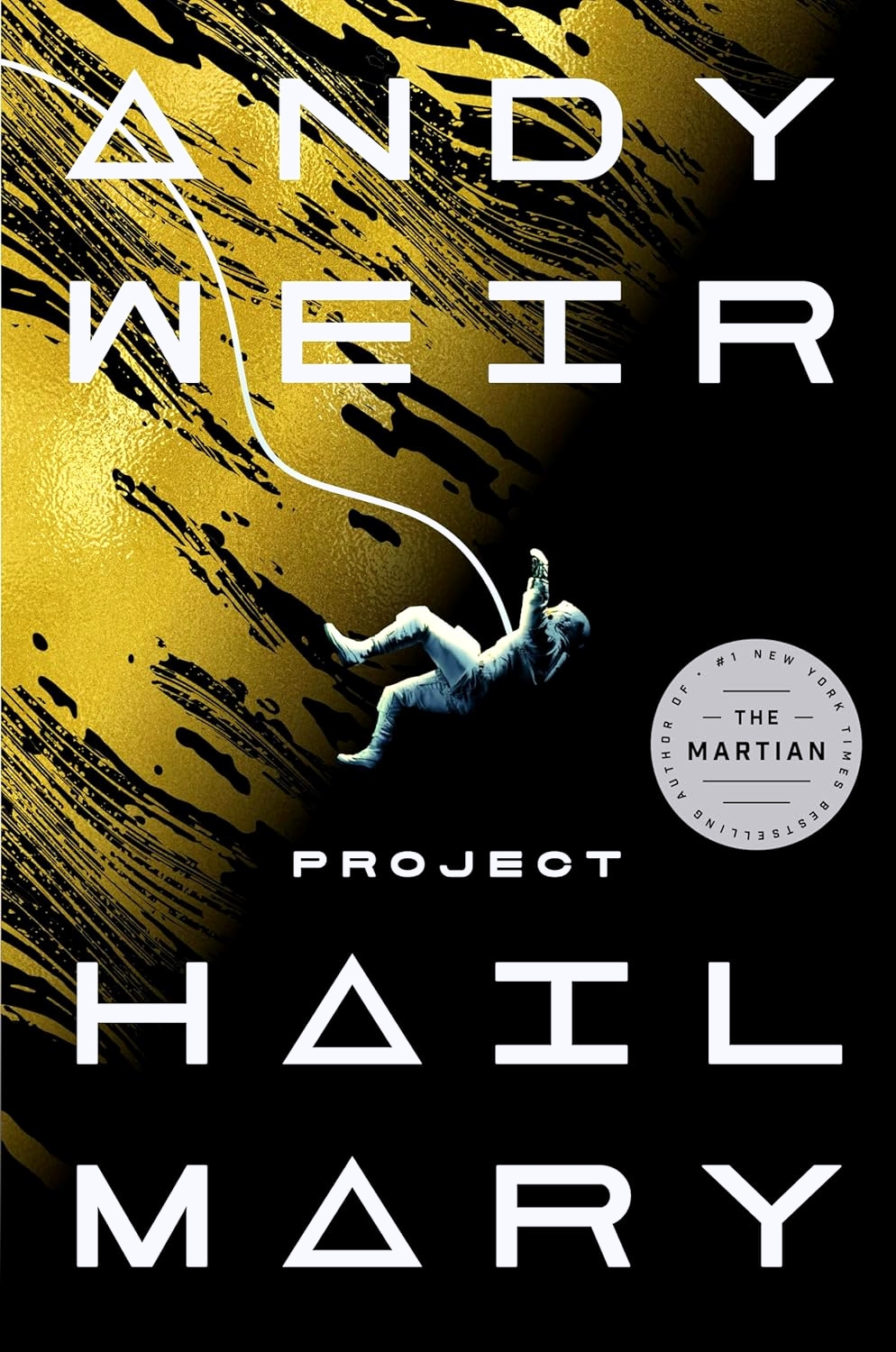
Project Hail Mary
Fiction by Andy Weir
Ballantine Books, 2021
Reviewed by Cade Jameson
I was accused of a being a hater. So I am. Everyone in the packed multiplex screening of Project Hail Mary was thoroughly enjoying themselves, except me (and my wife, she wants that on record—good for her). It wasn’t just the cringe-inducing humor, which “wasn’t for me” as people have begun to say since critical discernment has become so unfashionable. This movie, while clearly meant to be about the present climate catastrophe, was incongruously caked in the too-sweet feelgoodism of the hegemonic say-nothing-unpleasant agenda. It was impossible for me to hold my tongue. I felt like I was being trolled, dared to take issue with the movie’s evasions, so that I could be labelled anti-people-enjoying-themselves. Is this what people mean when they say they’re being gaslit?

Project Hail Mary, based on a novel by Andy Weir (who has been described by Eris on this blog as a hack-nerd infection on the SF genre), is a first-contact buddy comedy, featuring a sentient alien rock creature and a dorky human. It imagines an inverse climate catastrophe to the one we are experiencing in nonfictional reality, although clearly meant to signify (via wish-fulfilling fantasy) just that. The sun and neighboring stars have been colonized by interstellar, energy-consuming, alien micro-organisms, triggering rapid onset global cooling which will destroy civilization and most life on Earth in a matter of a few decades. One nearby star is unaffected, 12 lightyears away—Tau Ceti (setting of the far more enjoyable Barbarella). Cue wish fulfillment: Unlike our real world climate crisis, the nations of the world cooperate and give their scientists the resources to solve the problem. Astrobiologist turned middle-school science teacher Ryland Grace is improbably placed on the three-person crew sent to Tau Ceti to discover the reason that star hasn’t succumbed to the microbes in the hope that this information will save Earth. He is the only member of the crew to survive the voyage. When Grace arrives at Tau Ceti, he encounters and befriends Rocky, the alien rock creature, who is undertaking the same mission on behalf of his planet, and who is also the sole surviving member of his crew, thereby setting up a feelgood human-alien, overcoming-odds-together, friendship dynamic that is too saccharine for the senses to tolerate.
Imagine spending day after day on a spaceship with an alien who you’ve befriended, after departing a planet that, if an Astrophage didn’t show up in our system and start eating the sun, would otherwise be locked into catastrophic heating, and having that just seem to you like the routine course of history. The psychologists on your planet say your species’ unevolved brain has difficulty conceptualizing something so abstract as long-term terminal risk,1 and the astronomers say the reason we haven’t seen any signs of intelligent life in our galaxy is because at a certain level of technological development, intelligent species inevitably destroy their environment and plummet into civilizational decline. You don’t mention any of this to your friend the alien, or ask him anything about his own civilization. It’s not the sort of subject you or anyone else is supposed to talk about. That’s Ryland Grace—a creature of our own morbid-stage capitalism where there is (still) no alternative, despite climate catastrophe, the sixth mass extinction, Gilded Age-level inequality, rampant predatory grifting, and wholesale governmental incompetence.
For all the many vacuous movies Hollywood has given us that aspire almost to be about some pressing social issue, Hail Mary manages to feel particularly evasive. Is it not a movie about climate disaster? Is it not a contact story—a genre about time travelers and alien encounters which have historically served as a wrapping for subversive content? (Consider Twain’s Connecticut Yankee, where as a kid I encountered my first defense of the guillotine.) Hail Mary is neither of these things, but its passing resemblance can’t help suggest something is being self-censored (whatever, just a little civilizational polycrisis). Obviously, we are living in a period of cultural decline and the movies of the last two to three decades (not coincidentally coinciding with the rise of the big-budget nerd movie) are one of its glaring symptoms, so what was I expecting? In a less stupid era, a screenwriter might have had the awareness to recognize that SF genre convention called for at least a satirical nod at the course of human civilization. Consider the above mentioned Barbarella, a spoof whose SF premise is primarily an excuse to display Jane Fonda in skimpy spacegirl attire (along with some wonderful psychedelic sets), but whose titular character is from an Earth in which war and violence (and unfortunately physical sexual relations) are relics of the past. Maybe Rocky’s species the Eridians have put war behind them? Grace never asks.
After watching Hail Mary, I became curious about Weir’s novel. Surely the novel couldn’t possibly be as evasive as the movie, could it? Was it so equally cringe and devoid of substance? Was I hate-reading Andy Weir? I was indeed. I did it to satisfy my curiosity about the contemporary popular SF literary landscape.
Was the novel a slog to get through? The only thing Weir asks of the reader is the ability to withstand cringe. I almost don’t want to provide examples because it’s too horrifying. The book is written in the first-person voice of Grace, a nerd-identifying character, who says things like, “Who pooped in your Rice Krispies?” He also says “dang,” “darn,” “heck,” “fudge,” and “bull puckey” because he’s a school teacher, and that’s Weir’s attempt at giving the reader a character. Thankfully Hollywood toned this down a little, because I can’t imagine even YA readers (who I assume this book is for?) would find this funny.
Does Grace ever broach the subject of the precarious state of human civilization with Rocky? I seem to have missed it. At an early stage in the two aliens’ encounter, before they established a means of linguistic translation, Grace uses a clock to indicate to Rocky the time of their next meeting. Grace declares that he’s going to be careful not to be late for this appointment because he doesn’t want Rocky to get the impression that “humans are untrustworthy.” Then he adds immediately, “I mean...we’re pretty untrustworthy, but I don’t want him to know that.” OK so that’s how Grace feels, and he’s going to withhold this information from his friend?
At the very end of the book there is a very tacked-on and vague description of the civilization Rocky hails from. Depicting any sort of civilizational contrast or alternative (whether better or worse) is pretty clearly not something Weir is interested in or capable of doing, lest he risk writing a more interesting novel and offending potential customers.
Before reading Hail Mary, I had no prior familiarity with Weir, except that I knew he also wrote the book that the movie The Martian was adapted from. All I remember about The Martian is Matt Damon’s character using the word “science” as a verb. I recall cringing in the theater when I heard it. Stranded on a planet without food or air he can breathe, the movie’s hero declares, “In the face of overwhelming odds, I’m left with only one option. I’m gonna have to science the shit out of this!” Sciencing (I’m glad to see that my spellchecker still flags that) as a verb is quite obviously Weir’s modus operandi, the thing that fills him with childlike excitement. Grace wakes up on his spaceship with no memory—why? Apparently so Weir can devote the first quarter of the novel to his protagonist’s experiments with a pendulum, stopwatch, and measuring tape to figure out where he is.
I’ve selected an exemplary passage of sciencing to give a sense of how this works (or doesn’t) as literature. Late in the book, Grace figures out that he can locate Rocky’s ship in the deep dark expanses of space with some of the gizmos his ship is equipped with (you don’t really need to know what they are):
I have everything I need for the best radar ever! To heck with my built-in radar system, with its measly emitter and sensors. I have spin drives and a Petrovascope! I can throw 900 terawatts of IR light out the back of my ship and see if any of it bounces back with the Petrovascope—an instrument carefully designed to detect even the smallest amounts of that exact frequency of light!
You can see how exciting Weir finds this from all those exclamation points. Late in the third act of the novel, when Grace decontaminates the fuel tanks a second time, I was really worn down by Weir’s sciencing. That’s because, with few exceptions,2 the science in the novel isn’t particularly interesting. Whereas science fiction often takes imaginative leaps with its science, Weir’s version is more or less textbook stuff, give or take some incidental fantastic elements—incidental because Weir feels he must explain the fantastic elements, to make them sensible, to incorporate them into the type of science we learn in high school. It’s an exceedingly literal version of science. This is science teacher fiction, not science fiction. It’s the literary equivalent of Thomas Kuhn’s “normal science” (boring experimentation, as contrasted with the revolutionary science of the “paradigm shift” when the old theories are discarded and everything has to be rethought). It makes the book read like a transcript of Mythbusters.
On to the climate-action fantasy, which Weir has to insert this storyline because it’s what gets him to the crowd-pleasing climax where Grace and Rocky save the world. In this background plot, Weir gives us a politically neutered ripoff of Kim Stanley Robinson’s Ministry for the Future.3 The world is placed under the dictatorial control of a stern Norwegian administrator, which I choose to read as a fantasy desire for serious European—as opposed to ridiculous, incompetent American—international leadership. If you are paying attention to the present day results of liberal leadership in Europe (and I’m referring specifically to the rise of neofascist political parties and their now openly admitted selective support for international law), then this prescription feels underwhelming, but let’s move on.4 Grace gets plucked out of his classroom, put aboard a fighter jet, and flown to a scientific meeting taking place on an aircraft carrier. It’s very “gee whiz,” but there’s a meaningful juxtaposition of imagery here: Science, schools, and the military-industrial complex—an inversion of our upside-down world which undervalues science and underpays teachers while spending billions on war. But I don’t think that’s Weir’s intention at all. I think what he’s trying to say is this: History has given us the Nerd, and if you only let him science, he will solve all of your problems (it’s the Bill Gates outlook that every problem is a technical problem waiting to be solved). A longish speech which Weir puts in the mouth of the Norwegian on the fifty thousand years of misery preceding the Industrial Revolution reveals the poverty of Weir’s imagination. It was high school B-grade level and so dull, so lacking in any interesting historical detail, that I wondered if maybe I was missing something? Maybe I had to keep in mind that Weir’s fantasy is narrated through the mouth of an idiot, Grace, whose selective mastery of science trivia comes at the expense of all other domains of knowledge. Weir does poke fun at Grace for his social idiocy (that’s one endearing quality nerds possess, the self-deprecation), and, given Grace’s ignorance, any character attempting to communicate with him would have to simplify things. So perhaps Weir means for Grace to be an unreliable narrator, an idiot witnessing future-history? No, that would be too clever. There’s no counter-narrative voice. You never get the sense that Weir’s interests extend too far beyond science textbook trivia either.
What to make of this combination of cringe, sciencing, and totally pointless climate-action fantasy? Where does it stand in relation to science fiction literature? My first impulse was to argue that this isn’t science fiction at all, and that it should best be understood as a member of a specific genus of identify-affirming cultural products which proliferate as convenient forms of commercial exploitation: This is a nerd novel, a pretty cheap and easy-to-produce type of commercially-targeted nerdsploitation. Weir’s cringe and the sciencing function as nerd iconography, a means of branding the novel for its audience. This helps to explain why Project Hail Mary feels so un-funny, so not-for-me, and devoid of any substance for anyone who doesn’t identify with nerd subculture and comes to the novel expecting something more in line with science fiction’s literary tradition. But I have a worrying thought that I am on the wrong track and that I’m not seeing the whole picture. As I write my concluding thoughts, an alternative explanation occurs to me, and it points to something odd, scary, and possibly sinister. Here goes: Weir’s innocent, clueless optimism in sciencing doesn’t feel contemporary. There’s something eerily old-fashioned about his boyish, gee-whiz!-I’m-going-to-ride-in-a-fighter-jet-and-look-for-IR-light-with-my-Petrovascope! excitement. It seems closer to Back to the Future’s re-creation of the 1950s than our own times. I hesitate to reveal my suspicion because I know it sounds insane, but I cannot believe that a human individual in our age could have written this book, except for the fact that the author clearly has knowledge of contemporary events. I feel like I have encountered an anachronism. Perhaps Project Hail Mary is indeed science fiction literature, but a type of science fiction that the contemporary fan of Wells, Dick, Ballard, Haldeman, Gibson, etc. only knows secondhand from the genre’s historians? My suspicion is that this novel was written by some sort of unextinct holdover or freakish recapitulation of SF’s pulp era, from back when nerds held sway over the genre and science fiction was unpolluted with countercultural and radical ideas. But how could such a reversion, this thing, Andy Weir, whatever it is, possibly survive in our present climate? My effort to explain the Andy Weir phenomenon has resulted in more questions than answers. I can only offer speculation. Was he made in the lab, as a publishing industry conspiracy to cleanse SF of radical ideology? Perhaps Weir is some sort of nostalgia bot, like the Abraham Lincoln of Philip K. Dick’s We Can Build You? Or maybe we are suffering from the decaying of time Dick foresaw and sought to warn us about in Ubik? Whatever Weir is, we should all be alarmed.
— Cade Jameson
Cade Jameson is an ex-community college sociology instructor. He lives in Durham, North Carolina, and dabbles in writing science fiction. Follow him on Substack.
FROM THE VAULT: 'Ready Player One' and the living death of science fiction

Ready Player One is a sad testament of the true resignation of science fiction to the same forces of hapless insular hackery that ravage the fantasy genre. A self-supporting, self-legitimating machine, created by the pressures of genre-ghettoization within the industry.
Based on typical psychological just-so reasoning, it should be said.
On his voyage back to Earth, Grace runs out of food and subsists on what he calls me burgers, synthesized meat from his own proteins. That’s creative. I’ll give Weir that.
Robinson also makes far more compelling literature out of pendulum experiments in Galileo’s Dream.
I sensed something like a domination kink fantasy in the relationship between Grace and the Norwegian. All the scientists on the project suspect the two have a sexual relationship, which Grace denies. Since I choose to read Grace as a stand-in for Weir, I take the denial as a confirmation.
Huh. I like a good take down, but I don't think you found anything here. You're right that it's an obvious throwback to earlier science fiction - there's a reference to Arthur C. Clarke's Rendezvous with Rama that I found very telling. It's extremely close in tone to Clarke's writing, all the way down to the corny dialogue and paper-thin characterisation.
But yeah, it's all about that sciencey enthusiasm. Which you can dislike... but so what? If you want to make something of the absences of the book - like the meaningful discussion of how human society is messing up the planet - you'll have to tell us what should have gone in there, and why that would be better. Otherwise, why not just let pulp be pulp?
who knew this book had an entire militia of online shooters? anyways, as someone who HAS identified with nerd culture and subculture, and who should (at least in theory) enjoy nerdsploitation lit, I also find it shamefully vacuous. The Rick and Morty of novels or something