

Doing poetry wrong, confusing suicides, chronic pain, and Jane Birkin
Discordia (Book) Reviews for June 2026


BOOKS REVIEWED
Sire on Do It Wrong: How to Be a Poet in the Twenty-First Century by Derek Beaulieu (nonfiction)
Andrew Wu on Suicide by Édouard Levé, trans. by Jan Steyn (fiction)
Sire on ouch ouch ouch by Ev Ricky (illustrations & poetry)
Veeda Khan on It Girl: The Life and Legacy of Jane Birkin by Marisa Meltzer
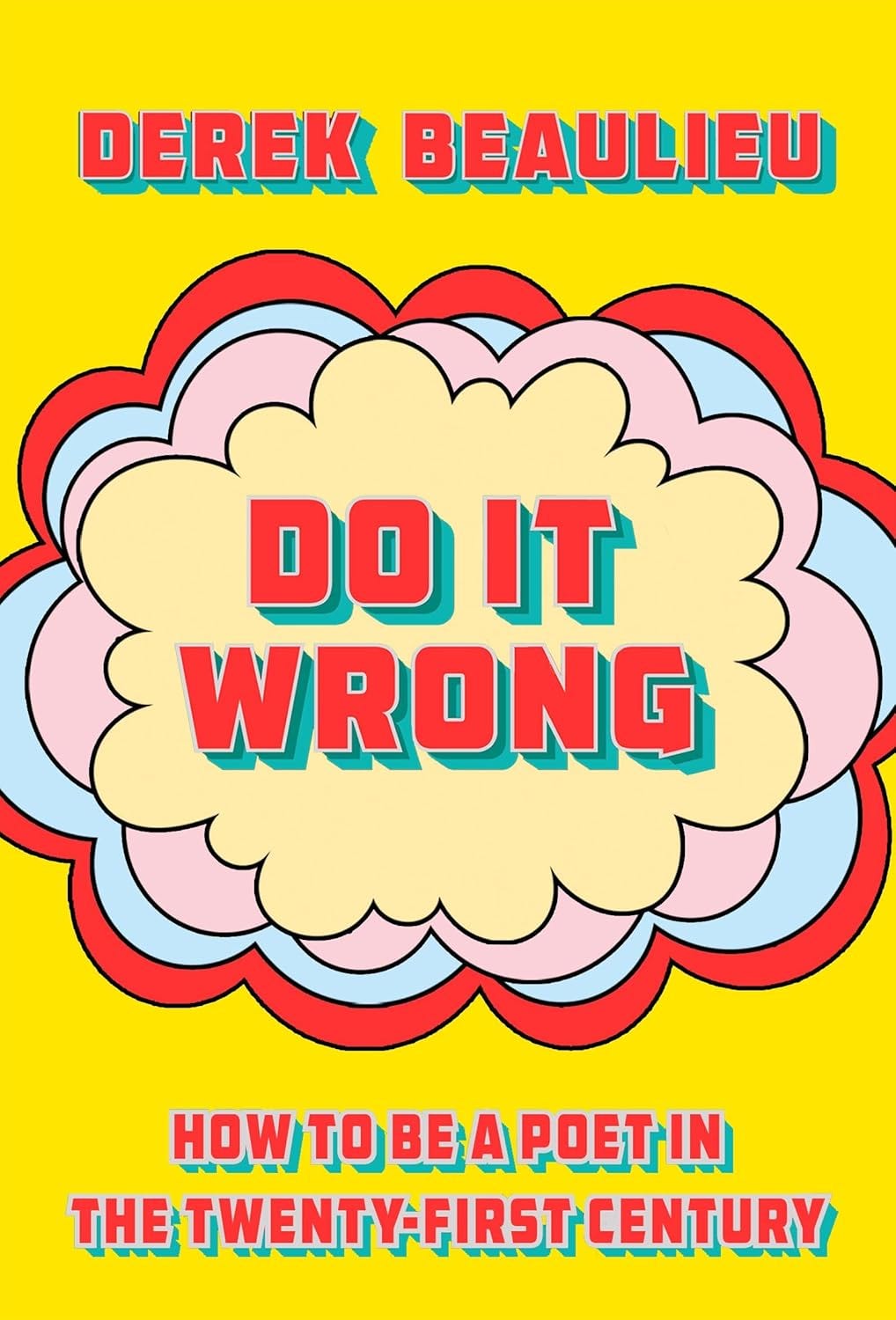
Do It Wrong: How to Be a Poet in the Twenty-First Century
Nonfiction by Derek Beaulieu
Assembly Press, 2026 (Publisher's Site)
Reviewed by Sire
The most arresting observations in Derek Beaulieu’s new self-help book for poets come early on. In the chapter “There is No There There,”1 Beaulieu does some quick cocktail napkin math on the economics of poetry publishing, and what the numbers can tell us about the genre’s presumable readership:
Five hundred copies [the average print run of a poetry collection] for 40 million people means that a good-selling book of poetry will have a readership of less than 0.0001 percent of Canada’s population. One ten-thousandth of 1 percent. […] For American authors, the situation doesn’t scale. The population is roughly ten times that of Canada, but the print runs for poetry are not ten times higher; they remain about the same at around 500–1,000 copies.
Following on from this premise, Beaulieu notes that, of the estimated $12,475 grossed from the sale of said 500 books, an author on a 10% royalty deal will make approximately $1,249 after the publishers, distributors and bookstores have taken their cuts;2 that even this paltry sum is an optimistic scenario given how few titles actually sell out even a single printing; and, looming above all this, that poetry makes up a mere 0.12% of total book sales.3
I can’t imagine there are too many non-delusional poets working towards a traditional publishing deal who are unaware of the general bleakness of the financial picture awaiting them, but it’s useful to have the ice cold water of your earnings will top out at like $5 a week tossed in your face from time to time as a reminder of how absurd it is to allow ‘careerism’ to dictate your choices as a poet. And for the audience of beginners and hobbyists that Beaulieu seems to be catering to with Do It Wrong, it’s not a bad idea to establish reasonable expectations early.
In his own practice Beaulieu is an extremely prolific experimental poet, and it’s consistent with that ethos when he concludes that, since you’re not going to sell anything anyway, you are therefore free to do whatever you want to do. (In fact, Beaulieu laudably makes available free of charge nearly everything he’s ever published.) The underlying message here is that gatekeepers have no real power once you realize there is practically nothing behind the gate that you cannot acquire on your own. Publishers don’t like your stuff? Make some zines and give them away. Depressed by your lack of readership? Burrow deeper into the community of fellow (similarly profoundly unread) writers. Prizes are a scam, winners chosen by exhausted compromise, laurels of thin air on scalps of thinning hair. There’s a lot to these basic premises that a Discordia reader can sympathize with.
In some ways, this all makes for a nice antidote to the Save the Cat!-style writing manuals that purport to instruct aspirants on techniques for producing commercially viable work while (in reality) stuffing their imaginations into boxes. But Beaulieu’s blandly optimistic tone is too similar to these For Dummies handbooks for comfort. In many respects, something like Rilke’s Letters to a Young Poet could also be described as a “self-help” book for “creatives,” but for all that book’s tenderness and pragmatic statements about the writer’s life, its great, defining quality is the seriousness with which it treats poetry. Upon being shown the works sent to him by the ‘young poet,’ which the reader can infer are of middling quality,4 Rilke’s remarks are tactful and generous, but he refuses to praise the poet unduly—one senses that to do so would be a betrayal of both his correspondent and of poetry. What he gives instead are his own ideas on how to see and to feel in such a way that, whether one has a genuine talent for verse or not, one can live in a condition of humble sensitivity that is conducive to poiesis.
By contrast, despite obviously being an obsessive who has moulded his life around his art, the Beaulieu of Do It Wrong mostly sounds like he’s talking about a hobby of little real consequence beyond signposting one’s own quirkiness.5 (I yearned for the prickly grievance farming of Stuart Ross’s cult classic Confessions of a Small Press Racketeer because, in addition to being funny, it was clear how much it burned his ass to see hacks have more success than the genuine talents—most notably himself.) As with most contemporary artists, Beaulieu has been forced to spend nearly as much time teaching in creative programs and hustling for grants and patronage positions6 as he has working on his own poetry. That’s why even when he tries to get serious about defending the importance of the genre, he can’t help but answer like the creature of the system that he is. Beaulieu checks off the required references to the supposed positive economic impact of Canadian artists (despite having established the puniness of poetry’s current stature); to Indigenous peoples (via a shoehorned-in two-pager on what ‘thinking like Natives’ can teach us about community); to Representing Identities, and so on and on. Witness the worst advice in the entire book:
A young queer student once asked me to read their manuscript and offer feedback. I shared with them that I was surprised, because their writing sounded like something I might write—and I’m cis-bodied, straight, male, and middle-aged. I suggested they consider how they could use a vocabulary, a structure, a POV, and a means of writing that is indelibly twenty-first century 2SLGBTQ+.
“Toss these sestinas. I want 90 new free verse poems about Sonichu on my desk by Tuesday!” he might as well have said. You can tell how proud he is to have acted so progressively in cramming this poor student right back into the ID Bucket after they’d made an effort to write outside of the framework established by their Feeld profile’s bio. One can write true poetry in an “indelibly twenty-first century 2SLGBTQ+” vein, but you’re also allowed to be a queer who locates your style in other elements of your identity and experience. If anything, by pushing this student into adopting a more recognizably queer-coded affect, Beaulieu’s advice is as likely to prevent the emergence of a unique style as it is to encourage it.
In Letters to a Young Poet, Rilke notes that, while he’s ostensibly offering advice to his correspondent, he is really speaking to his own younger self, trying to tell himself things he wishes he could’ve known, advice he even now wishes he could take. I don’t know if Beaulieu is writing ‘to himself’ in the same way (or if he realizes that’s what he’s doing), but if he is, he has fallen somewhat short of the intimate honesty of his greater forebears in the field (a number of whom are helpfully cited in the book’s recommended reading list). He’d have had a better book if he’d rid it of some of the pro forma-sounding liberal truisms larding it down and gave it more of his own strangeness, his own philosophies of poetry beyond, ‘It’s fun to do and it’s okay if you don’t win any awards.’ The book is better when his gift for free association, the sort of unreasonable synaesthetic logic all poets must have to some degree, peeks out:
I strive to write books that move and shimmer like the landscapes in my dreams. I imagine towering letters along the horizon-line viewed for an instant through the flickering of a copse of birch trees, street signs reflected in oily puddles on the sidewalk, poems trapped in the methane bubbles of Abraham Lake.
What a beautiful way of articulating why his own muse has led him toward the concrete, iconographic visual poetry for which he is known. Surely this sort of thing is more likely to fire the imagination of a young poet than bland pablum about poetry’s great worth to the economy or the meaning of an A+ grade. There is good advice to be found within Do It Wrong, and we would all do well to heed Beaulieu’s exhortations toward greater generosity and communitarianism. But overall, it’s more likely to make you want to give a poet a wedgie than to become one yourself. — Sire
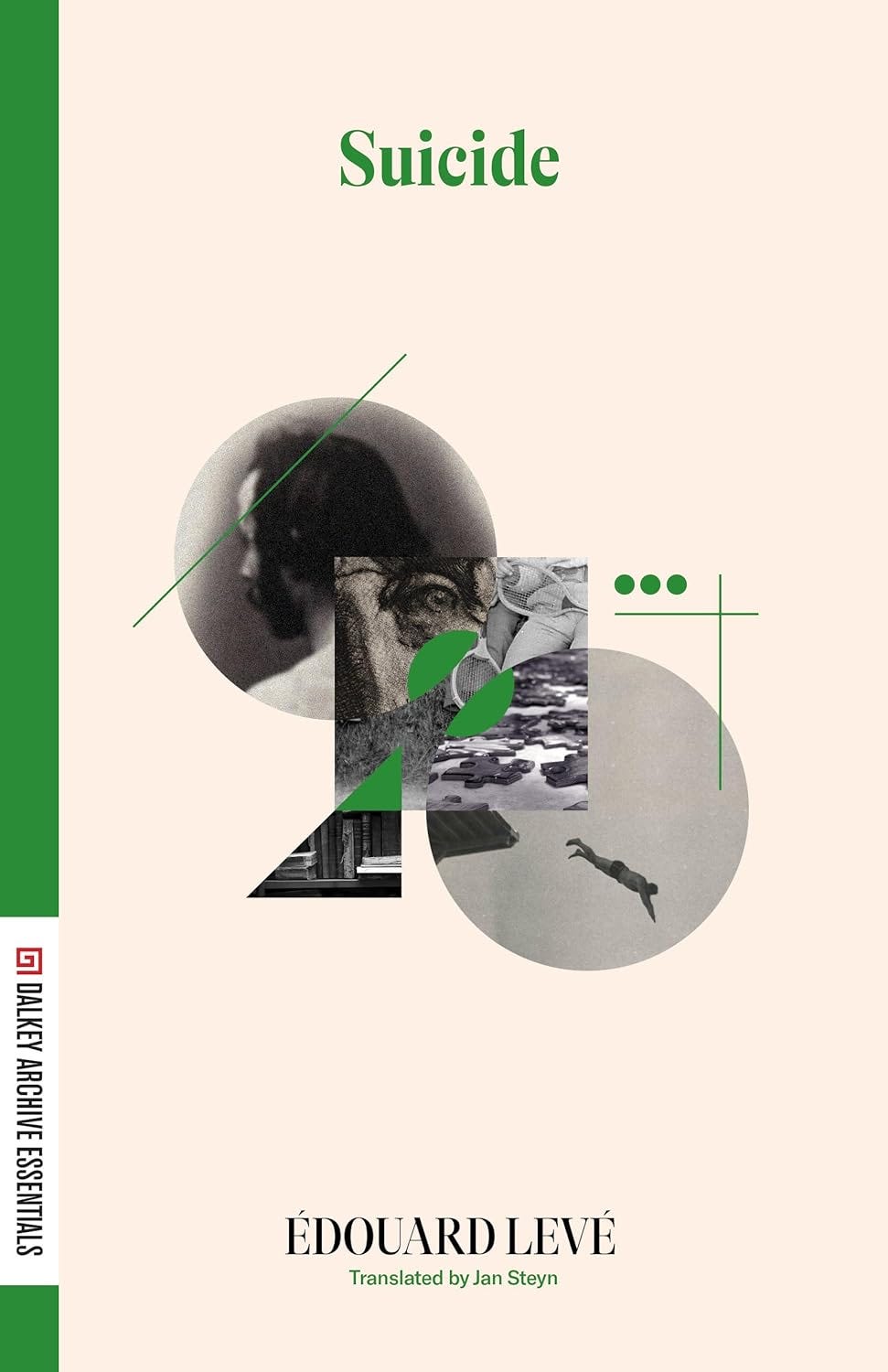
Suicide
Fiction by Édouard Levé, Trans. Jan Steyn
Dalkey Archive Essentials, 2025 (Publisher’s Website)
Reviewed by Andrew Wu
The way in which you quit it rewrote the story of your life in a negative form. Those who knew you reread each of your acts in the light of your last. Henceforth, the shadow of this tall black tree hides the forest that was your life. When you are spoken of, it begins with recounting your death, before going back to explain it. Isn’t it peculiar how this final gesture inverts your biography?
Édouard Levé (1965–2007) was a French artist and author. Self-taught, he produced a handful of books and series of photographs. His writing is meanderingly, almost mockingly objective—for example, Oeuvres is simply a list of hundreds of his ideas for possible works of art (some of which he eventually realized.)
Levé’s last work, Suicide, is a novella in which an unnamed narrator conveys to the reader a description of his friend, an unnamed you who committed suicide two decades prior. In March 2008, Suicide was published (in the original French) by Éditions P.O.L. In 2011, Dalkey Archive Press released an English translation by Jan Steyn, and in 2025, it was reissued as a part of Dalkey’s Essentials series. Before the mundanities of publication, translation, and distribution, in October 2007, ten days after sending Suicide to his editor, Levé hanged himself.
Suicide begins with the narrator recounting the act itself: his friend is to play tennis; he tells his wife he forgot his racket; he returns to his house; he shoots himself in the head (specifically the mouth, we later learn); his wife finds him a few minutes later; in her grief, she accidentally knocks over (and thus closes) the comic book that had been opened to specific pages that were to serve as a suicide note of sorts. The remainder of the novella comprises a series of the narrator’s observations about his friend—some banal, some tragic, some short and salient, some long and winding and full of digressions, all inevitably, irrevocably colored by the first act and the title. We learn in one paragraph that the friend spoke both French and English, and in the next paragraph that the narrator believes his friend’s death gave his life “coherence,” and in the next that the friend had not backed down from a confrontation with two aggressive drivers, and in the next that the friend’s “quiet way of observing others made them uncomfortable.” The title forces us to grapple with these details, some of them trivialities, as if they were vitally important. How relevant to his suicide is it that the friend thought it “better to listen to rock in a foreign language”? (Perhaps it is!)
We know also that there is a degree of unreality to the narrator’s observations. He cannot know some of the things he claims to. He says so explicitly, when describing the act: “I have never gone into this house […] I’ve replayed the scene hundreds of times, always in the same settings, those I imagined.” Other times we may infer he is guessing, though confidently so. “You would no doubt have needed to see these people for some time in order for the present to replace the past.” (No doubt, surely.) In life, the narrator and his friend were not so close, so how could he know so much? “I was more attached to other boys … [you] used to be so far-off, distant, mysterious.”
Mysterious indeed: one of Suicide’s themes is the way in which the unknown is more attractive than the known:
Those who die old are made of the past. Thinking of them, one thinks of what they have done. Thinking of you, one thinks of what you could have become. You were, and you will remain, made up of possibilities.
The friend dreams up imaginary holidays; likes the idea of new destinations until he arrives; thinks the lives described in books more real than his own; believes his parents wanted him due to “what they imagined [he] would be” rather than who he was. This theme is mirrored at every level of the novella’s construction. The narrator’s friend, after all, “died because [he] searched for happiness at the risk of finding the void.” Life is known, predictable; death is not. It is the unknown, too, that compels the narrator to revisit all these facts and stories of his friend—no one really knew why he shot himself. It is all patchwork guesswork. It is, indeed, in part, what compels us to read the novella, that unknown, that Levé hung himself and can never, in interviews or writing or future art, recontextualize or explain or elaborate upon Suicide.
Given the circumstances, one might come, as the narrator does, to associate the unknown with the future and the known with the past:
Religious and mythological painting would take you back to a past that was known and without surprises.
You wanted to know your future […] You would be able to consult the future like you could remember the past[.]
But it’s all muddled, isn’t it? Because, to the narrator, the past seems also mutable. “The way in which you quit it rewrote the story of your life in a negative form,” he says, in one of the novella’s most unforgettable passages. You think you know someone; in a flash, a heartbeat, they prove to you that you really knew nothing at all, and you are forced to reconsider, through a glass darkly, their entire being.
Such contradictions are the heart of Suicide. The past is fixed yet mutable. It cannot be changed except by the act of interpretation, yet the act of interpretation can change nothing at all. The narrator cannot know what his friend thought and believed, but speaks as though he were intimately familiar with him. They were not close in life; they are close in death. There was a suicide note of sorts, in the form of a specific set of pages in a comic book; it is addressed only once, briefly, after the initial description of the suicide, when the narrator describes how the deceased's father engaged with the book: “[he] bought dozens of copies, which he gave to everyone […] he is looking for the page, and on the page for the sentence, that you had chosen.” In the same way, too, we are given far more information than is necessary to understand the narrator’s friend’s suicide—“better to listen to rock in a foreign language”—and as such we are given nothing at all.
To attempt to make sense of these contradictions, this overflow of information, is futile, and simultaneously, the only thing we can do and the only thing worth doing. Such is the labor of literature and of life. For to those who grow old, sense-making is a slow, arduous, yet rewarding process—a few meaningless encounters here bloom, decades later, into a romance; a paragraph from a book read as a teenager resurfaces as one enters their fifties; the seemingly contradictory wisdom of one’s father and mother unify themselves in adulthood; the tendrils of life, long as they are, have the chance to organize themselves neatly, to weave themselves into tapestries that proclaim to the world, this is who I am.
A premature self-inflicted death, then, forces a sudden reckoning. Those meaningless encounters will never bloom. That paragraph will never resurface. One’s parents will be locked in eternal conflict. The tendrils of life, cut short, are interpreted not as curving here and there, seemingly at random, so that they might eventually come together in some beautiful form, but rather as pointing—all of them, in some way or another, forever and ever—toward suicide. — Andrew Wu
ouch ouch ouch
Illustrations and Poetry by Ev Ricky
Self-Published, 2025 (Artist’s Website)
Reviewed by Sire
looking
at all
the specimens
going,
OUCH
OUCH
OUCH
This slim self-published volume of full-colour self-portraits and minimalist poetic narration by Montreal-based multidisciplinary artist Ev Ricky7 was produced as part of a residency at McGill University’s Osler Library of the History of Medicine, a fascinating (and gnarly) collection of books and anatomical ephemera from the past few centuries of experimentation.
Ricky’s compositions are modelled on images from the master anatomist Andreas Vesalius’s De Humani Corporis Fabrica Libri.8 In addition to breaking new ground in the medical understanding of the human form, the art in Vesalius’s book also frequently depicts his hideously mangled subjects in allegorical poses that perhaps served as memento mori, reminding clinicians that these dead remains were once (and may yet be) vessels of spirit just like themselves, that they should be treated with care.
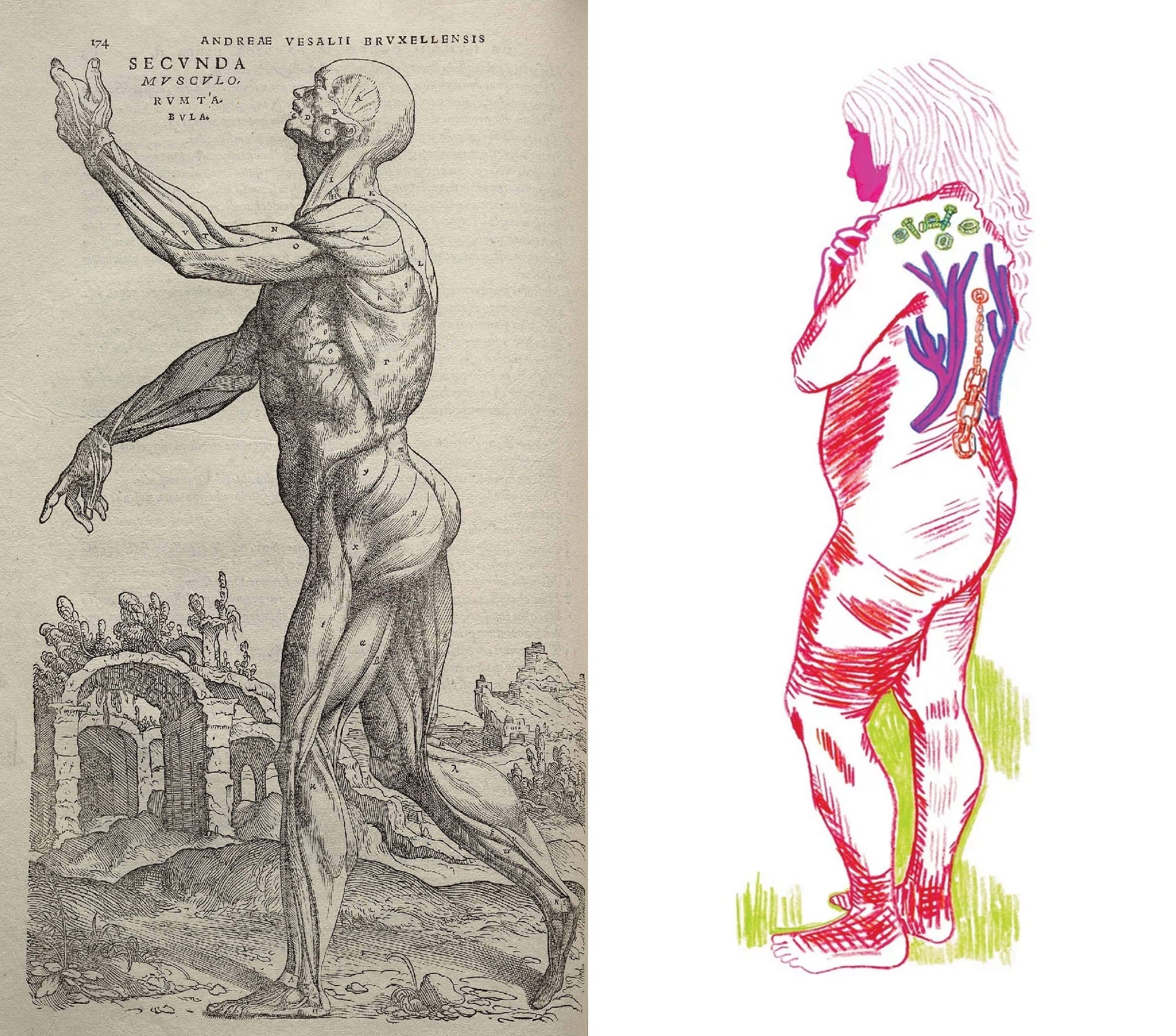
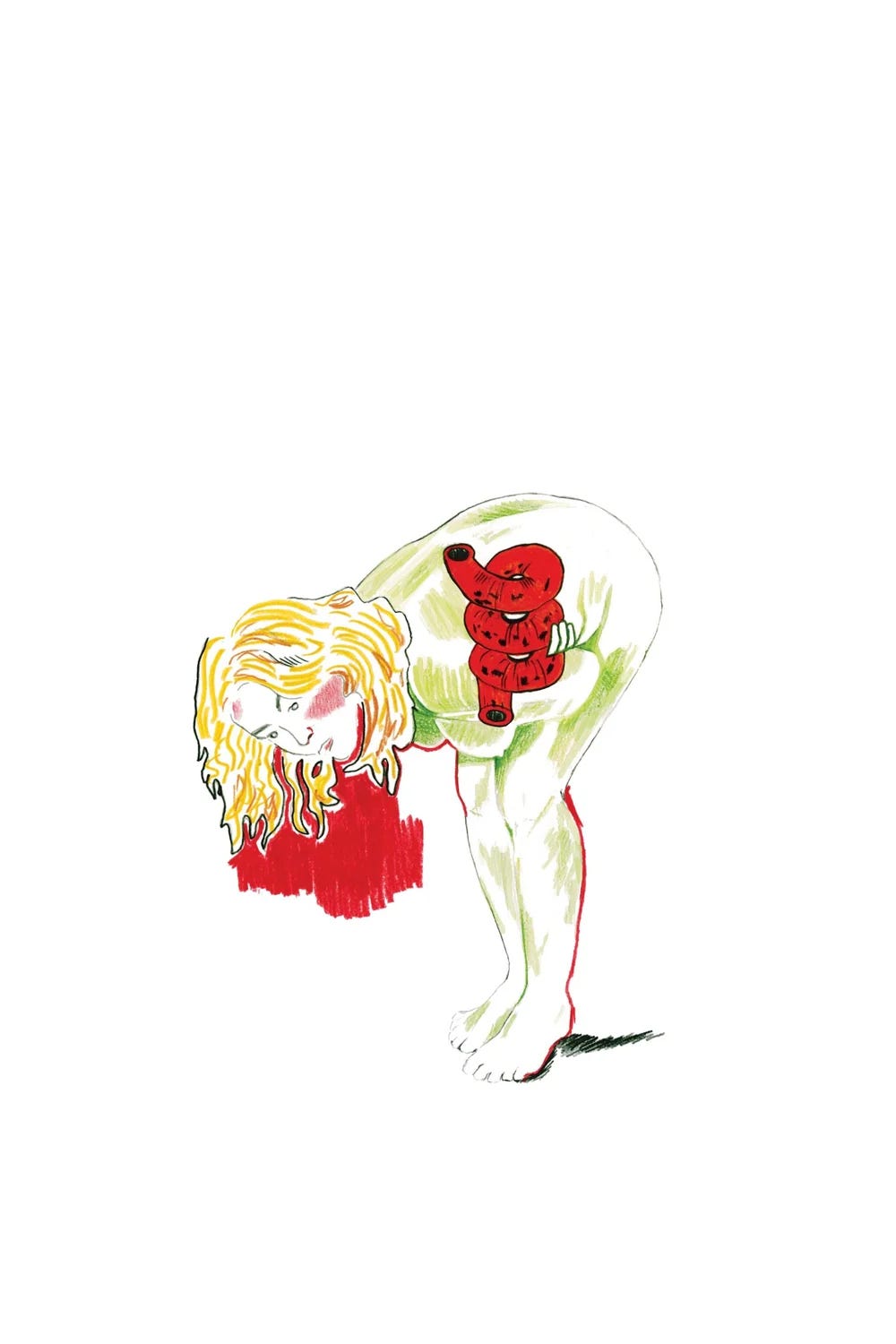
Ricky’s updated takes are in a sense making this same argument on behalf of the modern patient, rendering that invisible experience of pain with vivid cartoon logic: a pair of disembodied hands inside throat and pelvis wrenching the esophagus; bloody hooks lodged in the musculature of the upper back to keep the figure's ass from collapsing around their feet like fallen drapery; the discrete organs of the bowels and womb fused into a thorny mass. The drawings vary somewhat in style (some more draftsmanlike, others crude) but most are marked by bold washes of colour, as though to represent the way intense sensations pulse and throb beyond what it seems possible for the physical body to contain.
Despite the painful subject matter, and because of it, ouch ouch ouch is marked by a great sense of tenderness and compassion. The human figure’s solitary suffering is interrupted by a little yellow dog, whose simple needs and affections demand attention—though the visual signifiers of pain remain (a head full of shattering glass etc.), there is also a mingling of auras (and even swapping of features) with the other creature that resituates that pain within the greater experience of living. Ricky’s conclusions are oblique, and the artist doesn’t try to force a happy ending onto their account of ongoing chronic pain (even romantic companionship is introduced as “the gift / of a productive cough, / the woman who gave it / to me dying laughing / to a song in the kitchen”), but the final images seem to evoke both transcendence and endurance.
Ev Ricky has long been at work on their debut graphic novel I Wouldn’t Lie to You (working title), a book I expect to significantly raise their profile both regionally and abroad. But in the meantime, ouch ouch ouch offers further proof that they are among Montreal’s most intriguing comics-adjacent artists. The book is now in its second printing9—contact Ricky for purchasing details through their website. — Sire
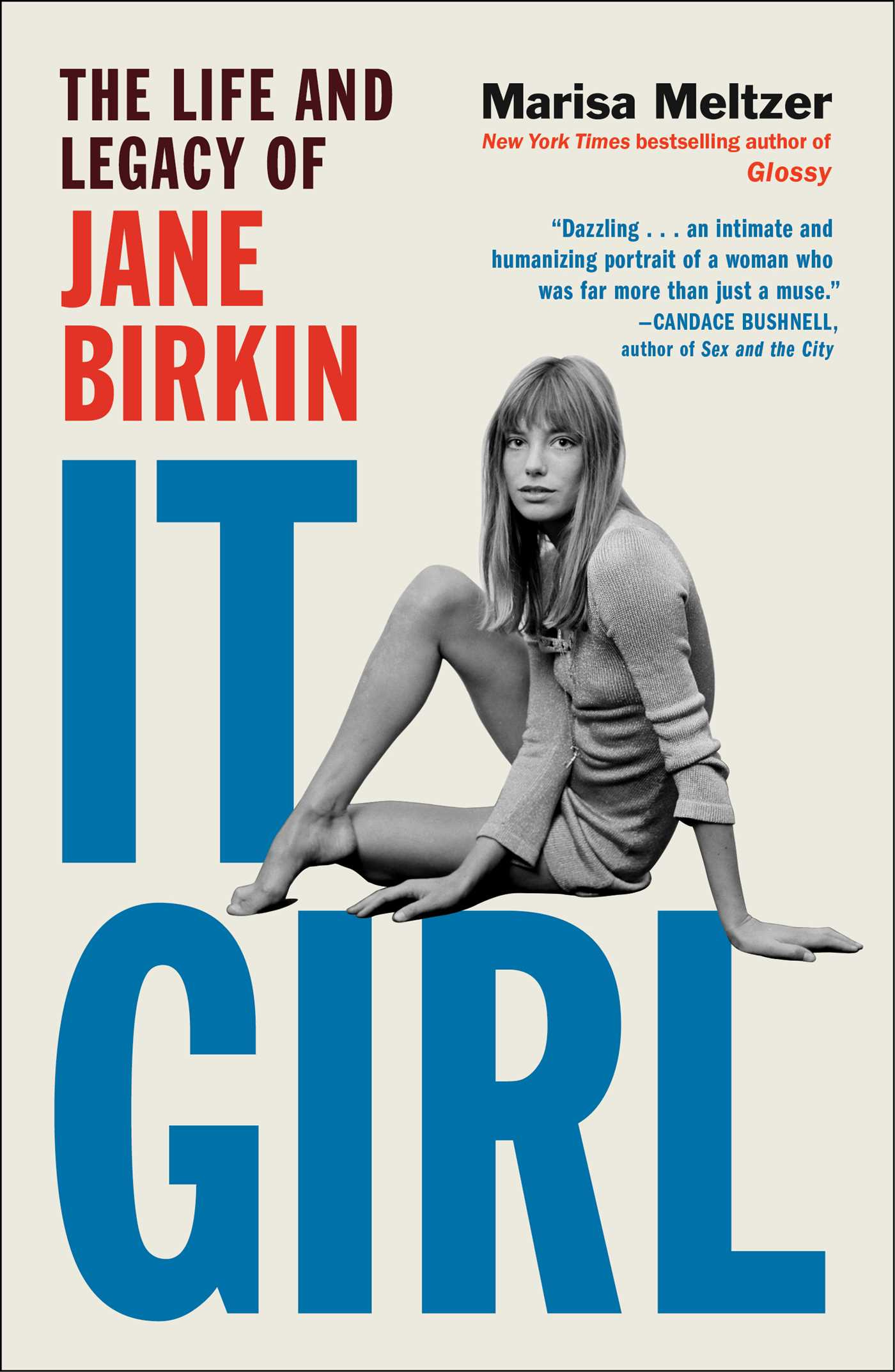
It Girl: The Life and Legacy of Jane Birkin
Nonfiction by Marisa Meltzer
Simon & Schuster, 2025 (Publisher’s Website)
Reviewed by Veeda Khan
Despite her stardom as a singer, actress, and socialite, Jane Birkin is perhaps better remembered for the objects associated with her than any particular artistic success. In the Anglosphere at least, one tends to think of fashion: the bag, the bangs, the jeans and white t-shirt. If enough curiosity strikes, or if one crosses the Pinterest recommended photo threshold to the point of actual interest, maybe there is a desire to find out more about the woman. And maybe that desire prompts one to pick up a book and not just do a cursory Google search. And maybe that book is It Girl, by New York Times columnist Marisa Meltzer. And maybe, once one reads it, one realizes the English Wikipedia article would’ve probably sufficed.
Concise and unaffected, and drawn exclusively from public sources, It Girl dutifully tracks Birkin’s rise from English debutante to household name. Born to a Royal Navy spy and an actress, Birkin has been a socialite since she was a teen. She dated three male artists, with whom she had three artiste daughters, who all splintered out into high-profile careers: Lou Doillon and Charlotte Gainsbourg are both actress-musicians, while Kate Barry was a photographer-turned-philanthropist. Such a diversity in artistic endeavors should come as no surprise. Birkin herself filmed seventy movies, directed one, recorded thirteen albums, and modelled many, many clothes.
Despite its rich subject matter, It Girl is a slim book, covering cradle to grave in just over 200 pages. Being concise is not a bad thing, but it’s clear that It Girl is more interested in interpersonal drama than exploring Jane Birkin as an artist. The emphasis is not on her endeavors, but rather the lovers behind them. I’m sure this is the easier narrative, if somewhat cliché, but even these relationships are presented as though they exist in a vacuum. Meltzer fails to meaningfully engage with Birkin’s cultural moment. Contemporaries Birkin herself envied are often namedropped—Fanny Ardant, Charlotte Rampling, and Brigitte Bardot to name a few—but their allure, much like Birkin’s, is relegated to physical attributes. It is difficult to parse Birkin’s cultural contributions at large when the culture itself is so ill-defined. These social considerations are not just a question of aesthetic evolution (although ye-ye, French chanson, and French New Wave are integral to the construction of Birkin’s image), but provide necessary context on the patriarchal society in which Birkin rose to prominence.
Among the many ideas that remain underdeveloped in It Girl, the most glaring is Birkin’s perpetual juvenility. Meltzer considers this a mostly personal aesthetic choice, spurred by early career coquetry in service of Serge Gainsbourg, the 40-year-old songwriting giant Birkin met at 22 and dated for the next 12 years. But how does Meltzer’s benign explanation of Birkin’s image square with the fact that Gainsbourg would, later in life, take his fascination with the “Lolita” trope to ever greater extremes? And how do we account for the fact that Jacques Doillon, her partner between the years 1980 and 1993, has been accused of sexual battery by three women? There’s obviously more to consider here than daughters and movies, especially considering the way her image persists. Sure, she may no longer bear the brunt of the criticism (the burden seems to have been most recently offloaded to Olivia Rodrigo) but her coquettish legacy endures in both pop music and high fashion. Since her ideals, both the ones she represented and the ones that she herself held, do not exist independent of their circumstances, they deserve a little more prying than the cursory Google Meltzer appears to have given them. The author seems generally uninterested in a deeper exploration, writing that “Birkin will be remembered for her proximity to volatile men.” If that’s the case, is it even worth remembering the woman at all?
Well, yeah. She’s cool as fuck. But you don’t need an NYT columnist to give you the details. Unlike other actresses of her era, and despite her deep shame and insecurity, Birkin was an open book. If you want to know more about her, your best bet is hearing it straight from her own mouth. Watch Jane B. par Agnès V. on the Criterion Channel. Read both volumes of her published diaries. Watch her bad sex comedies and her good Rivette films and her okay Doillon ones. Listen to her fragile soprano on Ex-fan des sixties with the English translations of the lyrics by her former lover Serge pulled up. Even Charlotte Gainsbourg’s fairly mediocre documentary gives you more insight into her life than this superficial biography. Jane Birkin’s influence is everywhere, there’s no denying that. If you decide to develop a sudden interest in the woman behind it, then go look for her. She’s not hard to find, and she deserves the effort.
CONTRIBUTORS
Veeda Khan reads and writes in New Jersey. Her work has appeared in Washington Square Review, Zone 3, and Dreginald. She is a 2026 NBCC Emerging Critic Fellow.
Sire is a real piece of work.
Andrew Wu is a writer, pianist, and biostatistics graduate student based out of Boston. He is the co-recipient (with composer Holden Mui) of an Emergent Ventures grant, which supports his life’s ambition—to learn, perform, and record all of Holden’s piano music. His favorite song is “Moon River.”
Interested in reviewing for Discordia Review? Check out our review guidelines and then email us a pitch.
A version of this essay has been floating around for ages, though I’m not sure of where it was original published—I seem to recall talking about it at a bar a decade ago, and I’ve paraphrased the quote I’ve pulled here a number of times over the years.
I’ll pause here to respond to the Self-Publishing Guy already writing a comment on this piece about how printing your shit on demand through Amazon means you get to keep all the money without some snob telling you how to write: I don’t care. Nobody cares.
Given that Rupi Kaur has apparently moved eleven million copies of Milk and Honey alone, it seems plausible that Kaur has outsold poetry as a genre since her big break in 2014.
The recipient of said letters, Franz Xaver Kappus, omitted his own half of the correspondence, allowing the reader to ‘receive’ Rilke’s words directly.
He has been more assertive in other publications—see the materialist provocations of 2022’s Surface Tension (Coach House Books) for one.
He’s currently the Director of Literary Arts at Canada’s well-heeled Banff Centre for Arts and Creativity.
Full disclosure, I know Ev Ricky socially; their work will also be familiar to Discordia fans from their zine My Life (K no. 5) and the cover art for Fellow Travellers No. 2.
Also a frequently used model for the illustrations of Fellow Traveller Opal Louis Nations, as seen in his Muscle-Flasher Smith with his 6-string Brain-Jo. In an earlier version of this piece, Vesalius was credited as the illustrator of the book, but it is believed that his original sketches were used by other artists (possibly the Flemmish Jan Stephan van Calcar) to produce the woodblocks for printing—so in short, I dunno who made them skeletons so spooky!
Technically third; the first version of the book was printed accordion-style in an edition of three copies for an exhibition.
Just fantastic critical riches here, thank you!
"Five hundred copies [the average print run of a poetry collection]…"
It might be worth adding that print runs of 500 are the norm in Canada because (I believe) the Canada Council demands it of the publishers it funds. This is what a publisher of poetry who wanted to switch to printing-on-demand but could not once told me. Extrapolating from the American numbers probably gets closer to the truth of how many books actually sell here.