

John Updike: Annoying Sex Nerd
How one of the most tiresome novelists of the twentieth century cemented himself as a sex idol for undersexed men


Recently, James Wolcott took to the pages of the London Review of Books to, as the cover of that issue put it, “reevaluate” John Updike—or, to put it more accurately, complain about how nobody gives a shit about Updike anymore. With the recent release of Updike’s letters (John Updike: A Life in Letters), Wolcott is disappointed to find them setting off far fewer fireworks in the literary community than he feels they’re owed, and so he has set out to fire off his own amateur pyrotechnical display made up of choice rockets from these latest Updike epistles in a desperate attempt to prove the man still has firepower. And he’s done an astounding job, really, insofar as it is astounding that, after reading the piece, I don’t think I’ve ever hated Updike more—yes, the rockets are in fact piece for piece a collection of resounding duds, more noisy than illuminating, and if I don’t end this stupid extended metaphor now I might just explode in a burst of purple sparks.
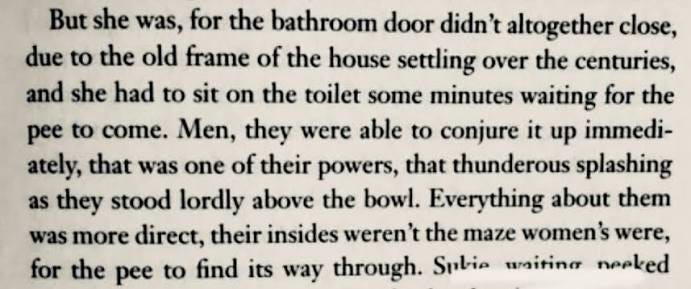
Wolcott, an obviously slobbering fanboy, cannot see Updike for the absolute dunce that he was, describing him as someone “on whom nothing was lost.” Is that so? Because I can’t easily think of writers on whom more was lost. Hellen Keller, maybe? There are few topics that Updike has ever opined on in his work where he hasn’t gotten so completely lost in self-love that it prevented him from competently observing it. I mean, Christ, even women’s anatomy—I hate to harp on this now-infamous stretch from Witches of Eastwick, but c’mon:
…the bathroom door didn’t altogether close, due to the old frame of the house settling over the centuries, and she had to sit on the toilet some minutes waiting for the pee to come. Men, they were able to conjure it up immediately, that was one of their powers, that thunderous splashing as they stood lordly above the bowl. Everything about them was more direct, their insides weren’t the maze women’s were, for the pee to find its way through.
And keep in mind that women’s anatomy is a topic Updike literally could not stop thinking about, and his letters continue to prove it, as well as how continuously said anatomy’s “mysteries” thwarted him. Updike, someone “on whom nothing is lost,” expresses as much to Philip Roth:
…the changing shape of pussies [may be seen as] the single most quietly pivotal event of our times. What do women think about, while they studiously bend over their crotches, razor in hand, consulting the template of the newest high-thigh swimsuit cut?1
Hey John, since this question seems to be driving you absolutely crazy, have you tried just asking one? I walk into the room next to me. “Hey honey, what do you think about when you shave your pussy?” She looks at me perplexed. “Don’t slip.” There you go! Maybe if I’d told her that shaving her pussy is “the single most quietly pivotal event of our times” it would have given her more pause to think about how much more profound her thoughts ought to be as she participates in this moon-landing-level event. Wolcott seems to share the fascination, or at least scrambles to inherit it like a little brother receiving a sought-after potential hand-me-down. “If these two geniuses couldn’t figure it out, what hope for the rest of us?” …What? James! John! Just ask your fucking wives! Or your mistresses! Or literally any woman who will put up with you asking this inane fucking question! Are you retarded?
Updike did have a strange obsession with bush in particular. Flipping through my annotations in Witches of Eastwick, I find I’d honed in on sections like:
Alexandra, seeing their source in the thick black pubic bush which beneath the water seemed to sway back and forth almost like a penis
and
She liked to sit just as she was only on a chair and spread her legs so her bush felt all big and the curls of it glittery and let them just lap and kiss and eat. Hair pie, a boy she used to know in New York State called it.2
Looking through Updike’s letters myself, the obsession continues, with Updike literally sending letters to the Playboy editorial to thank them for sending him some magazines. And let me tell you, Updike does not “read it for the articles.”
Thanks so much for Oui. I feel better knowing that Henry Miller wanted one also. The difference (la difference?) must be the pussies; now that pubic hair has become as it were official, the average man has the chance to examine the amazing and tenderly monstrous variety of foliage hitherto known to only the most assiduous private collectors. I missed, in Oui, a redhead, with her piquant amber bush; a true blonde, I guess, is as hard to find as a four-leafed clover.
Anyway, I feel satisfied, if not sated.
Obviously, Updike was a chauvinist. It’s basically what is best known about him at this point. Dale Earnhardt drove cars, Michael Jordan balled, John Updike wrote stories about how women are tall children you have sex with. The plain open misogynists are always more readable than the chauvinists, because at least the plain open misogynists are rarely so irritatingly condescending. But even then, it’s easier to tolerate a habitual chauvinist like Vonnegut than Updike because at least, in most of Vonnegut’s best work, women (and men’s relationships with them) are not the focus, whereas in Updike they dominate the entire frame. But women’s minds are perpetually a mystery to Updike because he has simply never thought to ask them anything. And here’s the thing, I’m not even saying Updike has to like women, but he at least should have some faint understanding of them. I think even an unrepentant hater of woman like Bukowski ultimately spent a lot more time listening to what women said and thinking about how they felt than Updike did, and it’s the obvious imprecision that results in Updike’s work that makes it just so grating, to say nothing of how confidently he believes he understands his subject.
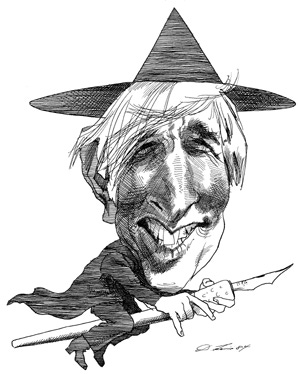
Wolcott speaks enviously (as well as endlessly) of Updike’s sex life, a banal preoccupation of both Updike’s readership and Updike himself. The updated terminology for someone like Updike, a slimy sex addict who frequented suburban wife-swapping parties and treated sex like a hobbyist treats model trains, would be “sex nerd,” a not particularly envious sort of loser. To the unhappily-married boomer jackoffs Updike attracts,3 the mere suggestion of having sex with someone other than your wife (let alone her having sex with someone other than themselves) is a prospect so erotic that it drives them mad, and they go on to write 6,000 word essays in the London Review of Books with barely-concealed erections just so they can tell us how hot it all is. This is smut for the 50+ male literary crowd. This is their “romantasy.” Updike, to his credit and in a rare moment of actually not allowing something to be “lost,” saw this fixation in his work under at least a somewhat furrowed brow: “I don’t know why I write about sex. It’s sort of a weakness.”4
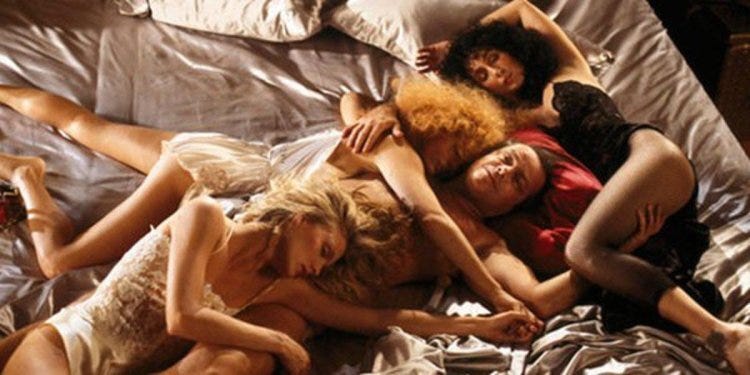
Not that that stops a guy like Wolcott. Guys like him can’t get enough of it, it doesn’t register to them as “weakness” at all. Nearly half the piece (maybe more!) is dedicated to celebrating Updike’s prodigious fucking; Wolcott compiles a number of Updike’s saucier excerpts, including such lines as, “and how nicely you blow; my recalcitrant member just twitched at the memory,” and “my cock is yours—up or limp, your toy and acolyte and (sometimes timid) explorer,” and he seems impressed by what he’s reading (“what an operator”). There is almost nothing I can think of that is less sexy than Updike’s sex writing. Barring the revelations of at least some degree of incompetence (he writes to a lover of his failure to find the clitoris, a piece of anatomy that God designed as a glowing red button), Updike will write something like “the faint taste of your cunt in my mouth has become the most precious thing in the universe” when a simple “all I want to do is eat your pussy” would suffice. If you’re feeling really wordy, maybe call it a fucking pussy. As a rule of thumb, I think dirty talk is at its best when it aims for simplicity, because it demonstrates an animal precursor to rational thought, something that doesn’t have time to wax poetic too much—you can be a bit witty with it and playful, but it’s very easy to overdo it; it isn’t the time to be writing purple paeans to pussy. I suppose that’s just a personal thing. But what makes Updike such a painful over-writer to me is that he never understands when it is or isn’t appropriate to write in this register. Sometimes it feels like it’s the only register he’s got.
Anyways, I’ll leave you all with some other choice excerpts from the letters. You tell me if you think any of this is hot.
You ever menstruate? I haven’t met your period yet, but I must soon. How nice! I think I could drink your blood if you asked.
Beauty in your face, the way it opened and closed at the same time, when your cunt was entered; beauty in the wonderful bird-and-flower-expert’s way you would examine my prick; beauty in the way your naked body would slither in the guest bed
Though we’re in a hard place, between the first undressings, the first revelation (you taste good, like a labia should), and any sure shore of ease and frankness with the world.
Your fantasy of having some of my sperm to lace your tea makes me wish I was all cock—all cock, balls, and prostate gland—instead of being only a tiny fraction cock. You, in truth, are all cunt—your mouth is a cunt and your eyes invite me in and your whole being is as rosy if not as wrinkled as your very wonderful cunt.
…the day we said “Yes” to our various requests for oral contact; and your lovely blue letters arriving on the mail table in Adelaide; and the triumph of fucking you on my filthy floor through a virtually sleepless night and those prophetic physical inhibitations of mine at first…
I loved that black girl in The Tenants, with her miniskirt and tight cunt.5
A quick post-script, and maybe I’ll write more on this another time, but Updike’s best novel by far was his epistolic S., which does center a female POV character. What is most enduring about it is that his completely vapid bimbo of a protagonist just feels so colourful and natural for him as he writes out the contents of her vacuum head. Wonder why?
And, strangely, this is actually the second time a mid-twentieth century suburban male writer’s annoying letters have been something we’ve mocked (and also in which I refer a lot to an LRB article? weird):
Philip Larkin, holiday terrorist

Philip Larkin hates his childhood home. “We all hate home and having to be there,” says Larkin in “Poetry of Departures.” He laments “writing home… [as] if home existed” in “The Old Fools.” He declares, eponymously, in one of my personal all-time favourite poems, that “Home is so Sad.” Well, dear reader, if you’ve ever wondered what has caused Philip La…
You may want to argue that that sounds like he’s being facetious, but I would leverage the quote above it to argue that “barely.”
You know damn well that this is what Updike called it.
That isn’t to say that that’s all his audience is—he was a very popular writer, obviously that made his readership broad, and frankly the biggest Updike fan I know is a woman in her early 30s—but there’s also a “type.”
Though I’ll add that what he says next very much aligns him with the Poetics of Retardation, which Discordia endorses:
“You’re stuck with what interests you as a writer and you have to keep writing about that instead of what should interest you or what interests other people.”
Updike actually wrote this one to Bernard Malamud, author of The Tenants. It was basically the only thing he wanted to praise about the book. What the fuck would you even say to that if you got that letter? What the fuck?
I don't know, reads too much like standard haterade. The dude published an insane amount of verse and prose both fictive and non-. It's a massive American achievement, his corpus. The writing is a little purple at time but give me somebody who takes a full swing as opposed to someone who's all fearful and beseeching and afraid to offend on the page. Male writing from the 1950s-1990s (pre-internet) just feels more honest and less surveilled. Some of it smacks of chauvinism and sexism and misogyny by the standards of 2026, but I don't know why we're so comfortable judging prose written in the past as if it's supposed to magically conform to modern sensibilities.
Eris, Love it when we hate the same! I could never get into Updike. I never could get beyond the first few sentences of his novels or short stories. Decades ago, when an issue of the New Yorker fell into my hands (note how I duck and dodge), with a short story's first sentence I could name the author before flipping to check. (Okay, it was bound to be one of five, still . . . I pride myself on spotting an Updike within eight syllables . . . ) I really tried to go all the way with the A&P one. I suppose I could try again.
Thank you!