



Shakespeare is one of our greatest teachers. This isn’t a very popular conception these days—the academy has little use for the idea of literature as a department of wisdom, and little desire to deal with it as it actually relates to life. Besides, many, many readers in our century are primed to resist the idea that literature can really teach us how to make sense of our lives. Maybe the contemporary glut of sub-Trilling liberal pieties gets us halfway there, in constant platitudes about literature as a tool for engendering empathy. Or perhaps people are genuinely turned on by gurus hocking Ancient philosophy and “Christian classicism” as vaguely plausible codes for right-living (pun intended). But whether left or right, progressive or conservative, the character of our age can’t help but subsume literature’s guiding, healing properties into dull, practical notions of self-improvement. Our emotional relationship to what we read could once be perfectly understandable in Aristotelian terms of a dramatic catharsis, or a deep inward contemplation—now we mostly have reading-as-therapy, which is a dead cliché.
New talk of revived Romanticism (of which I’m agnostic), on this platform and elsewhere, has perhaps opened up the return of an ideal of l’art pour l’art—of art for art’s sake. Though what happens when this finally gets noisy enough to jolt against the contemporary creative industries’ obsessions with clean, digestible identitarian storytelling, is anybody’s guess. And as happened with the exquisite decay of the original Romanticism, l’art pour l’art eventually becomes a byword for art as a grandly artificial performance—for The Decadence, which worked once as tragedy, and has made its fitful return as farce in our high days of fascism, body modification, and the cynical camp of internet-speak. But of course, even the greatest of believers in art-for-art’s-sake, the divine Oscar, was himself one of English literature’s great fountains of apothegmatic wisdom.
What I’m trying to say is that among the many things literature does, teaching us how to live is surely one of them. I don’t mean it does this didactically, or simply, or in any form reducible to prescript. If it could do that, we’d have pamphlets, and not plays; we’d have treatises and catalogs and manuals, but no lyric poetry, and no romances. Ironically, all those more didactic genres used to be more artistic themselves. But now we’ve mostly lost them, just like we’ve lost the art of the sermon or the chronicle or the epistle. Despite the blazons in your local bookstores, ours is a time lacking in real genre. Perhaps this even further obscures the old reality, that alongside consolation and inspiration, what we’re seeking when we read is communion with some kind of genuine tutelary spirit. With a teacher. And Shakespeare is one of our greatest teachers.
What does he teach? In the largest sense, an all-embracing doctrine of the human imagination. Humani nihil a me alienum puto. Shakespeare’s stage is not just a place for history, or myth, or human action, or human drama—it’s a sacrosanct little world, in which the imagination is allegorized for our observance. Theatrum mundi; all the world’s a stage; yes, yes, all well and true and good. But also—the stage itself is the world. The theater is The Globe. And it’s only via such an imaginative space, made local for a moment, that we can begin to understand the larger world we’re living in. I’m sympathetic to the historicizing impulse of current Shakespeare scholars. It’s fashionable and practical to shrug off the idea that Shakespeare had any universal insight into human life, or any special sense for portraying the deepest levels of our emotional existence. Yet he did—he practiced a telescopic art, as universal as the great world religions and the epic poems of all times and places. Like many artists, I can’t abide by a practiced academic doubt for very long. So I contend: Shakespeare is our professor of the imagination—of its bounds and diversions, its dead-ends and heights—and any poet of the imagination requires from us a properly imaginative response. The intentional fallacy is of little use here.

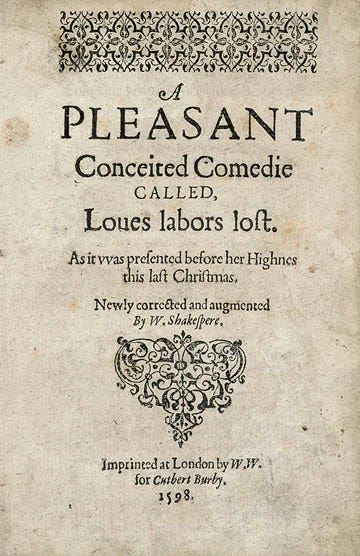
Love’s Labour’s Lost is one of the first truly great Shakespeare plays, even if its strangeness has often made it seem slight to commentators. Though published in quarto in 1598—the same year as the landmark posthumous Folio “Works” of Philip Sidney—it was probably written several years before that, in the mid 1590s. The quarto title page had it as “a pleasant conceited comedie” and bragged of its performance before the queen, the Christmas before. The play languished in (relative) obscurity after Shakespeare’s death, until in the twentieth century people began to revive and stage it with interest again. I’ve not been able to shake the sense that this has something directly to do with modernism. The late Victorians and modernists had already reevaluated and canonized several more “difficult” early modern poets, John Donne being the most famous. And just as Hamlet has something of the post-modern about it (like Quixote, it frequently seems even more post-modern than anything the twentieth century ever produced), Love’s Labour’s Lost has something almost properly modernist in it. Exhaustive language games, multiple registers, stylistic critiques, meta-jokes on contemporary poetic styles and practitioners—embedded within its comedy is the early Shakespeare’s first full declaration of his own poetic powers, and a critical statement on the poetry of his day. These things are inseparable, since one of the things Shakespeare succeeds in doing with Love’s Labour’s Lost is to indicate just how far beyond the poetry of his own time he’s preparing to take his work.
If our rough timeline of the Shakespeare plays is correct, and Love’s Labour’s Lost was likely written somewhere around 1595, this places the comedy in the middle of that period in which Shakespeare was beginning to stretch and test his full poetic genius for the first time. The three parts of Henry VI, Richard III, Titus Andronicus (which I firmly believe to be a purposefully bad play and a satire on Thomas Kyd), and the apprentice comedies, The Comedy of Errors, The Two Gentleman of Verona, The Taming of the Shrew—all were behind him. At this point, Shakespeare was probably twenty-nine or thirty years old, with at least some three or four years under his belt as a playwright (and renown in London, due to the spectacularly successful narrative poem Venus and Adonis of 1593—his most popular work in his own lifetime), and surely many more as an actor. His next narrative poem The Rape of Lucrece, published in 1594, was similarly quite successful. Briefly, he had the ear of the nobility of his day, and was yet to become primarily a playwright. It’s reasonable to assume that, at this point in the decade, Shakespeare was still very much thinking of himself not just as a playwright, but as a poet in the traditional sense, and throughout this time he was surely involved in composing the Sonnets (the posthumous printing of Sidney’s Astrophil and Stella in 1591 had kicked off a revived vogue for Petrarchan sonnets that absolutely obsessed the Elizabethans of the ‘90s).
Love’s Labour’s Lost likely reached the stage around the same general period as Romeo and Juliet, Richard II, and A Midsummer Night’s Dream. These plays are, respectively, Shakespeare’s most exquisite exploration of the romantic language of his day; his first great attempt at a tragic character; and, in the Dream, the defining statement of himself as an artist—the moment wherein he declares the point of all this playing, and begins to articulate the nature of his art, something which is evolving in its understanding beyond only poetry, unspooling towards a larger, more profound vocation. In Bottom’s magnificent waking monologue especially, the Shakespeare of the Dream is beginning to understand just what he’s trying to show people about the nature of representation, and the nature of the imagination. It unfurls the first clue to that vision of the world he’d begun to communicate to the world. For the rest of his career we see him working this further out, through the best of the histories and comedies, the cosmic horror and doubt of the high tragedies, the problem plays, and finally the late tragicomedies (sometimes called the Romances), where he almost seems to come to something of a resolution regarding this vocation, at the end.
That is, Love’s Labour’s Lost arrives in his first truly fecund period, and is not only Shakespeare’s first great comedy, but his mature statement on English poetry as he found it—and probably found it somewhat lacking. As in Romeo and Juliet, Love’s Labour’s Lost is filled with sonnets. Though in a much more ironic sense, the sonnets of Love’s Labour’s Lost are never very good, and such is clearly the point (though this didn’t stop them from being anthologized several times during the decade). The failure and subsequent achievement of the characters to use language well is a kind of covert meta-structure in the play. And as one of the two or three works of his which stem from no clear source material, Love’s Labour’s Lost is so basically plot-free, it’s the Elizabethan equivalent of a “hang-out” movie, where characters come and go and get involved in little tricks with each other, but in which actions never seem to point to any particular denouement. Even the play’s conclusion is a peculiar one (of which more later), yet by the end it makes a complex statement about what actually makes great poetry.
As the play begins, the King of Navarre has convened his courtiers Dumaine, Longaville, and Berowne, to announce their withdrawal from the world, swearing off the company of women for three years, in pursuit of scholarly renown (“fame” and “honour” says the King). So, declares the King, “Navarre shall be the wonder of the world; | Our court shall be a little academe, | Still and contemplative in living art” (1.1.14-16). Part of the beauty of the play is that they never really get to begin their project. The King and his courtiers are glorious, bone-headed fops. Only Berowne has any brains—he’s one of Shakespeare’s first real gentleman wits, the first of the type that finds its later height with Mercutio and Benedick and even Prince Hamlet. Berowne is far from keen to swear to three years without women, sleep, or good food, and his series of sophistical attempts to get out of his oath are brilliant examples of an empty poetic rhetoric:
Why, all delights are vain, but that most vain
Which, with pain purchased, doth inherit pain:
As painfully to pore upon a book
To seek the light of truth, while truth the while
Doth falsely blind the eyesight of his look.
Light seeking light doth light of light beguile;
So, ere you find where light in darkness lies,
Your light grows dark by losing of your eyes.
Study me how to please the eye indeed
By fixing it upon a fairer eye,
Who dazzling so, that eye shall be his heed,
And give him light that it was blinded by.
Study is like the heaven’s glorious sun,
That will not be deep-searched with saucy looks.
Small have continual plodders ever won,
Save base authority from others’ books.
These earthly godfathers of heaven’s lights,
That give a name to every fixèd star,
Have no more profit of their shining nights
Than those that walk and wot not what they are.
Too much to know is to know naught but fame,
And every godfather can give a name (74-94).
Berowne’s voice here is very close to several of the Sonnets. Shakespeare is reveling in his own virtuosity, in his ability to twist and turn the conceits of Elizabethan poetry inside out, often with little concern for meaning. This is delight in the pure form of the Renaissance lyric, and Berowne is its perfect vehicle, since Berowne is himself all form, all rhetoric and wordplay. As the Shakespeare of the Sonnets does, Berowne picks up words just to see how many times he can use them without destroying their meaning (“Light seeking light doth light of light beguile”), making “eye” and “light” and “while” and “blind” into a constant, dazzling chime on that bright, open vowel. Fair eyes and stars, looks and books, are all classic clichés out of the love tradition begun by Petrarch—but they’re moldy conceits, at that point in the 1590s more than two centuries old, which the Elizabethans had made faddish again, and which Shakespeare never stops parodying throughout the play. These are also the same clichés with which the dour Romeo begins Romeo and Juliet, and which the far more naturally poetic Juliet teaches him to move beyond, in order to be worthy of her love.
Indeed, this is something of a theme across Shakespeare’s great comedies (and Romeo and Juliet is a comedy, for its first half): the best female characters are generally far better poets, and far wittier, than the men are. Even in a nearly-equal exchange, like that of Much Ado’s Beatrice and Benedick, it’s more than clear who would win in a direct contest; while poor Rosalind in As You Like It is so clever she’s forced to literally write the script for Orlando to woo her with. Love’s Labour’s Lost is no different: almost as soon as the King and his courtiers swear their oaths and declare that any man will be punished if found in the company of women, Berowne reminds the King that the Princess of France and her ladies are already on their way, to handle her father’s monetary complaints. Soon enough the Princess is arriving with her ladies—and their task in the play will be to outwit, humiliate, and finally teach the men just how silly it is to retreat from the world into sterile scholasticism. The Princess is herself a rather brilliant wit, while her chief lady-in-waiting, Rosaline serves as a ready foil for Berowne.
Here I must confess to some personal fantasies about Shakespeare’s names. Since Berowne is just about the closest any male Shakespearean character comes to sounding like the sprightliest Sonnets, it’s hard for me not to see him as an occasional surrogate for the author, composed just as Shakespeare himself was falling in love. Which is not to say that Shakespeare puts himself into his play (just as making Hamlet and Iago poets nearly as great as himself doesn’t mean he sees himself in them; they’re more likely ways for him to characterize and feel out to the furthest those departments in his own self—certain aspects of his own poetic understanding). Yet I still have my suspicions. Throughout Love’s Labour’s Lost, much is made of Rosaline’s “darkness,” just as Shakespeare does with the “Dark Lady” of the Sonnets. Of course this was also a Renaissance commonplace, that dark hair was less fair than light—yet one nebulous enough that plenty of arguments have been made about its racial implications (for instance, there’s a persuasive body of scholarship on the “Dark Lady” as an Arabic, Indian, or sub-Saharan African woman, while another tradition puts forward Aemilia Lanier, an Italian poet of Jewish heritage).
Yet neither am I saying that Rosaline is literally a stand-in for the woman Shakespeare apparently loved. But the name shows up in other places: Rosaline is, after all, the name of the woman whom the dejected Romeo is pining after at the start of his play; and it may not be for nothing that Shakespeare gives his most ingenious comic heroine the name Rosalind (at least once emended in the play to Rosaline, to jokingly complete a bad rhyme). All I’m saying is Shakespeare has a marked tendency in his love stories to portray a dull young man enchanted by a woman who raises him to her level, and teaches him to use his language more carefully. Indeed, in Love’s Labour’s Lost Shakespeare seems to use Berowne to think through and satirize his own tendency towards mere verbal fireworks, which of course dovetails perfectly with a satire of the courtly Petrarchan revivalist poems of his day, as in the attempts of Navarre and his courtiers to write their own hackneyed love-poetry. Poetry which the ladies subsequently dismiss (as Shakespeare was possibly dismissing many of his contemporaries), as mere “bombast and as lining to the time.” That is to say: only good for stuffing.
While the courtiers court the ladies and write their mediocre sonnets, the verbal games of the play refract through the parade of “lower” characters as well—below the courtly level of the aristocratic war of the sexes, there runs a slew of different comic types: Don Armado, the old Spanish knight; his witty page Moth; Costard the rascal; Dull the constable; Jacuqenetta the maid; Nathaniel the curate; and finally Holofernes, Shakespeare’s immortal parody of the kind of humanist schoolmaster whom the author himself surely suffered under as a young grammar-school student in the provinces.
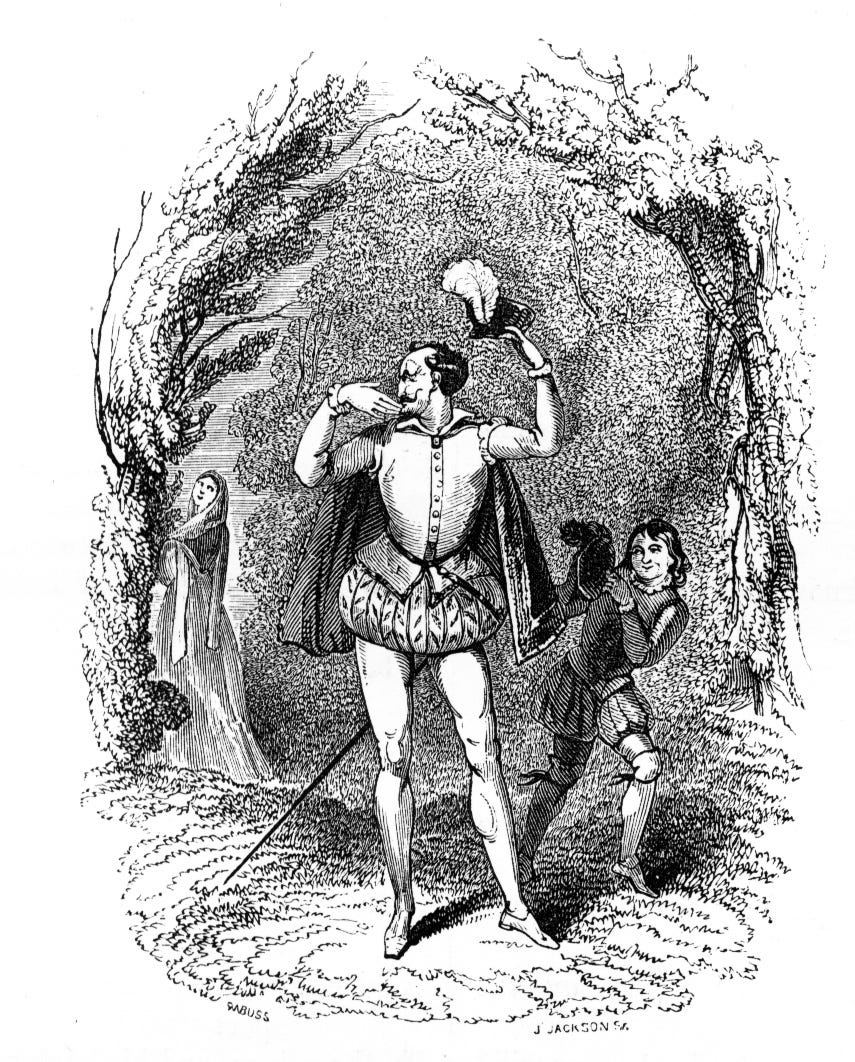
The arrival of the first of these, Don Armado, is presaged by Navarre: “A man in all the world’s new fashion planted, | That hath a mint of phrases in his brain” (169-70). Berowne agrees, and calls him (in jest), “A man of fire-new words, fashion’s own knight” (183). Armado has been imported to Navarre to be entertainment for the courtiers. The knight is ridiculously old-fashioned, a kind of proto-Quixote who has arrived far too late for the glory days of chivalry. His own language is full of archaisms that would’ve seemed comically out-of-date to Shakespeare’s audience. And yet, as Navarre and Berowne’s introductions suggest, Armado is also an unstoppable coiner of new terms—like Holofernes, he exists in part so Shakespeare can make vicious fun of the fad for neologisms which possessed English grammarians and scholars throughout the sixteenth century, leading to the derisive term inkhorn, for their pretentious Latin borrowings and pointless formalities.
The knight arrives with his page, called Moth (or Mote), and already we have two contrasting models for “lower” forms of wit. Armado is only vaguely capable of cleverness; mostly he’s Shakespeare’s caricature of an outdated striver who misunderstands eloquent language to mean only haughty archaic terms and painfully ineffective new ones. Moth, however is a natural wit. The following section may suffice to exemplify the page’s nimble dance:
Armado: Boy, what sign is it when a man of great spirit grows melancholy?
Moth: A great sign, sir, that he will look sad.
Armado: Why, sadness is one and the self-same thing, dear imp.
Moth: No, no; O Lord, sir, no.
Armado: How canst thou part sadness and melancholy, my tender juvenal?
Moth: By a familiar demonstration of the working, my tough signor.
Armado: Why tough senior? Why tough senior?
Moth: Why tender juvenal? Why tender juvenal?
Armado: I spoke it, tender juvenal, as a congruent epitheton appertaining to thy young days, which we may nominate tender.
Moth: And I, tough senior, as an appertinent title to your old time, which we may name tough.
Armado: Pretty and apt (1.2.1-18).
We can see how wit sometimes gets started at the basic level of synonym (for the rhetoricians of the day, the figure called synonymia). Yet Shakespeare shows us the difference between mere piling up of synonymia on the one hand, and the actual translation of metaphor on the other. “Tender juvenal” is not bad on Armado’s part: “tender” is right for a youth, and “juvenal” suggests both the Roman satirist Juvenal and the juvenile Moth himself. But the following phrase, “…congruent epitheton appertaining to thy young days, which we may nominate tender…” is inert pointless verbiage, an unknowing parody of scholarly and clerical language, overflowing with blots from the inkhorn. Armado is so in love with his own vaunted terms for things, that when he does get started on metaphor, he can only inflate and inflate past the point of sensibility, as when he declares that “The heaving of my lungs provokes me to ridiculous smiling,” or when he invents a new name for the afternoon, calling it “The posteriors of the day.” He’s always technically accurate; he simply has no understanding of the register he’s attempting to use.
Moth, however, is a true native of the world of words:
Armado: My love is most immaculate white and red.
Moth: Most maculate thoughts, master, are masked under such colours.
Armado: Define, define, well-educated infant.
Moth: My father’s wit and my mother’s tongue assist me!
Armado: Sweet invocation of a child — most pretty and pathetical!
Moth: If she be made of white and red,
Her faults will ne’er be known,
For blushing cheeks by fault are bred,
And fears by pale white shown.
Then if she fear or be to blame,
By this you shall not know,
For still her cheeks possess the same
Which native she doth owe (90-107).
Armado’s charge, “Define, define, well-educated infant” is one of the most sublimely silly moments in Shakespeare. And yet Moth’s simple little extemporal poem in ballad measure is by far the best of any character’s compositions within the play. It has all the plain diction of a good Elizabethan song: it wouldn’t be out of place among the tunes of Thomas Campion, or Ben Jonson’s “Celia” lyrics. In the figure of this poor page, attached to his pompous knight, we see Shakespeare neatly implying how little wit has to do with one’s station—and also how little it has to do with any “higher” diction. Moth is perhaps only clever, but he far outdoes any of the other low characters, each of whom represent some particular department of wit gone wrong. Dull the constable, for instance, is singularly unable to understand even the slightest joke, while Costard the knave is at least able to pun, yet suffers from a stunning tendency to confuse words for things, as when Berowne gives him his “remuneration” for delivering a letter to Rosaline, and the fool thinks it must be the Latin word for three farthings.
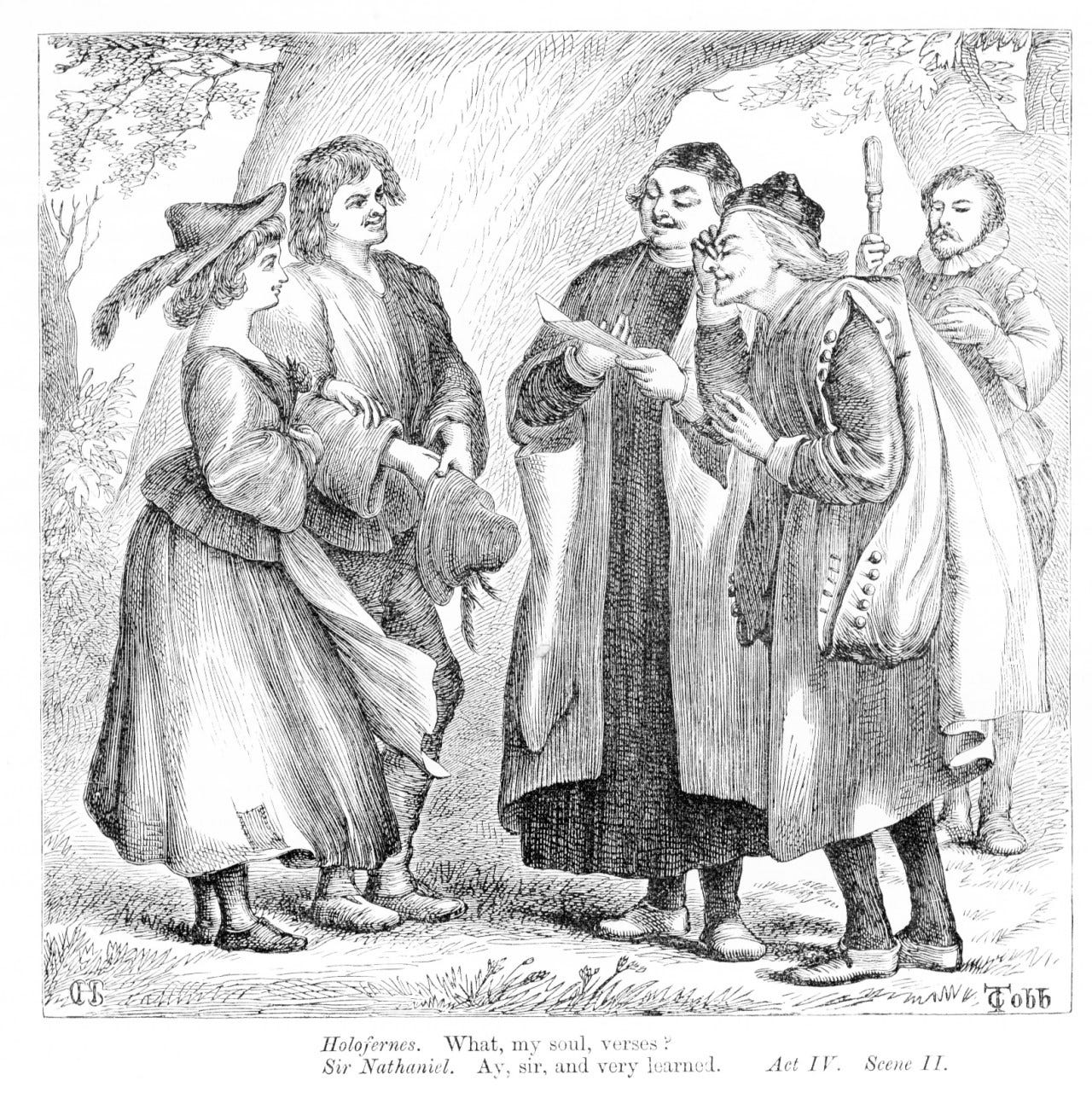
This tendency towards misunderstanding the purposes of figurative language reaches ridiculous heights in the schoolmaster Holofernes, who is seemingly incapable of saying anything without larding it heavily in Latin phrases and piling chains of synonyms on top of each other, in a parody of Erasmian copia (or rhetorical amplification through epithets, held to be the best and most-abused virtue in sixteenth-century rhetoric). Holofernes is an entirely self-important pedant, a parody of Renaissance rhetoricians. Or, as he declares his particular “genius” to be:
This is a gift that I have, simple, simple; a foolish extravagant spirit, full of forms, figures, shapes, objects, ideas, apprehensions, motions, revolutions: these are begot in the ventricle of memory, nourished in the womb of pia mater, and delivered upon the mellowing of occasion. But the gift is good in those in whom it is acute, and I am thankful for it (4.2.82-89).
Holofernes comes the closest here to genuine literary language, and yet of course it’s all in a faux-humble pride at his own ostensible brilliance—and even then, it runs long. Confronted with Berowne’s poor Petrarchan sonnet, he turns critic, and complains to his follower Nathaniel, the curate:
You find not the apostraphus, and so miss the accent: let me supervise the canzonet. Here are only numbers ratified; but, for the elegancy, facility, and golden cadence of poesy, caret. Ovidius Naso was the man: and why, indeed, Naso, but for smelling out the odouriferous flowers of fancy, the jerks of invention? Imitari is nothing: so doth the hound his master, the ape his keeper, the tired horse his rider (144-151).
“Let me supervise the canzonet,” is up there with Armado’s “Define, define, well-educated infant” as one of Shakespeare’s greatest moments in making sublime silliness out of his characters’ absurdities. True, Holofernes knows his literary history—he knows Ovid, Shakespeare’s own favorite poet—and talks passionately about poetic value, completely dismissing “imitari” (also imitatio, a translation of mimesis, the doctrine of art as imitation, inherited from Aristotle and made universal in the Renaissance). Holofernes at least knows that poetry is useless without what he calls the “jerks of invention,” the capacity to create or produce some new meaning, beyond the mere imitation of form or action, beyond even the capacity for achieving “numbers ratified” (numbers meaning the metrical line in poetry). But when he turns to write his own extemporal poem on a deer, or “pricket,” which the Princess has hunted down, he isn’t a very good poet himself. And even before this, he fails to articulate new meaning, and instead gets stuck in language games with Nathaniel and the constable, Dull:
Nathaniel: Very reverend sport, truly; and done in the testimony of a good conscience.
Holofernes: The deer was, as you know, sanguis, in blood; ripe as the pomewater, who now hangeth like a jewel in the ear of caelo, the sky, the welkin, the heaven; and anon falleth like a crab on the face of terra, the soil, the land, the earth.
Nathaniel: Truly, Master Holofernes, the epithets are sweetly varied, like a scholar at the least: but, sir, assure ye, it was a buck of the first head.
Holofernes: Sir Nathaniel, haud credo.
Dull: ‘Twas not a haud credo; ‘twas a pricket.
Holofernes: Most barbarous intimation! yet a kind of insinuation, as it were, in via, in way, of explication; facere, as it were, replication, or rather, ostentare, to show, as it were, his inclination, after his undressed, unpolished, uneducated, unpruned, untrained, or rather, unlettered, or ratherest, unconfirmed fashion, to insert again my haud credo for a deer.
Dull: I said the deer was not a haud credo; twas a pricket.
Holofernes: Twice-sod simplicity, his coctus! O thou monster Ignorance, how deformed dost thou look! (1-24)
Poor Dull has simply misheard Holofernes’ pompous “haud credo” (“I think not”) as “auld grey doe” and yet he gets the full Holofernes treatment, as the schoolmaster’s rhetorical flourishes simply drown any possible meaning in verbiage. Holofernes is addicted to his figures, and hammers on and on at them, relentlessly, taking both copia and synonymia and lowering them to the level of a linguistic vice. This is not the proper use of language, Shakespeare keeps saying throughout Love’s Labour’s Lost, parading these characters as they wander in and out of his plotless plot, in a labyrinth of wondrously dumb and excessive language, which Moth witheringly declares “a great feast of languages.”
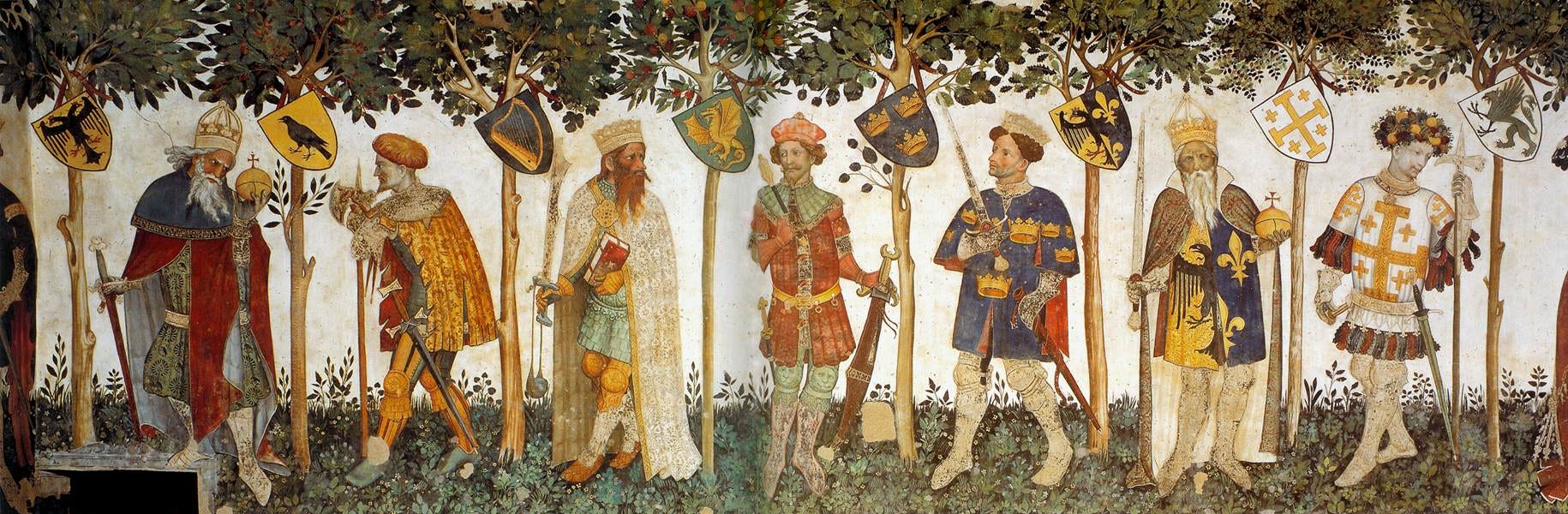
Indeed, the parade of the low characters becomes even more explicit as they stage a grand pageant in the final act, portraying the Nine Worthies of ancient legend—heroes like Pompey, Hercules, Judas Maccabeus, et al.—for the entertainment of the aristocrats. Only Costard and Moth survive the performance unscathed, since among the low characters they make the fewest attempts to use a “high” poetic language, whereas Nathaniel, Holofernes, and Armado are viciously mocked by the nobles, and firmly put back in their place—effectively censored by the play’s dramatic engine, for failing to understand the right uses of language.
Simultaneous to this, Shakespeare has slowly brought his aristocratic war of the sexes to its high point. Once the courtiers write their miserable love poems, they eavesdrop on one another, and each discovers the others breaking their vows to avoid women. At this point, Navarre and his dejected courtiers turn to Berowne, realizing their “little academe” has already failed in its sterile project, and beg him to exercise his wit. Berowne does so, in the finest rhetorical performance of the play, slipping into a speech and reaching a climax in which all the Petrarchan mannerisms and Renaissance clichés the courtiers have unsuccessfully experimented with are finally yoked together in a proper salvo of dramatic blank verse:
Have at you, then, affection’s men-at-arms!
O, we have made a vow to study, lords,
And in that vow we have forsworn our books.
For when would you, my liege, or you, or you,
In leaden contemplation have found out
Such fiery numbers as the prompting eyes
Of beauty’s tutors have enriched you with?
Other slow arts entirely keep the brain
And therefore, finding barren practicers,
Scarce show a harvest of their heavy toil.
But love, first learnèd in a lady’s eyes,
Lives not alone immurèd in the brain,
But with the motion of all elements
Courses as swift as thought in every power,
And gives to every power a double power,
Above their functions and their offices (4.3.311-26).
Berowne has tied everything back to the courtiers’ exchanges at the start of the play, and is beginning to draft some genuine, compelling poetry. Particularly in that cadence, “And abstinence engenders maladies,” we even get a slight premonition of the more darkly ironic tone Shakespeare had mastered by the time Hamlet. But Berowne continues, reaching his full crescendo:
And when Love speaks, the voice of all the gods
Makes heaven drowsy with the harmony.
Never durst poet touch a pen to write
Until his ink were temper’d with Love’s sighs;
O, then his lines would ravish savage ears
And plant in tyrants mild humility.
From women’s eyes this doctrine I derive:
They sparkle still the right Promethean fire;
They are the books, the arts, the academes,
That show, contain and nourish all the world:
Else none at all in ought proves excellent.
Then fools you were these women to forswear,
Or keeping what is sworn, you will prove fools (338-50).
This is a rhetorical victory for Berowne (and, in a way, for Shakespeare as a poet). He has fused the clichés of Petrarchan poetry, the wealth of mythological and poetic Renaissance commonplaces, with an accomplished rhetoric, and in so doing he gives the men the inspiration they need to move forward and finish the action of the play. There are perhaps some comparisons to be made in these lines with Shakespeare’s early rival Marlowe, who first mastered and delivered that powerful, high dramatic blank verse to the Elizabethan stage. Some, too, with the Euphuism of John Lyly, who had charmed Elizabeth’s court with his elegant plays in the 1580s. But it’s hard to imagine Marlowe’s steady rolling cadence, or the constant deliberate symmetry of Lyly, ever managing to produce something as essentially stately and graceful as this. Shakespeare is still working within the bounds of the prior blank verse tradition: each line is essentially an enclosed syntactical unit, even those lines that run over to the next. (The progress of Shakespeare’s verse through his career can be traced as much by his increasingly broken line as by its subtle tendency towards the Anglo-Saxon and Medieval over the Romantic and High Renaissance.) Here there’s an even, fluid mix of registers, characteristic of the 1590s, while the structure and form of each thought are kept within the polite bounds of the verse as he’d first received it. It is late-Elizabethan classicism, pure and clear. Sidney himself couldn’t have done much better.
Of course, the comedic beauty of the play is that Berowne’s rhetorical victory doesn’t translate to a dramatic one. After vowing at the end of the fourth act to leave behind their ridiculous ascetic project and woo the ladies of France instead, Navarre and his courtiers utterly fail to do so. First pretending to be Muscovites visiting the ladies’ tents, the ladies figure out their plan immediately and play a joke on them, swapping their masks. Following this humiliation, the courtiers and the ladies settle in to watch the low characters’ Pageant of the Nine Worthies, only for a messenger from France to arrive, announcing that the Princess’ father has died and she must return home at once. And here is where Shakespeare somewhat hauntingly subverts the expectations of an ending. When Navarre and his courtiers approach the ladies, declare their contrition, and pledge themselves to them, the women do not immediately accept them. Instead, they demand a year of penance from each suitor before they will agree to marriage. As the Princess demands of Navarre:
…A time, methinks, too short
To make a world-without-end bargain in.
No, no, my lord, your grace is perjured much,
Full of dear guiltiness; and therefore this:
If for my love, as there is no such cause,
You will do aught, this shall you do for me:
Your oath I will not trust; but go with speed
To some forlorn and naked hermitage,
Remote from all the pleasures of the world… (5.2.865-73)
Berowne for his part is charged by Rosaline with employing his wits in to cheer up the sick. Then the ladies prepare to make their journey, but first Armado returns, to bring in the figures of Heims and Ver (winter and spring), and suddenly the final moments of the play are no longer given to the drama itself but to two peculiar songs of cyclical nature. I’ll quote these eclogues in full, since they aren’t too long, and since they’re such remarkable pieces of poetry. First Ver’s song:
When daisies pied and violets blue,
And lady-smocks all silver-white,
And cuckoo-buds of yellow hue
Do paint the meadows with delight,
The cuckoo then on every tree
Mocks married men; for thus sings he:
“Cuckoo!
Cuckoo, cuckoo!” O word of fear,
Unpleasing to a married ear.
When shepherds pipe on oaten straws,
And merry larks are plowmen’s clocks;
When turtles tread, and rooks and daws,
And maidens bleach their summer smocks;
The cuckoo then on every tree
Mocks married men, for thus sings he:
“Cuckoo!
Cuckoo, cuckoo!” O word of fear,
Unpleasing to a married ear. (968-85)
Then Heims’ song:
When icicles hang by the wall,
And Dick the shepherd blows his nail,
And Tom bears logs into the hall,
And milk comes frozen home in pail;
When blood is nipped, and ways be foul,
Then nightly sings the staring owl
“Tu-whit to-who.” A merry note,
While greasy Joan doth keel the pot.
When all aloud the wind doth blow,
And coughing drowns the parson’s saw,
And birds sit brooding in the snow,
And Marian’s nose looks red and raw;
When roasted crabs hiss in the bowl,
Then nightly sings the staring owl
“Tu-whit to-who.” A merry note,
While greasy Joan doth keel the pot. (986-1001)
The last words of the play after this are Armado’s: “The words of Mercury are harsh after the songs of Apollo. You that way; we this way” (1002-3).
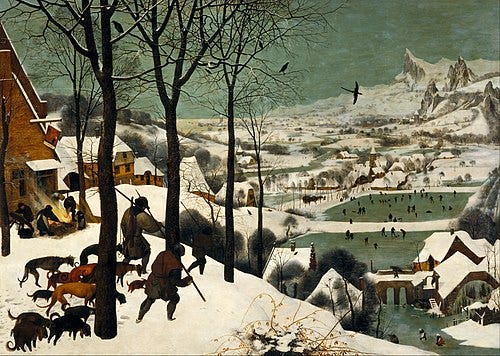
There’s far too much going on in these poems for me to handle it all in a post already running long. From the start of the play, the artificial academic world of the men was opposed by the presence of the women, who represented a sort of injunction towards genuine sexual union and existence in the social world. By the time the messenger has arrived and announced the King’s death, their courtly world of aristocratic word-games has been thoroughly punctured by something like the reality principle: the necessity of death has interrupted the comedy, and forestalled the possibility of a normal marriage plot. Shakespeare’s peculiar solution to the frustration of the traditional comedic end is to bring out yet another stage in his succession of subtle reminders to the audience. Not only have we seen the courtly figures of the play brought down from the heights of their verbal games and sex wars by the serious intrusion of death—he now hauls before his audience two figures of the alternating seasons, as if to say that underneath all this language and human action, there remains the endless cycle of nature, humming along beneath it.
It’s an astonishing vision to sum up such a high comic play: the songs of Heims and Ver are rugged and simple—resolutely not the songs of aristocrats and elegant poets, but country songs, conjuring up that old medieval England that always lingers in the back of Shakespeare’s mind. They belong more to the world of breviaries and calendars in the late Middle Ages than to any elite Renaissance court. They’re also far more subtle than first glance suggests. After all, it’s the cuckoo, in the season of green and life, who sings “a note of fear” and “mocks married men,” while the owl in the cruel winter keeps the working woman company. Shakespeare mingles in a note of discord with the pastoral, just as he mingles a glint of hope in with the wasteland of winter. The poems are, of course, directed at both the noble characters and the audience itself. In a way, they almost remake and refute everything we’ve seen up until these last moments. It’s a prime example of Shakespeare’s uncanny art: all along, we’ve been laughing along to a ridiculous play about rhetoric and verbal artifice, full of puns and comments on the poetry of its day—only the for the final statement to come from the lips of the seasons themselves, reminding us what goes on underneath it all. After giving us examples of so many lyrics and styles and registers, what we end with is Shakespeare at his most elegant, simple, and apparently natural.
What we’re meant to make of this is far from clear. But by this point, Shakespeare has shown his exquisite sense of his own powers in so many ways: outdoing his contemporaries, showing their fads to be trifles; delivering a series of subtle criticisms of the styles of his time, replete with examples of the whole past century’s failures at rhetorical performance; then setting up the final act of the play with a full and virtuosic example of that rhetoric in dramatic poetry. Yet at the end, he takes a left turn into these two quiet, bare songs of simple nature, with their strange notes of disquiet mixed in.
“The words of Mercury are harsh after the songs of Apollo,” says Armado, and indeed the fall from comedic heights to the fact of death is a harsh one. But where the courtiers have been sent, the audience has been sent too: off from the golden world of the stage, back out into the “real world” where they must scramble to find some meaning and come to the right use of their divine gift of language. “You that way, we this way,” as if to say that, being actors, they must inevitably reach the end of their fiction. While we, poor things that we are, will go out into the world again. But remembering, perhaps, that the games of language are a wonderful artifice, while underneath it all—perhaps even behind death itself—the world goes on. And though it may seem bent on causing us pain, it also provides for us, in the strangest of times. We can’t understand it, except in brief, in a pair of simple songs sung on a stage. Then it’s back out into the world again, and we can only hope we’ve gained just a little more wisdom, to help us figure out how to live in it.
This piece was originally posted on Vita Contemplativa in October 2025. We thank Sam for the opportunity to republish it here. Visit Vita Contemplativa to subscribe.
NEXT UP
Pacheco, Baudelaire, and the memory of desire

The human mind is wired for closure, and maybe it’s simply exacerbated by the fictions we write, creating an infinite feedback loop that holds us in constant anticipation of resolutions that don’t and can’t happen, some of us paralyzed by our feeling of its imminence, like the protagonist of Henry James’ Beast in the Jungle, only for life to come and go without fanfare. Some of our greatest stories meld the two and create resolutions out of the lack thereof; the acceptance of a lack of closure becomes the closure, but this is itself ironically still a kind of closure, a resolution we will never experience, because then the book ends, the cover closes with a thud, it is over, it is closed, and we remain.

This was a lovely surprise and a pleasure to read.
Sub-Trilling liberal pieties indeed. I think the attention economy and the mental patterns and habits it seems to inculcate undercut our ability to get away from a question like 'what can this do for me right now?' and towards 'what is this showing me about reality?' Trilling never had to deal with our modern online environment and its insistence on rapid responses and reward-driven digestible insights. All we can do is provide counter-pressure, which you're clearly doing with this article. Nice one, Sam.