

Write a manifesto; slay your enemies
How to improve a literary scene


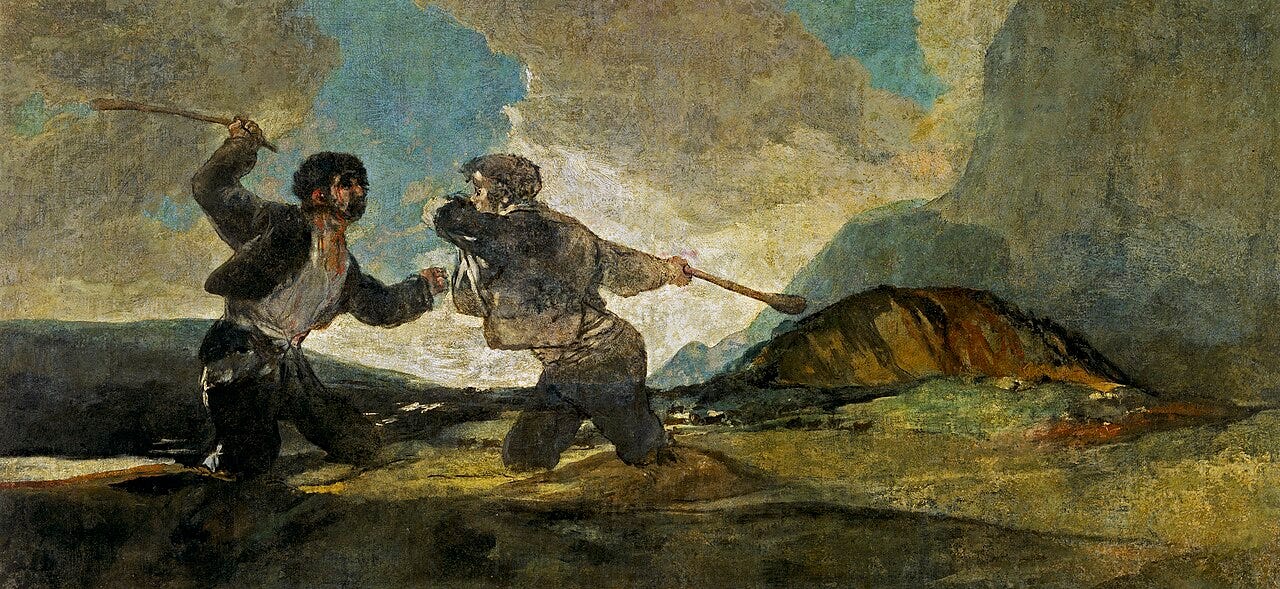
“What do you think an artist is? An imbecile who has only eyes if he’s a painter, or ears if he’s a musician, or a lyre at every level of his heart if he’s a poet, or even, if he’s a boxer, just his muscles? On the contrary, he’s at the same time a political being, constantly alive to heartrending, fiery, or happy events, to which he responds in every way… No, painting is not done to decorate apartments. It is an instrument of war for attack and defense against the enemy.” —Pablo Picasso
“Without contraries is no progression.” —William Blake
What makes for a good “literary scene”?
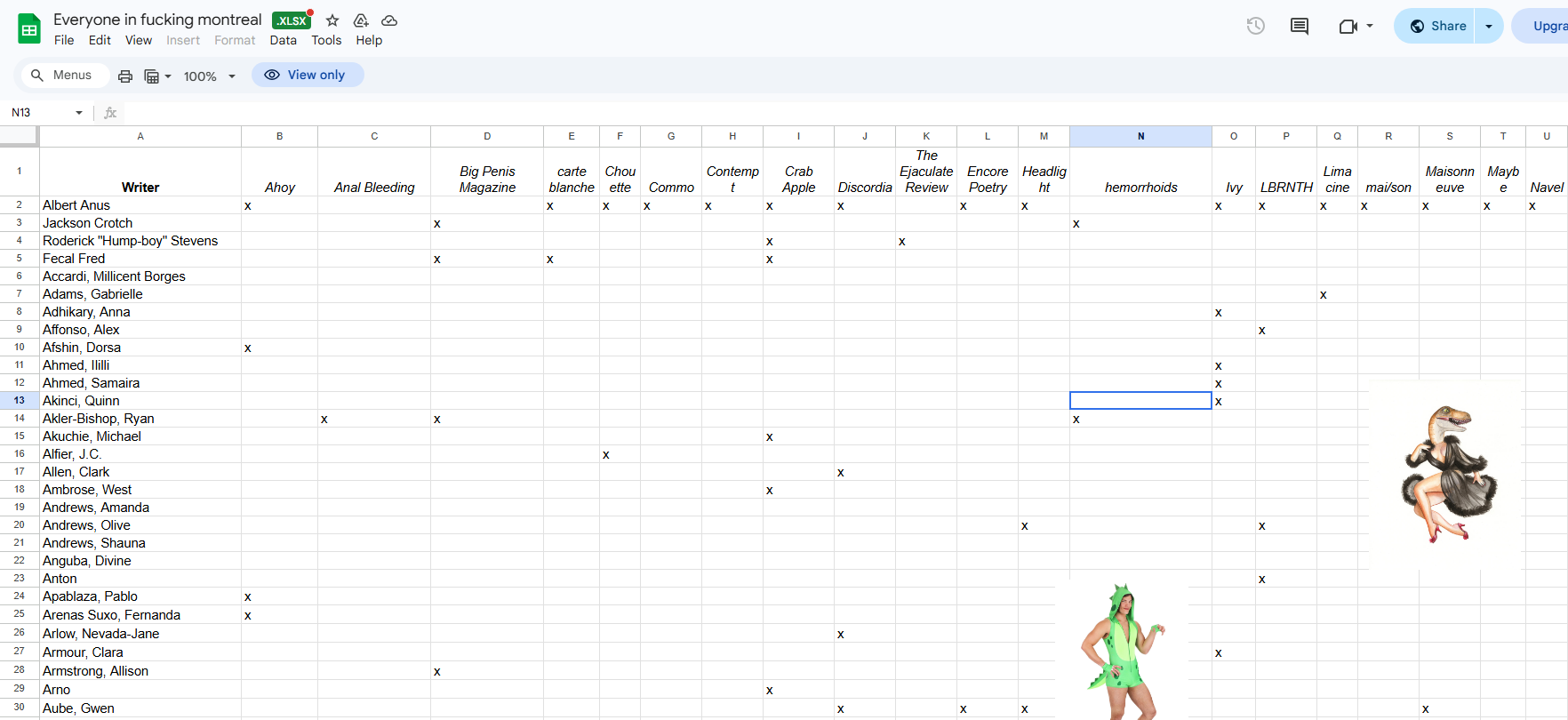
Recently, Sire wrote a piece on the blog about the glut of literary magazines in English Montreal (the updated count is approaching 40), which has been nothing if not controversial. While we received plenty of positive feedback, there have also been some reactions that were… shall we say less than glowing? So great was the throbbing pain in some folks’ asses that someone vandalized the spreadsheet Sire made for that piece1 and someone else paid money to spam our Instagram page with thousands of bot followers, presumably out of a desire to get our account flagged or fuck with our engagement, acts so flagrantly juvenile that… well, you’d think whoever concocted them would actually be Discordia fans!
But to our haters, I ask you: when was the last time there was such fervent and lively discussion in the Montreal lit scene about a topic everyone seemed to have a divergent opinion about? The piece has thus far spawned several reaction pieces, including one by Jeremy Audet, one by Darby Myr, one by Rebecca Lawrence Lynch (which we published on her behalf), and one upcoming by Courtney Loathe, all discussing the piece and its feedback from different perspectives (and multiple people have now approached me “joking” that they might write a response too—I say go ahead!). At the JRG Open Mic last week multiple people approached our editors to either discuss their feelings about the piece or to remark on how they had encountered spirited discussions about it out in the wild, and, by the time the mic was shut off, it seemed as if it was all anyone was talking about. I had a friend this weekend tell me that someone was talking about the piece all the way out in New Brunswick. When was the last time literally anything at all in this community caused excitement or reaction? Controversy? Discussion? Anything? When was the last time you truly felt invested in a conversation the scene was having?
Sire expressed his belief that there are too many literary magazines in this city that don’t do enough to justify their independent existence along aesthetic lines,2 and he offered plenty of constructive criticism to those ends—mostly suggesting these magazines begin to take stronger stands for matters outside of “identity politics” and venture to write pointed manifestos outlining clear stances (something Discordia has advocated since its inception). That and there was some light ribbing. Admittedly, Sire did at least confess that he thinks a lot of the poetry being produced by the Montreal scene is not very good. If I’m being honest, I don’t disagree. But Sire loves this city and this “scene” and so do I, and we want—and Discordia as a collective wants—to make this scene better. How do we do that?
Well, if you believe yolk magazine Director of Marketing Jeremy Audet in his response to Sire’s piece, the answer is to cool it with the criticism, unless that criticism is about matters of “representation,” and reduce friction within the community to the point of making it completely smooth. So says Jeremy:
Creative writing, like all disciplines in the arts, will always benefit more from quantity than not. It generates a positive feedback loop: the more people write, the more engaged the community; the more engaged the community, the better the writing; the better the writing, the more people write.
…with the implication throughout the rest of the piece that the most hospitable environment to creating as much quantity as possible will thereby give rise to the best art. This, according to Audet, can only be nurtured if we resist conflict, derision, acidity, what have you. Two issues emerge:
Jeremy is effectively utilizing a kind of “supply-side economics” model. Decrease regulation via the curtailing of aesthetic criticism and you will drive creative growth because of a lack of constraints and with creative growth emerges an expanded market which will eventually yield better goods. This did not work for the economy, and it won’t work for art.
More importantly, it simply is not how healthy arts scenes have ever functioned historically—how many arts movements actually yielded quality simply as a sheer result of maximizing quantity? It runs completely counter to the logic of cultural history.
Harold Bloom has gotten heat over the years for his many controversial opinions, but he was right when he said “literature is not a sewing circle.” The conditions which have produced the great literary works of history were not ultimately “copacetic”—they were marked by tension, by conflict, by competition. To say that a principal “maxim” (to borrow one of Audet’s several malapropisms) of the arts is “community” is a facile analysis. Yes, the arts have often been encouraged by “community” but these “communities”—at least when producing actual art that meant anything—were often tribal in nature. The New York School, the Imagists, the Objectivists, the Confessionals, the San Francisco Renaissance, the Harlem Renaissance, the Beats, the Realists, the Surrealists, the Infrarealists, the Romantics, the Symbolists, the Decadents, the Naturalists, the Augustans, the Neoclassicists, the Futurists, even alt lit3—pick one, pick any. All were marked by some form of antagonisms toward aesthetic tendencies outside their own—hell, often even within their own too (see: this footnote I once wrote about the conflicts within the Romantic movement). Klimt and his friends built a vibrant community of artists in Vienna, but that movement was not called the Vienna Everybody’s Valid, it was called the Vienna Secession. Antagonism borne out of passion for aesthetic sensibilities will not limit the literary movement in this city, it will help make it more expansive, and it will make it more alive. If you’ve read Marx, if you’ve read Hegel, if you’ve read Nietzsche, and so on, it should be clear how many diverse analyses there are on why conflict within culture is both inevitable and necessary. A progressive cultural direction is one which will be marked by conflict, indelibly. Otherwise, you’re just in an arts and crafts club, or a community group in a hospice where the terminally ill find something to occupy their time before they die.
We want to encourage the literary scene to vehemently voice aesthetic disagreements, to stand by principles that amount to more than “I’m [insert identity here].” Audet’s desire, on the other hand, is to shut discussion down—his piece was titled, after all, “Nobody Asked for This,” thereby suggesting that one should only do or say things which are explicitly “asked for,” which do not provoke controversy or offence or “I’M NOT MAD” counter-blogs. This, to Audet, is the core of a healthy arts scene: never doing anything that makes anybody upset. Wow! Great idea, Jeremy!!! Writers: if you have half a brain then you already know that that doesn’t constitute sound artistic advice, and would discount most of the greatest works in art history. Don’t be concerned with what people “ask” of you. To quote Wilde: “the moment that an artist takes notice of what other people want… he ceases to be an artist.” Art and criticism isn’t about what people want from you, it’s about what you think they need.
We have no access to objective meaning in this life, but if we do not provide our lives with meaning ourselves, if we do not subscribe to values we put our faith into, we wither as nihilists. The same goes for art. If you fall victim to aesthetic nihilism, to the idea that art is merely “subjective” and “everyone’s taste is valid” then you rob art of its vitality. Just like life, it doesn’t matter if you have any actual access to objective Truth, you have to live like there is a meaning to life, and you have to write like your aesthetic principles are important. And just like we ought to fight for what we value in life to truly appreciate and understand it, we must fight for what we value in art too. We must become irrationally absorbed by obsession with our artistic missions, and in coming together in conflict set our competing visions against one another, to rally for what we stand for against what we do not, against what we consider bad aesthetic principles—because if we do not, then it will all be for sheer, dead craft.
Sire’s piece has, to my surprise, divided the Montreal lit scene right down the middle. You, the writers of Montreal (or wherever you may find yourself facing such a fork in the road), must ask yourselves what your priority is as an artist. You have two options. Choose their path and you might have a better chance at getting a book deal, getting a smattering of awards, etc. If you’re lucky following this path, you might even earn a “career” in writing. But know this: no one will spend a second reading your work after you die. You’ll be lucky if your books get read more than a year after publication. Copies of your books will fill boxes in your basement storage until an inevitable flood destroys them. On the slim chance that you “make it,” you will be confined to a lifetime of bland cocktail party talk while your work takes part in no “conversation” at all outside of milquetoast bookclubs, doomed to be forgotten.
This is writing towards death.
Or you can choose our path. You don’t even have to like “us,” you can reject Discordia’s values almost entirely,4 I’d be happy if you did—so long as you did it on aesthetic grounds. Refuse to play nice, make an aggressive stand for what you believe in as an artist, and you will have a far more exciting and impassioned artistic life, you will be a living part of the progressing story of the arts and a throbbing fibre of its sinew as it rides history, and, if you’re extremely lucky following this path, you may one day make it into the halls of Writer Valhalla, where at least someone will continue to read your work after you die. And it will have been because you were a part of something that stood for something.
This is writing towards life.
If sensibilities of the arts that are not your own don’t offend you, then you don’t actually have sensibilities, or at least not very strongly-held ones. Dig deep. Find what you believe in most in your art, and once you’ve discovered it, fight for it. Do not contend with the mediocrity of the aesthetic nihilist, do not sell your work short because it’s all just “subjective.”
Fight! Get in my face! Give me something to chew on with more substance than some pandering careerist HR-culture lecture about the importance of representation without aesthetic content, of the necessity to surround oneself with overly-gracious banality, or some quasi-neoliberal desire for “quantity” with the expectation that that must, mathematically, eventually yield quality. Do you have aesthetic principles? Then prove it to the world and to yourself. Form a movement, and write a manifesto in defence of your values, or a screed poised against us or literally any other movement in this city. Organize around shared aesthetic virtues. And fight about them, too. This will bring us the scene we deserve.
This is the “discord” that Discordia demands. Reject writing towards death! Write towards life!
Post-Script Gossip
[Exaggerated sigh] Okay, okay, you want to know about the underlying scene gossip. I know my readership.5 Well, myself, Sire, and others all tried to get in touch with Audet (whom none of us know personally) to tell him we thought his read on the piece was all wrong. I knew I’d be writing a response but felt I should at least approach him for his disagreements and opinions (I’ll be honest, I think there were stronger arguments for some of his positions than he actually made in the piece). I thought this would at least allow him some fairer representation in this continuing clash. But no dice.6
Audet refused to name us in his piece, but did include Discordia in his defensive list of local publications at the end of it. Few if any of his descriptions managed to challenge Sire’s actual critique, but the line about us reads as follows:
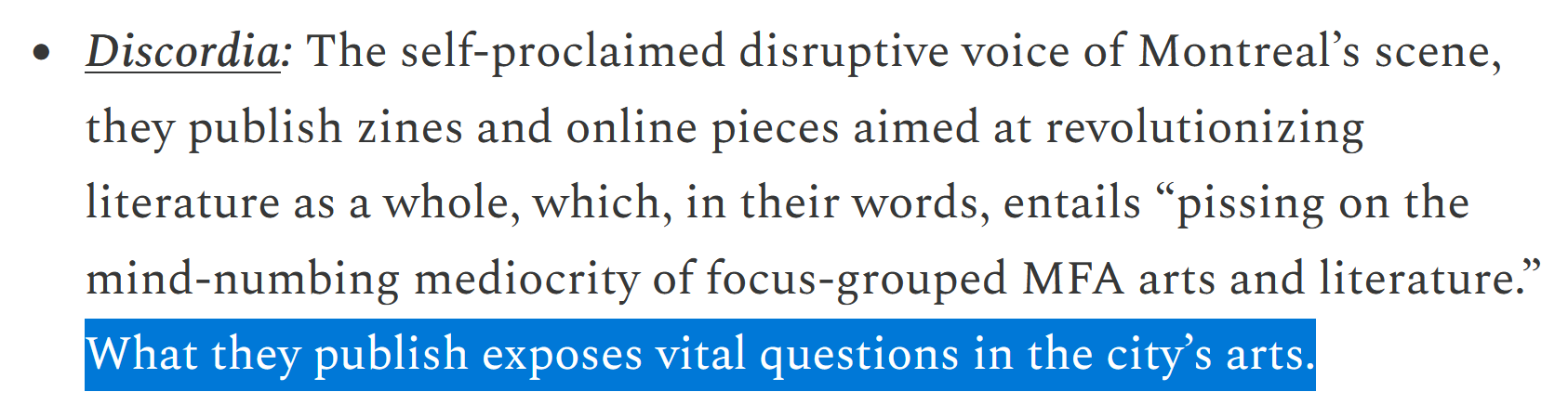
Which was obviously disingenuous considering it’s at the end of a piece with a title that literally suggests we ought to shut the fuck up. Further still, Audet even deleted a comment I tried to leave (twice) directing readers to the original piece in case they wanted to see the full discourse and make up their own minds.
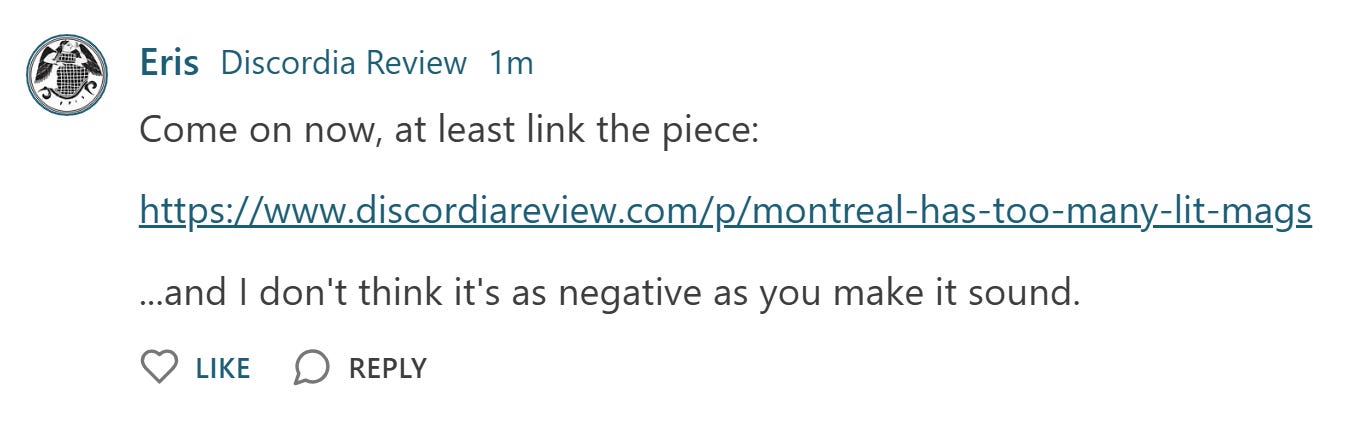
A bit cheeky of a comment, sure, but ultimately inoffensive. And again, how can it be that Audet thinks Discordia asks “vital questions” when he thinks those questions shouldn’t even been read? The whole thing was immensely cowardly, if not simply childish—and this is me talking, have you seen how childish the shit I do is? When Audet DM’d me about it, I didn’t mince words. At this point I was simply at my wits’ end.
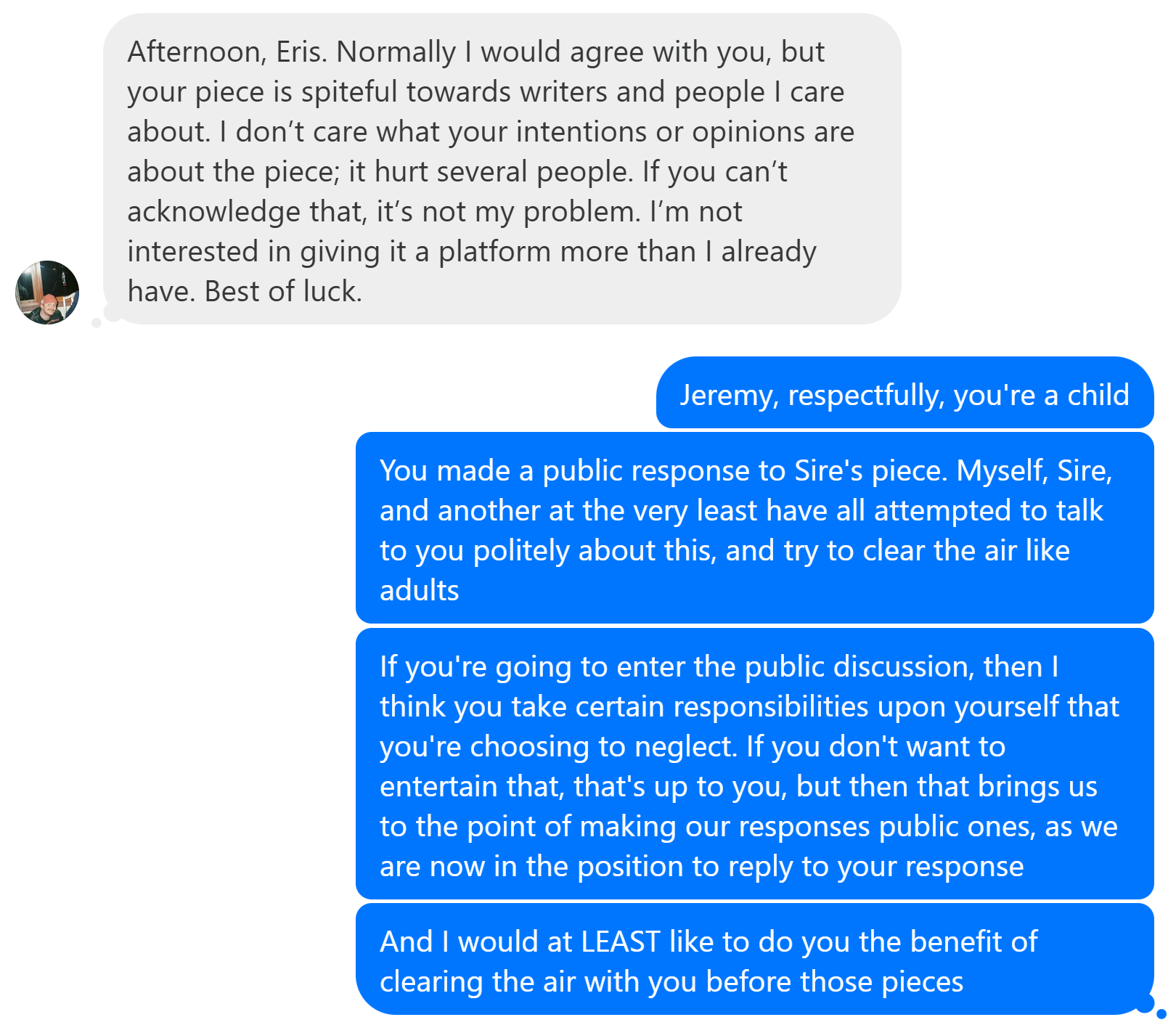
I really don’t know who the several people are that were hurt by the piece, but I believe they are out there. We don’t really name any of them outside of the spreadsheet, yet I hear that for at least a few people being named on the spreadsheet alone constituted some grave offence. But the thing about publishing is that it is quite literally the act of making something public. It’s not like Sire raided anyone’s diary, or even cited any particular writer as being “bad” (I certainly would have, but Sire has more tact than I). This publishing data is being combed by Google as we speak. More nefarious hands than ours are already on it. We used these names to do local publishing math. Ultimately, it’s unlikely anyone will even take note of your name on our spreadsheet in the first place. You’ll live.
So there you have it, the story of Discordia and Audet, of which I think I reserve the right to complain, and so I have. The great irony is that Audet is actually (allegedly) doing with Canto, his new magazine (press?), something in line with what we suggested, in that he is tying his outlet to a specific form, the long poem (though it would be nice to see a manifesto emerge from his cohort alongside it). [EDIT: for posterity, an informant later told me of overhearing that Jeremy Audet was at De Stiil the day the piece dropped and YELLING and SWEARING on the phone to people about the piece lmao what a fucking spazzlord]. To the rest of the people mad at a piece that hardly takes the time to name or shame any specific writers or magazines, I paraphrase the great poet Carly Simon: “You’re So Vain (You Probably Think This Blog Is About You).” Cue music.
RELATED
Further proposals for demoralizing your local literary community

The first edition of our Modest Proposals for Demoralizing Your Local Literary Community has already gone through six printings (in zine format), and has been responsible for an estimated 13 people quitting the arts entirely. In that spirit, we asked the Poetry Heel to provide another batch of suggestions for radical social surgery.
Really he should have minded the share settings lol
Sire: Well, yes, but the vandalism ended up being kind of an improvement really.
Mind you, he also pointed out that this may not be sustainable when one considers just how big the scene actually is. I’m not going to name names, but a number of the larger IG accounts affiliated with the magazines and presses around town do not fare well when the data is scrutinized. The actual community in town reading local lit may be as few as one thousand. Seen below: a cropped portion of some analytics on a local lit mag’s Instagram following that suggests that the majority of their followers are probably bots.
No, I don’t know why I listed them in the order I listed them in either.
What Discordia stands for, for the record: work which embraces outsider aesthetics, work which makes poetic the un-poetic, work which is crass and causes offense or in poor taste, work which speaks to the unpleasantness of life and experience, work which speaks to our most complicated and frustrated emotions (those which are at odds with themselves, those which we resist acknowledgement), work which confesses the id, confesses one’s nasty self, work which isn’t afraid to displease, work which resists the focus-group “craftsmanship” of the MFA (even when produced by those with actual MFAs), work which has a sense of humour about itself, refuses to take itself too seriously. Our north stars include Frederick Seidel, Richard Brautigan, Billy Childish, Grace Paley, Daniel Jones, Roberto Bolaño, Darius James and others. That said, we also endorse some formal playfulness—though we have yet to put out much to that effect yet, there are some things in the works.
Sire: I know few people who enjoy gossip more than Eris himself.
Eris: I never said I wasn’t a part of my own audience!
As for the piece itself, regardless of whether Audet understood what it was arguing, I don’t think there’s a single claim he makes in his response that I agree with. Unlike Audet, I believe the urge to destroy is a creative urge (a la Bakunin, someone I often don’t see eye to eye with but I do think he had that straight); I don’t think judging a writer on the basis of their artistic merit is “punching down” (actual claim he makes!); I don’t care much about representational identity writing; and I think “professional careers” in the writing world should not be maximized because they breed a class of careerist writer-bureaucrats that ultimately kills art (but I will write more on that another time).
Yeah, when people say "every perspective is valid" they are often implying that there's no point in fighting. But I think, if every perspective is valid, everyone should have confidence in their perspective, and we should fight it out and see what perspectives win!
The sad thing about these radical subjectivists is how little they value their own feelings and judgments.
Because I am pettier than you and your team, I feel compelled to point out a couple other errors made in Mr. Marketing Director's piece:
"It was moralizing to see a community of young, inspired artists take shape before our eyes..." - this is not what the word moralizing means. Encouraging might be the word?
"We are lucky, in Montreal, to benefit from this energetic landscape, from the ability to ascribe to a certain journal or ideal and not another..." - perhaps the word he was looking for is subscribe? Though I'm not entirely sure.
Worrisome stuff to see from a fiction editor. Can't knock him for practicing what he preaches though. Quantity over quality!