



Editor’s Note: We’ve been fans of Luke McGowan-Arnold (irregular notes) for quite a while now, and we’re very pleased he’s agreed to become an occasional contributor here at Discordia Review. By way of introduction, enjoy this expanded essay from his ‘stack, originally published as Irregular Note 2: Grappling with Reality back in 2024.
I was back in Rockford visiting my family when I started thinking about the ideas that became this essay. My dad and I were driving somewhere. I forget where. The bank? But we were talking about Baldwin as we do. Who’s better as an exemplar of the African American literary tradition for the 20th century despite all of his flaws? I was complaining as I always do about how contemporary literature, particularly in the African American variety, pales in quality when compared to the literature written in the 20th century. The novel is a bourgeois art form and in our post-integration world what does a petit bourgeois Black subject know about the African American condition? Well, a lot, but they aren’t great at writing about it and there are political reasons as to why.
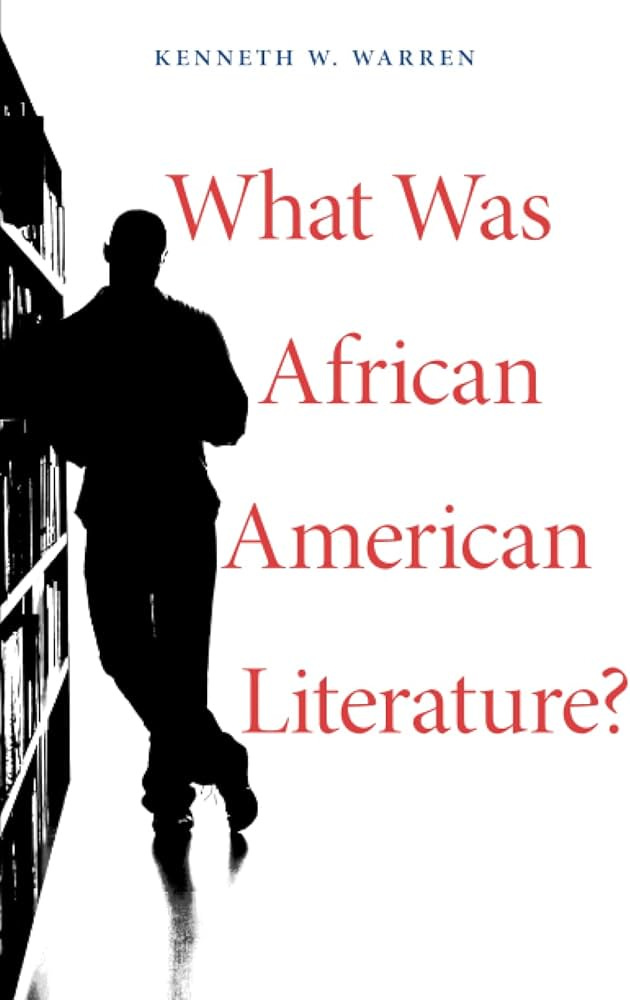
I read an article a few years ago called What Was African American Literature? A Symposium by Walter Benn Michaels, Erica Edwards, and Aldon Lynn Nielsen that profoundly impacted the way that I have been thinking about contemporary literature, especially literature written by Black people. The article describes a book written by Kenneth W. Warren called What Was African American Literature? Warren argues that African American literature has ended as it only existed in the period when Black people in the United States were contending with Jim Crow. The reason Warren says “African American” is because he believes that African American is reacting to a particular set of circumstances. As Michaels argues,
“[Warren’s] point here is not that the civil rights movement rid America of racism. It is instead that the way we do inequality now (including the way we do racial inequality) is not the way we did it then, and that acting as if it is constitutes both an intellectual mistake (you get the history wrong) and a political mistake (you end up making things more unequal instead of less). In other words, he’s not denying, that ‘post-Jim Crow remains a society of dramatic inequalities’ or that ‘black Americans are disproportionately represented among those who lack adequate health care, incomes,’ etc. On the contrary, as Warren understands very well, post-Jim Crow society is actually even more unequal than Jim Crow society was.”
The quote about the intellectual mistake of emphasizing certain histories brings me to my reading of On Beauty by Zadie Smith. While Zadie Smith is not an African American (she is British), On Beauty is a book about a multiracial African American family. Smith does an excellent job capturing the reality of African American petty bourgeois classes, and their contrast with the African American working class. Her engagement is even more surprising, as much of the contemporary Black British writing that attempts to engage with African American history and culture is misdirected and often imprecise. But perhaps this is why we need more literary novelists like Smith and fewer members of the Substack commentariat. The book focuses on the Belseys, a multicultural family (as in there’s a white dad and a Black mom) who live in Wellington, Massachusetts, which I think is supposed to be a fictionalized version of some elite university town in the Boston area. The novel is concerned with the identity formation of a Black petit bourgeois multicultural subject. I have a lot of investment in her narrative about this, given that I share a lot of those identities, but I also believe she bucks a trend in recent literature of not focusing on political questions of the African American condition.

In particular, I want to look at Levi Belsey, one of the young Belseys in the novel. Levi is a mixed race man similar to myself with two parents in academia, though my life differs in some key respects. Unlike Levi, I did not grow up in a predominantly white city. I did not attend private school with all white people. I did not have a white father. These are assumptions that are often made (understandably so) about a petty bourgeois Black multiracial subject. In my own experience attending a mostly white college, other members of the Black middle classes often figured I grew up in the suburbs or went to a fancy high school like them. They thought I was like Levi. And why is that? That’s where we have to return to the work of our friend Kenneth W. Warren. Integration in many ways has insulated a certain class of Black people from much of the day-to-day racism that affects Black working class subjects. Furthermore, many middle class Black people participate in the institutions that oppress other Black people (especially the working class and the poor). Examples can range from Black politicians like Eric Adams or Cherelle Parker to prominent figures in the softer institutions (like academia or publishing) that can provide ideological justifications for oppression of the Black working classes. While there are far too many examples to name, much of Black writing these days follows a format of “speaking for” a particular group of people, no matter how hated this group might be by their supposed spokespeople. This as true on the left as on the right, with people like Cherelle or Eric chastising the Black working classes while Black middle class leftists demean them as uninteresting and unable to adequately address their own oppressive conditions. (The poor writing by Black middle class writers about Black urban rebellions that I’ve written about at The Metropolitan Review is one such example.) Following this line of thought, Black petit bourgeois ideology must also exist in terms of what characters are written or not written about in literary fiction.
The central question circles around understanding how progressive Black petit bourgeois subject formation occurs. Zadie Smith brilliantly describes Levi’s development through culture and the contemporary American social justice movement space. The novel was written in 2005. It is clearly a product of the Bush years, so Black working class anti-police rebellions (as well as their milder Black Lives Matter iterations or the Palestine student protests) are absent. Levi begins his desire for “authentic” African American culture by becoming friends with working class Black youth through hip hop music. His attraction to hip hop is partially, in my view, a manifestation of his desire for a Black masculinity that he senses is absent due to his white father. Unsurprisingly, when we talk about biracial pairings, people are often unwilling to talk about the need for Black masculine role models. Subsequently, after some conversations with his friends, the novel finds Levi becoming politicized by the 2004 Haitian coup d’état as well as the working conditions faced by Haitian immigrant workers at the college. Eventually, Levi steals a painting by the legendary Haitian artist Hector Hyppolite in an act of class suicide against Monty Kipps, a conservative Black academic who bought the artwork from Haitians in an exploitative fashion.
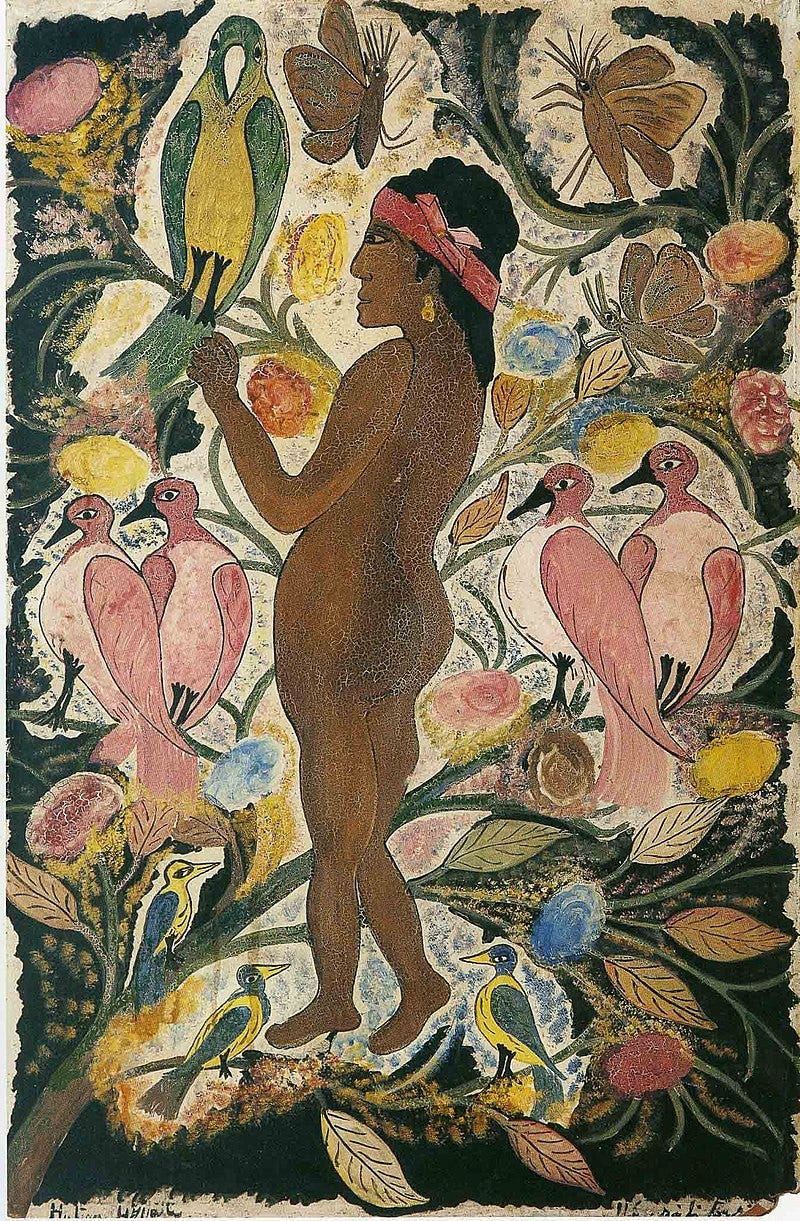
His argument with his mother at the end of the novel as she confronts him for stealing sorta illustrates a class and racial dynamic that many contemporary Black authors refuse to contend with. Levi chastises his mother for getting with a white man as well as the fact that they pay their Haitian cleaning lady Monique four dollars an hour:
“‘People in Haiti, they got NOTHING, RIGHT? We living off these people, man! We–we– living off them! We sucking their blood–we like vampires! You OK, married to your white man in the land of plenty–you OK. You doing fine. You’re living off these people, man!’”
The quote speaks to how Levi’s own guilt around his family’s wealth (and his association with whiteness) has spurred him to political action. Furthermore, it speaks to a complicity of the Black middle classes in the United States in the global exploitation of the African working classes in places like Haiti or even further afield in the continent. In addition, Carl, a working class poet and friend of Levi’s who is allowed into one of Wellington’s writing seminars as a charity case, is frequently depicted with his alienation from Wellington and broader university society as a Black man. He eventually gets a job working as a hip hop archivist. The tension between the Black working and middle classes (even those who have liberal ideology such as the Belseys) predicts events like the uprisings in Baltimore in 2015 against the Black political classes who run the city. In many respects, these anti-police rebellions should be understood as a class struggle of Black working class people pushing back against their Black petit bourgeois managers.
Though Smith does not share my politics (which I do not believe is necessary to create worthwhile art), her description of the contradictions of a Black petit bourgeois subject, especially in regards to a certain type of class politics, is rare in contemporary literature. I return to the work of Kenneth W. Warren. While I disagree with him that African American literature has ended, I share the critique that for African American literature to hold any meaningful social stake, it has to engage with the fact that, as Warren says, “the way we do inequality now is not the way we did it then.”
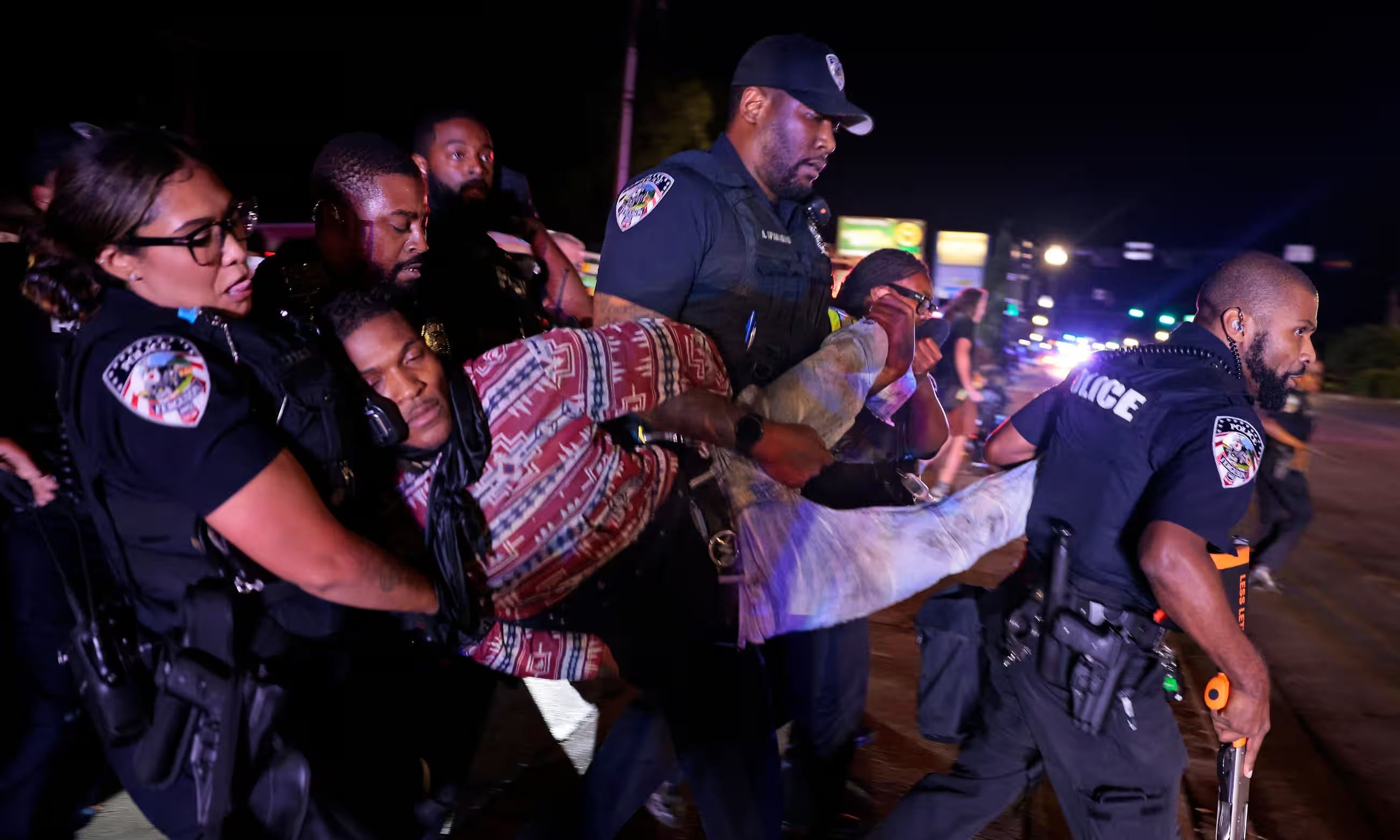
I have friends who read my manuscripts. I will ask them sometimes to relay their impression of the main themes of my work. While there’s a variety of answers, one of the things that stuck with me was my friend’s reflection that my work deals with class inequality in the Black community. As a novelist, grappling with that stuff is key to any work I move through. In a few short years post-Ferguson uprising, the police department there was thoroughly integrated. In my original post of this essay, I used a photo to illustrate this point. In the photo, a young Black man is dragged out of the protest during a ten year anniversary protest for Mike Brown by a bunch of Black cops. The ruling class has a real investment in integration of institutions and narratives that praise integration. So perhaps writers with a progressive orientation (Black or otherwise) may endeavor to write a bit more about our current conditions that maintain inequality rather than fixating upon the past. Narratives that remain sympathetic to the Black working classes and critical of the Black petit bourgeoisie can (unsurprisingly) be at odds with liberal narratives of diversity, equity and inclusion.
My own background is not one that was alienated or even insulated from Black working class reality. Furthermore, there were numerous moments in my parent’s lives where their day-to-day finances were deeply precarious. While this is not comparable at all to the daily violence experienced by Black working class or Black poor subjects, I think these experiences as well as going to a Black high school in the hood and my own parents’ politics significantly shaped who I am. I easily could have ended up as some sort of apolitical or liberal professional class person (like the novel’s Jerome or Zora or Kiki) in terms of how I think about race and class were it not for these experiences. But through my involvement in the social movement against the police that defined Black political consciousness in the 2010s, I developed into who I am.
I have many more thoughts on On Beauty but I think these few will have to suffice for the moment. I called this essay “grappling with reality” because I think the best writing grapples with our material and lived realities. Grappling is a martial art which involves wrestling, grabbing and throwing your opponent. Our opponent as writers is reality itself, and in particular the social conditions that create our lives. We have to grapple with and try to make sense of it rather than evading it. We must depict the world as accurately as we can even if it means exposing ourselves in ways that make us uncomfortable, rather than relying upon past narratives that no longer address our present conditions. I disagree with Warren: African American literature is not dead. But if it is, we must revive it by grappling with our immediate material realities with bravery, honesty and wit. I am uninterested in artists as self important “cultural workers,” but to me, good art necessitates a candor that will shock the marketplace and audiences of the multicultural liberal publishing world, just as the candor of the African American writers of the 20th century such as Baldwin did when they wrote of their own times. They grappled with reality. We must endeavor to as well.
MORE GUEST WRITING
theory of the hack

Good art and fine writing stands the test of time; great art and great writing is eternal. But only the hack provides the true image of their era’s excesses, shortcomings, and blind spots. Thus the work of the hack has a unique historical value. The great artist is immortalized in hagiography and flattery, which smoothens things over and obscures the pit of failure and mediocrity that threatened the great artist at all times. The hack is immortalized in satire, which is written from inside the pit.

What an incredible essay!
i think this is right:
“Our opponent as writers is reality itself, and in particular the social conditions that create our lives. We have to grapple with and try to make sense of it rather than evading it.”
great work