



Instagram poetry? What a dated topic. What’s next, an obit for Harambe?
Yes, yes, I know. And part of the reason for this thrashing being so passé is that the body of this post was adapted from something I wrote back in 2018, at the end of a series of book reviews I did over the course of two years endeavouring to “understand” Instagram poetry. Instagram poetry came to prominence last decade, growing in tandem with the platform itself after it debuted in 2010, and taking advantage of its image-driven content system to create easily-digestible and visually-pleasing arrangements of words on a square background. As for the content, well, imagine you got a series of motivational posters but they were all written by nth-level manic-depressives—so for every “live, laugh, love” in the bunch there’d be just as many that said “love is pain and I am in the pits of hell” or “I am actually the most powerful person on earth and the reincarnation of an antediluvian god”—and you structurally realigned the words to resemble what to the eye looks like a “poem” (give them enjambment, put them in a tasteful serif font, make the background a more neutral paper-like tone). In effect this was just nearly-verbatim repeating the tried and true content of hysterical breakup or empowerment inspo posts, which had always been on the self-aggrandizing or histrionic side in the first place, only those suckers never had the ambitions to call it poetry. Additionally imbued into all this was an equally-timely obsession with a certain form of identity politics, but erring toward that tendency’s lowest-common denominator—think Beyoncé awkwardly standing in front of the word “Feminist” while a TED Talk sound recording of Chimamanda Ngozi Adichie paraphrasing Betty Friedan plays in the background, that kinda beat. So, you know, irrelevant at this point… Right?
Well, go to your local Indigo,1 or whatever your equivalent big chain bookstore is for my non-Canadian readers, and you tell me what the poetry shelves look like. Unless it’s one of the ones that serves as a de facto university bookstore, you’re likely looking at a whole lotta Instagram ink. Instagram poetry is still dominating poetry sales well into the 2020s—it seems, in fact, to be selling even better by some estimates—and people are still writing in defence of it against all of us snobs who might pooh-pooh the stuff. This is no dead horse I’m beating here, this bronco is still bucking lively and fierce. But ought I beat it? Why not let it graze peacefully? Why not stick to my own fields? Why not labour this metaphor even more?
Once, when asked to comment on the ascendancy of Kenny G, an obvious excuse for an easy clowning on the latest thing “ruining jazz,” saxophonist Branford Marsalis put it bluntly:
He’s not stealing jazz. The audience he has wouldn’t be caught dead at a real jazz concert or club. It’s not like some guy says, ‘You know, I used to listen to Miles, ’Trane and Ornette. And then I heard Kenny G, and I never put on another Miles record.’ It’s a completely different audience.
Not at all an unfair point, but my riposte to Marsalis would be this: what about what lies in the future of your hypothetical jazz fanatic? Where will he be then and who will take up his mantle when he’s gone? Truly great jazz records were still big sellers in the 1970s—Miles, Herb, Weather Report—and while the genre maybe hadn’t retained the primacy of its heyday, there was still life in it. Then came the 1980s. The three best-selling jazz albums of the ‘80s were all by Kenny G. The following decade, the decade of the Jazzman President, the dominant mode of jazz would become Christmas background music. I’m not saying Kenny killed jazz, there were plenty of contributing factors—MTV, an aging audience, radio deregulation, slashing of arts funding, hip hop replacing jazz as the vanguard of black musical expression—but Kenny G was the symbol of that process. Kenny G epitomized the soulless, commercial side of jazz’s destruction, tied up in a neat corporate bow and sold off as a cheap mass-produced commodity. That is why he inspired ire. And as to whether Kenny G could ever be a helpful lowered entry-point for a prospective jazz fan, well, there’s low entry points, and then there’s ramps that don’t even reach the gate. The popularity of something like Kenny G winds up being a one-way mirror in front of jazz; the popular conception of jazz reflects from it, but it has none of the qualities of what lies behind it. People who like Kenny G are unlikely to enjoy ‘Trane, and people who might have otherwise liked ‘Trane will probably be kept away by Kenny G.
And so it is with Instagram poetry.
Okay, time for the thrashing.
I have heard complaints that Instagram poets rip one another off, and I know that Rupi Kaur in particular has received accusations of plagiarism, but I seriously believe those rumors to be unsubstantiated. For starters, most Instagram poets can barely read to begin with,2 let alone rip off something they’ve just read. Furthermore, and what I intend to prove here, is that they’re far more often simply ripping off themselves. To prove my point, I am going to be conducting a study of Nikita Gill, one of the scene’s most prolific and successful writers, and simply focus on one conceit: Gill’s use of “fire.”
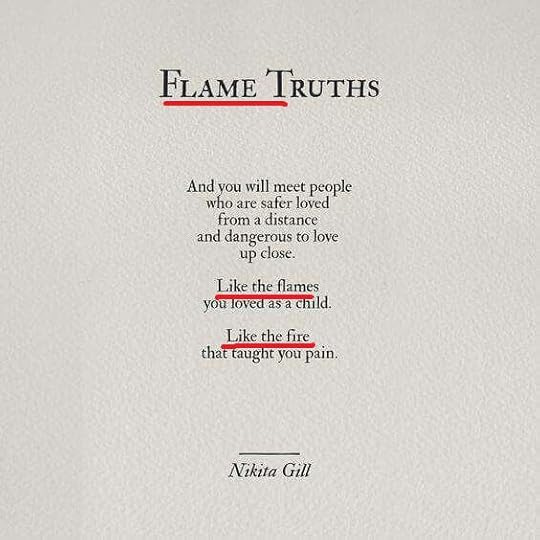
Fire is probably second only to flowers in the pantheon of straw-poetry cliché, and so this study would seem, at first, to not be particularly funny, except that Gill—in spite of the myriad ways one could use “fire” as an image—often still repeats herself.
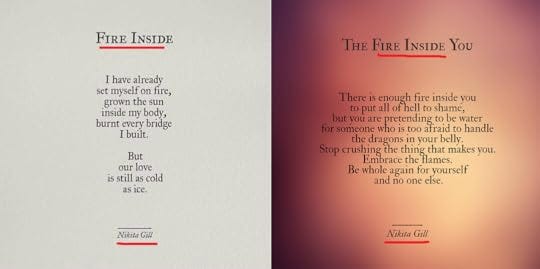
By which I mean a lot.
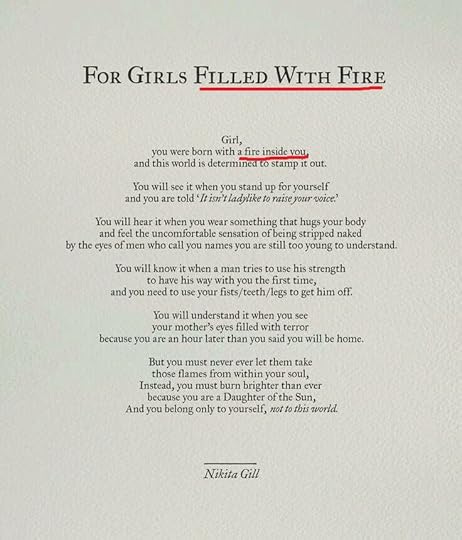
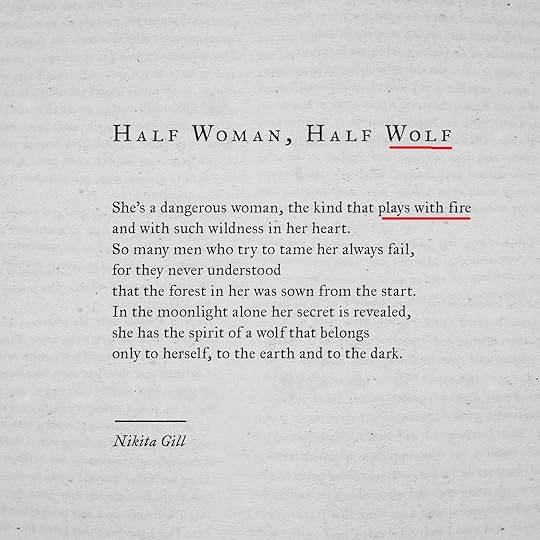
Every once in a while she might randomly bash two of her clichés against one another, in ways that seem almost arbitrary. Like a child mashing barbies together in order to discover the carnal human secret, Gill seems intent to, through brute force, accomplish the same thing for her poetic ambitions. Take “Wolf and Flame,” for instance:
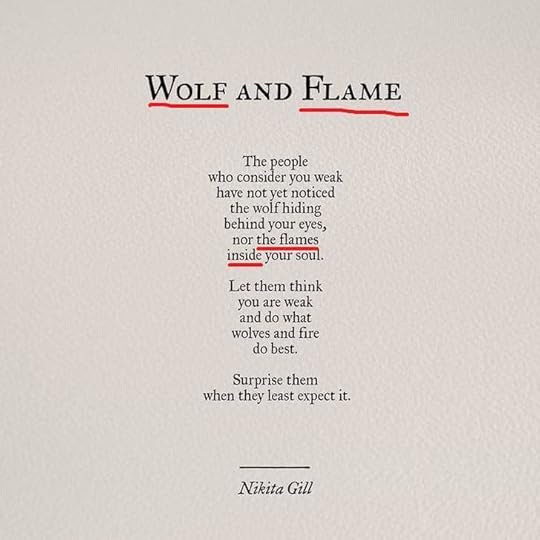
...a bashing of images so novel, Gill couldn’t help but repeat it.
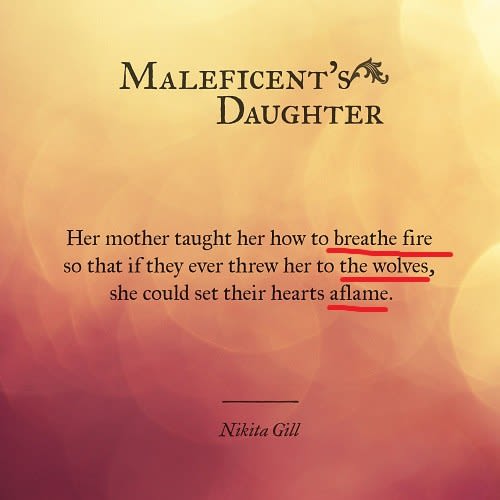
…more than once.
In relation to fire, “ashes” are also a common occurrence in Gill’s work, leaning on the Phoenix/wildfire cliché of ashes as a symbol of rebirth or redemption. You can see her use it here:
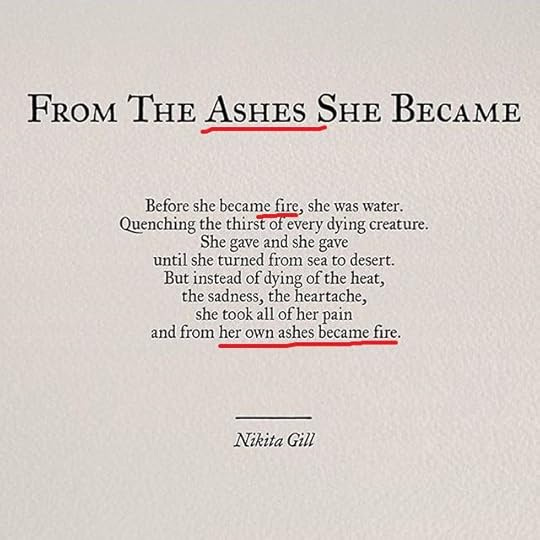
(…hold on a second, she was water, and then fire? Only in-between, after being water, she became a desert? And then from the ashes of having never been fire, she became fire? A bit of a confused metaphor, but alright. Moving on).
And here:
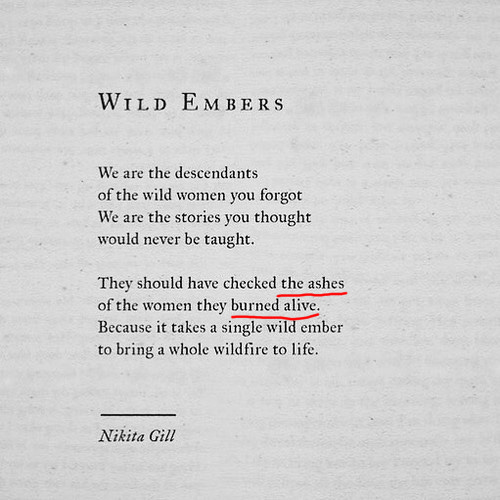
…though these are far from the only examples.
Someone even went so far as to tell her that Rome was on fire once:
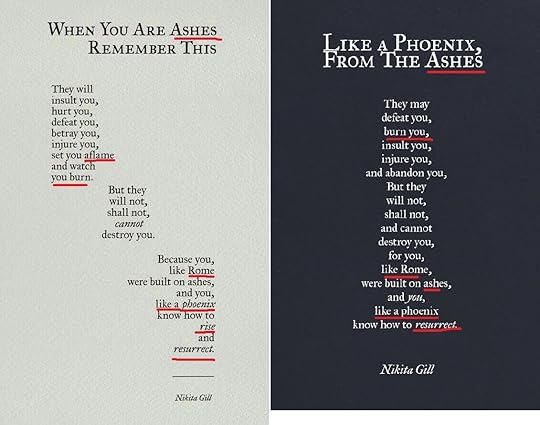
Those are admittedly so similar that I can’t help but think they might just be different drafts of the same poem. But this one certainly isn’t:
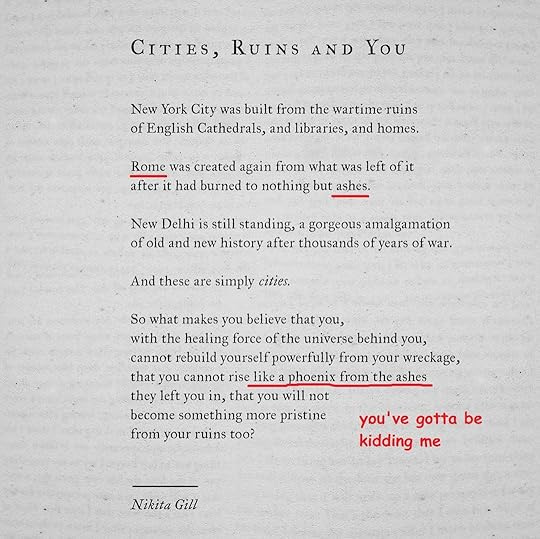
I should point out that she is from London, which has also been on fire, or that stalwart Rome was still eventually overcome by barbarians, but I suppose that’s neither here nor there.
Her book Your Soul is a River has an entire section called “Fire,” which is entirely made up of poems that evoke fire, and specifically contains a poem called “Fire and Ash.” That poem has a section that goes like this:
And whilst looking at you, I learn:
You are living proof that fire can rise again
even from cold ashes.
Fooled you, that’s actually from a poem a few pages earlier called “I Look At You and Wonder.” But I could have easily used this excerpt from another poem in the same section:
The next time love wants to take you,
think of yourself as a forest.
When a wildfire comes to devastate you
instead of just surviving it,
you learned to grow in ashes.
Or this, which is from yet another:
Now let me show you how
I let your flames destroy me,
how I built myself up from the ashes,
and how people who are half phoenix
can resurrect when burned.
Which isn’t even the only phoenix reference in this book, it happens again in another poem:
But remember,
there are beginnings in endings,
through destruction there comes life
and you have the same strength in you
that makes the phoenix rise
from the flames.
In Your Heart is the Sea, Gill outdoes herself with one of the funniest lines I think I’ve ever read:
The forest of my alone finally has grown back from the ashes.
In her collection Wild Embers she again repeats the fire/ashes motif:
from the ashes of the old,
embers breathe new life to its fire,
giving us a chance to mend,
And again:
Set a wildfire inside yourself
and then regrow.
Which is to say nothing of all the other references to fire in that volume, including a poem called “Burning” and one just called “Fire”—which, by the way, has her bring in the damn wolves again!
But lest you think such repetition is unique to Gill within her milieu, let me introduce you to r.h. Sin, another very successful Instagram poet, and the kind of guy who addresses his female readership in his work like he’s running a Looney-Tunes-length tongue over his lips while brandishing a fork, knife, and bib (you’ll see shortly). He also wrote a poem about a fire burning inside a woman:
she couldn’t be tamed,
rebellious lover
refusing to settle for less than
she deserved
there’s this fire that burns within
her
the type which could never be
put out as she used it to light her
own path
she, unchained and free3
An image so good he uses it again in another poem:
there’s fire within her
don’t try and put it out
just add to it
And another:
what failed to weaken her flames
became fuel
And another:
She was the flame that no one
could put out. Burning brighter
than the sun, refusing to be
taken lightly.
But don’t worry, he has a fire inside him too, but it’s one of those fires that hurts:
There are flames in my soul,
deep where no water can reach
me and as I continue to burn…
Mostly, however, Sin is preoccupied with burning things down, usually bridges. Here’s just a few:
I don’t have exes
just a few mistakes
a list of regrets
and things gone up in flames
from the bridges I’ve burned
I’m the one who burns bridges
just to light my path to a new direction
bridges will be burned
but stronger ones will be built
upon their ashes
burn bridges if you have to
don’t be afraid of the flames
use the fire as warmth
use the fire as a torch
to light the path toward
sadly, i watched from the other side
as you burned the one bridge
burn bridges for warmth
burn bridges for light
burn bridges to others
who don’t deserve
to get to you
I’d walk away, only to return
giving you permission to burn
through the foundation
that once represented us
in flames
and so as I light this match
tossing it upon this gasoline-filled
room
tonight, what we were
goes up in flames
our love in ashes
I set fire to every memory
we made then smiled
as I watched us go up in flames.
Together we wrote the book on
our relationship, tonight I’ll
burn the pages.
And hey, who doesn’t like a little rising from the ashes?
today, just like any other day
you’ll rise from the ashes
a fire set by those who wish
for you to fail
And, reader, I’m not even putting you through all his references to being burned by love or burned by regret or burned by memory or burned by sex or burning other people through any combination of the previous, because there’s still more poets to roast above this fire. Let’s do a few more in quick secession. Here’s a line from Trista Mateer:
The same way
she rose from the sea,
you rise like a phoenix
from the ashes of things
that no longer serve you.
And here’s a line from Tyler Knott Gregson:
Rise my soul, rise through the flame and the ash,
rise through the waters that fill the spaces
And here’s a line from Najwa Zebian:
Just as a fire gives rise to new, stronger growth in a forest,
every time you burn out, you have a chance to grow even
stronger.
And then there’s Atticus, the Instapoet behind the chrome Guy Fawkes mask.
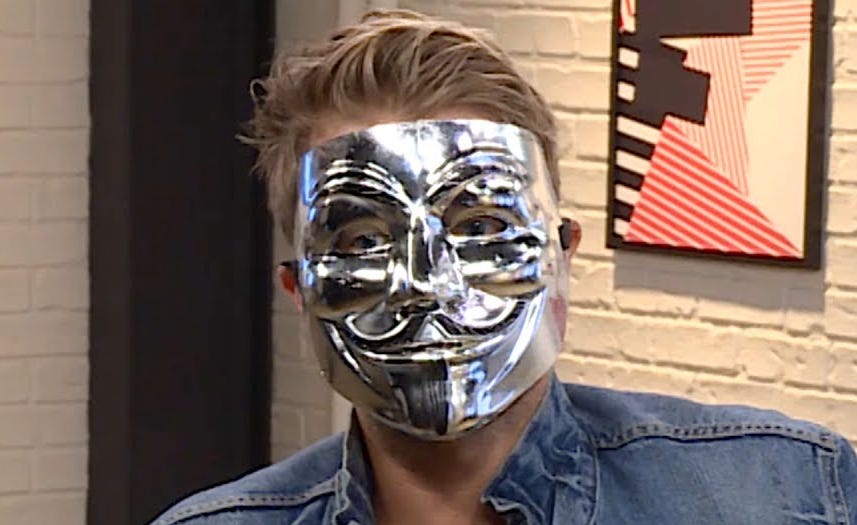
He also can’t help but also write about fire and ashes and rebirth. Here’s from his collection titled [shudders viscerally] Love Her Wild:
In her heart
and soul
she set fire to all things
that held her back
and from the ashes
she stepped
into who she always was.
Atticus actually has remarkable restraint when writing about fire, because when he repeats himself it’s more often than not to do with angels and clouds and flying, or, perhaps my favourite, “girls in the rain,” which I can’t resist tangentially revealing to you here:
In this world of bits and pieces
she was whole
so entirely in front of me
the one honest gift
of my life
dripping there
in the rain
We tangled in bedsheets
skateboarded in rainstorms
I don’t know the meaning of life,
but kissing a girl
while drunk in the rain
is pretty damn close.
We ran from beach clubs
in rain showers
drinking champagne from bottles
jumping into pools in our clothes
and kissing under lightning,
Swimming pools were invented
to kiss girls in the rain
and if they weren’t
they should have been.
you look your best
soaked in champagne
under fireworks
dancing in the rain.
Like Sin, the guy gives me softboi pickup artist vibes. Perhaps his doofy 4chan Dr. Doom mask is his version of the ubiquitous PUA Jamiroquai hat. Okay, back to the “fire” thing.
There’s amanda lovelace, who has a whole book that is basically just poems about fire—people containing fire, people using their fire, things burning, something she terms “woman-rage-fire,” and, most embarrassingly, multiple direct references to the “girl on fire” conceit from The Hunger Games:
in our bellies:
fire fire fire
& sometimes
not much
else.- these are the real hunger games.
for the girl on fire.
thank you for inspiring me to
gently set the world alight.
you may have
a gown of flames,
but those same flames
run through my
veins.
And here’s one which, as a bonus, also happens to be about Hillary Clinton (the judge’s score cards are up and… yes, that’s earned some extra points for cringe, folks!):
to the woman
who fought to
keep our fire
alive
but got
pushed into
the pit
instead.
thank you
for believing
we could be
more than
fading embers.- for hillary.
And so on and so forth. It’s a recurring motif in her other volumes as well. Here’s a poem she wrote about a guy being like fire:
he was made of fire
& i was made of ice.i came too close to
his flame& he melted me
with his embers,reducing me down
to a puddle.
…and here she is comparing people to fire again, but unlike Gill having water become fire, Lovelace here opts to have fire become water:
today
you are
the fire
& tomorrow
you will be
the sea
And here’s Rupi Kaur doing the same thing:
how do you turn
a forest fire like me
so soft i turn into
running water
However, like Atticus, fire is not one of Kaur’s real staples. In her case it seems a bit too aggro for her work—she traffics in softer clichés. Stuff like flowers, for instance. You can usually mix and match with these guys: sun, moon, stars, flowers, rain, forests, the movies of Walt Disney, and so on. It’s a shallow pool they’re wading in and they’ve all already pissed in it. Say whatever you like about Rupi Kaur though—[I pause while you do this]—despite her reliance on clichés she rises significantly above her peers in her ability to at least utilize them creatively. After returning to a number of the abovementioned poets, I was legitimately shocked to find Rupi Kaur using metonymy. At one point Kaur doesn’t refer to herself as fire, she refers to herself as the crackle of the fire. WOAH!!! The first time I read Milk and Honey, I wanted to throw the book across the room. After reading the other Instapoets in short succession, I felt like she was blowing my fucking mind. She doesn’t always choose the path of least resistance. She is at times, if anything, um… perplexing?
i am not street meat i am homemade jam
thick enough to cut the sweetest
thing your lips will touch
Huh????
Her work is also notably sensuous, it is of the body, she often lingers on sensation in ways that are markedly more vivid than anything her contemporaries produce. It always falls short, yes, but it’s at least something. Rupi is top dawg for a reason. Her Instagram posts have a more tasteful design sense, too—she talks in her profile in The Cut about how much she thinks about things like font, for instance. She’s more thoughtful than the rest of them, which shows in that she’s only released four books in ten years rather than several a year like a number of these guys (Sin, for instance, has dozens of books). But it’s still quite bad.
I think that, in spite of everything, there is a deep societal hunger for poetry, one of the most irrelevant artforms in the world. The fact remains that in spite of the fallaciously prescriptive arguments that Rupi Kaur is not a “real” poet and that her work is not “real” poetry, it was nonetheless sold as poetry, and it was nonetheless bought as poetry. She’s merely a bad poet, like Kenny G is a bad jazz musician. They fail at fundamental aspects of their crafts—principally, they fail to surprise. Rupi Kaur and her contemporaries are not successful in spite of the fact that they are poetry, they are indeed successful because they are poetry and because an audience existed anxious to consume poetry, but who live in a world that lacks the patience for it. So they instead get quick, digestible slop, something you can read as you flip by on your phone and not give a second thought, something to be sandwiched in-between shitty depression/anxiety memes and ads for mobile games that don’t exist. Difficulty is not endemic to poetry, it is endemic to the world poetry finds itself in.
And you may even like:
Your Poetry Sucks: The Heel Manifesto

We are living in an era of aesthetic nihilism. Nothing is true, so everything is permitted. But if nothing means anything—if nothing has any relative “value” next to anything else—then why try? After all, it’s just as valid as anything else. Don’t you WANT to live for more than that? Don’t you WANT to see your work as the expression of something worth taking preciously?
Reader, you really ought to read that Deadspin article, as well as The Cut profile it links to. Both are a trip. Rupi Kaur gets swarmed by birds!
A funny note about r.h Sin: when I first looked at his work I was at least sort of impressed by him having a less obvious approach to line breaks than the rest of them, but then I noticed the way his line-spacing varies—half this dude’s line breaks obviously come from the fact that he’s simply increased the right margin so much they break on their own lmao. An example:
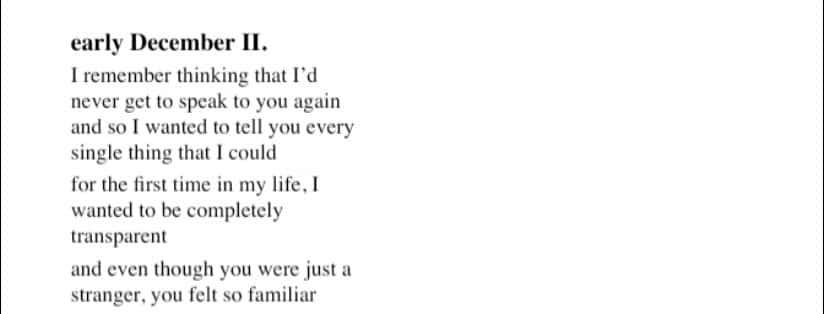
Sire: More importantly, after I joked that the above poem was just a rejected draft of that Earth, Wind & Fire song, we discovered the lyrics kinda fit…
The thing with Gill's "homeless man's Mary Oliver" act is that it really is nothing more than a resonant tone of voice; Sort of sensual and imagistic in this vague way, declamatory and self-helpy. It feels flattering to be spoken of like the heroine of a romance novel, but there isn't much of anything underneath the style, which really shows through in the limited selection of imagery she deploys.
sometimes its nice to indulge in some quality haterade