

Lindy West's Adult Disgraces
On the perversions of the over-therapeutized subject


In which I am again very late to the party.
Somebody told me I should prepare to write about Lindy West’s Adult Braces back in fucking January. I said I didn’t know who the fuck that was. Then I looked her up and I remembered who the fuck that was. She wrote that terrible-sounding Roxane-Gay-core book Shrill: Notes from a Loud Woman (the title says it all) back in 2016. I wrote a takedown of Bad Feminist some years ago that I’ve considered updating to post up here, though at this point in time I’m far more interested in Gay for her suspicious political connections (which I wrote about here). Why would I waste my time with Lindy West?
Boy am I an idiot.
This is some very rich lit world drama, not simply because it is a very bad book—though it’s that too—and not simply because it’s slathered in salacious gossip milked from the teats of a trio of loudly-lowing lolcows—though it’s also that—but because it opens up so many fronts for cultural critique. Discordia contributor Hilde von Bingen already wrote a fantastic piece about all this, skirting by some of the squeamishness many commentators have in tackling the subject of the psychosexual race drama unfolding underneath it all, and while I often like to opine on psychosexual race politics myself, I’m not going to step on her toes as she’s already summed it up nicely. Still, as Klaus Zynski put it, “we [have] somehow talked about this both entirely too much and not nearly enough.” West has given me a great opportunity to write at length about something I’ve been wanting to for years now: the over-therapeutized subject.
But first, an overview. A number of my followers tell me they specifically follow me so I can catch them up on lit drama they’d otherwise avoid, so here’s the skinny (not there’s anything wrong with the fat [which would be the longer version {Lindy West is a body positivity activist}]). I picked up a copy of West’s 2016 breakthrough book Shrill to take a look and provide some background and, despite the misogynistic tidal wave massing off our shores and making women’s issues feel as pressing as they’ve ever been, shit like Shrill is still basically fucking unreadable. West’s introduction to the copy I was reading was penned just after the 2016 election and saw the author questioning the extent of Russia’s involvement in Trump’s victory and wondering if they’d do an audit of the vote. Anything but blame Hillary or the Democrats, the ultimate actual authors of the American Tragedy.1 Then, after talking up the vital importance of reading a book like her own, she writes about how the big-boobed tree from The Last Unicorn2 is fat-shaming or something. You get the idea of the tradition West is emerging from. According to Slate, “West argue[d] that she has helped change the culture around issues such as fat acceptance, rape jokes, and Twitter misogyny even in the relatively short span of time she’s been writing about them.” Hey. Lindy. How’s that been going lately?
On to Adult Braces. The book is a very easy read as every chapter is about half a kw (kilo of words), which is especially handy as every time you think to yourself, “I couldn’t possibly read any more of this stupid fucking chapter,” you notice that you’re almost done anyways, so why not carry it through to the end? You chuckle at my comic exaggeration. Reader, I am not exaggerating. I am just going to write out the entirety of chapter 1 for you (for educational purposes; I’m educating you about this), titled “Alarm,” so you can see the sort of thing you can expect inside. I don’t want you to miss a word because I don’t want you to think I’m misrepresenting this. This is the whole, uncut chapter.
I was snoring on the green velvet living room couch, Carrots the cat purring on my chest, when a caustic beeping woke me.
It sounded like a twentieth-century alarm clock, not an iPhone—an old-fashioned, analog, gritty kind of beep. The time was 6:52 a.m. Sam and Kirsten were still asleep upstairs, and I didn’t want to wake them. As I searched for the source of the noise, it changed to a slow beep for a while, then switched back to fast beeping. Did Kirsten set an alarm because she wanted to get up and say goodbye to me, but then she accidentally left her phone down here? It had to be a phone. There was a little pouch on the dining room table. I looked in there, but it was just Sam’s wallet. No beeping phone. There was an iPad on the table. Maybe Kirsten’s alarm was going through the iPad? No, not that either.
I noticed a small cardboard box tossed in with the previous day’s mail. It was addressed to Kirsten and the return address said, simply, Good Stuff, and an address in Minneapolis. That seemed like good news, because a murderer wouldn’t put a return address, would they? The beeping was definitely coming from inside the box.
Okay, I thought, it’s a bomb. Sam had been getting death threats because she worked on And Just Like That, the Sex and the City reboot. It was not impossible that a crazed Sex and the City fan mailed Sam a bomb because they didn’t like how Miranda was treating Steve.
If there was a bomb in that box, I thought, because of Miranda Hobbes’s queer awakening, and I just let the house blow up with two of my favorite people and four of my favorite cats inside, I’d be really upset. So I gingerly picked up the bomb, took it outside, and set it on the front step. Certainly a bomb can’t penetrate a residential front door! I was a hero! Eat your heart out, Richard Jewell!!! I went back inside.
Satisfied with the morning’s counterterrorism operation, I started on my chores, packing and organizing to get on the road. I had to leave Kalamazoo by 8:30 if I was going to make it all the way to Duluth before sunset. After about an hour, I peeked my nose around the door and found that the beeping had stopped.
“I found a bomb,” I said. “I put it outside.”
“You found a bomb and you put it outside?”
“Yeah.”
Kirsten went out on the porch, then came back in, laughing and carrying the bomb. She grabbed some scissors and opened the deadly parcel (“NOOOOOOOOO!!!”—me, tackling her). Inside was an alarm clock. Kirsten’s teenage son, Gordie, had been sleeping through his phone alarm, so she’d ordered an old, loud, vintage alarm clock on eBay and the seller had mailed it still set and with batteries in it.
It wasn’t the first time I thought something was a bomb when it was actually a chance to wake up.
“One time, I got woken up by an alarm clock. Really says a lot about my life,” says Lindy West. Even for the paltry length of the chapter, this is too fucking long. Chapter 2 begins with Lindy getting upset about the gendered politics of the song “Kokomo” by the Beach Boys. Somehow this leads to Lindy planning an actual trip to Kokomo (off the Florida Keysss) only to discover that Kokomo does not exist. You know that episode of South Park, back when it was still funny, where Stan’s grandpa locks him in a room listening to Enya until he wants to kill himself? Chapter 3 actually sort of picks up with a brief anecdote about how she once had a dentist who turned out to be a schizophrenic crackhead, but while that gem of an anecdote gets about 50 words, 350 words are then dedicated to what it’s like to have your head X-rayed by a dentist, a normal procedure to get done at a dentist’s office.3
But it’s chapter 4 where we are introduced to the biggest, meatiest controversy. Lindy’s husband, Aham, is caught publicly cheating on her by one of her fans with a girlfriend Lindy is unaware of. Lindy is beside herself. The rest is swiftly becoming blogosphere lore: Aham turns it on Lindy (they have a quiet polyamorous arrangement that the fan was unaware of, but he demands more investment in the polyamory or he walks); Lindy relents because she doesn’t want to lose Aham; Aham’s girlfriend moves in; Lindy is miserable, but then Lindy learns to Stop Worrying and Love the New Girlfriend. But who is Aham? Aham is a “he/they” stand-up comic and musician4 whose sister wrote a book about racism that once (or so I learned after very quickly skimming the Wikipedia page) led to a YA author saying her (Aham’s sister’s) “basic assumptions […] create an inhospitable climate for other racially marked bodies” because she used the term “Indigenous American.”5 That is to say that Aham comes from a family that seems to naturally enable annoying discourse.
For all intents and purposes, Lindy is completely fine with the arrangement. I know this because she tells us so in her book:
If you think I have been brainwashed and I am secretly miserable, I simply do not know what to tell you. Also, it shows me you haven’t met Roya. She’s so good. […] What am I supposed to do—not have Roya? Because some strangers are convinced I’m secretly unhappy and they know better? Because I’ve written candidly about having complex feelings? Because these two skinny devils must be conning me since I’m obviously too ugly for them to actually want me? That’s what my “defenders” on the internet say. Are you sure you guys are on my side? Because it doesn’t feel like it!
The truth that no one can imagine is that I am—exclusively—the one who pushes my partners away.
…
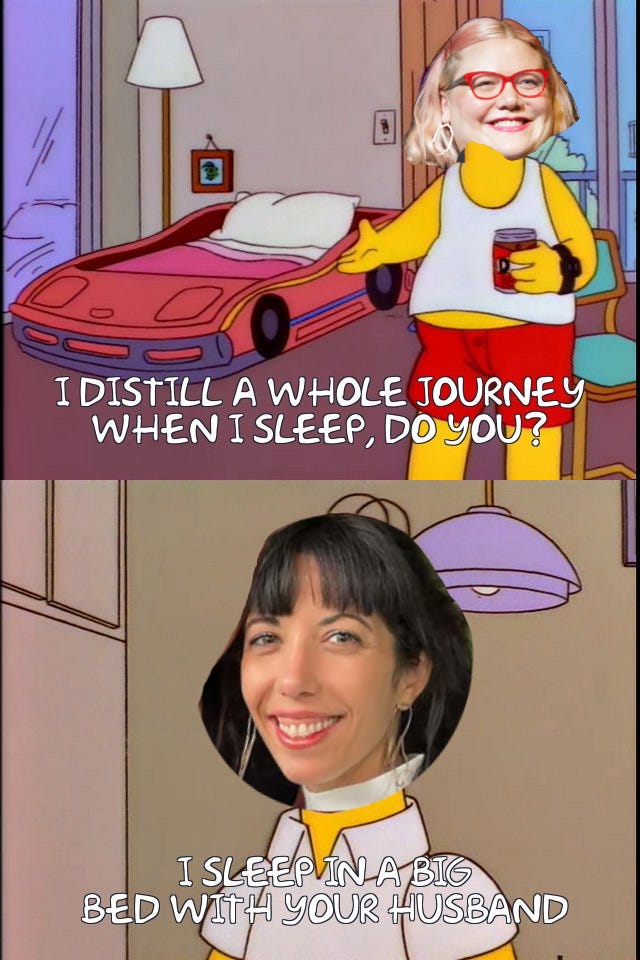
Getting to sleep in the guest room? Sometimes Roya and I fight over it! Keeping the window all the way open all night long with my audiobook playing while hugging my stuffed cat Esmerelda? […] Embracing the pure pleasure of sleeping alone feels like a distillation of this whole journey. It’s what I want. I like it. It doesn’t have to mean anything more than that.
I’m sure you’re all familiar with the concept of “Stockholm Syndrome,” but I just want to spend a minute reiterating the key point: it’s cognitive dissonance. The hostage thinks: this man is my friend, I like this man, and he likes me. But these observations cannot coexist with the obvious reality: if you’re such friends, then why does he have a gun, and why can’t you leave?
But Lindy is a modern woman. She has access to modern psychological care—she has therapists, at least four by my count from flipping through the book—and one imagines that the practitioners of this care must want what is best for their patient’s mental well-being. So where exactly are Lindy’s therapists during this whole process? One of Lindy’s therapists, Judith, tells her she has ADHD and sends her to get her “heart chakra” tamed by a hippy named “Rainbow.” Meanwhile, her couples’ therapist tells her of her polyamorous relationship that “three is more stable that two, if you think about it […] you can’t build a table with two legs.” WHAT THE FUCK ARE YOU TALKING ABOUT??? “Ah here’s a specific situation where three things are better than two things. Ergo, relationships are analogous to this situation, because it is a situation where three things is beneficial.”
See, the reason this book is called “Adult Braces” is because Lindy had to get braces as an adult (duh) to fix her teeth which otherwise appeared to be fine from the outside. All of this therapy, these are the metaphorical other adult braces, these are the parts of her life that have “helped her become sane.” But, like with the table, braces are not a good analogy for this just because the resulting analogy agrees with how you’d like for reality to be. For a lot of people, therapy is a process of self-justification; it is focusing on the parts you wanted to hear and not the ones you didn’t. People assume this isn’t the case, because they ultimately come away from therapy having acknowledged “problems,” but for many the “problems” are conveniently those that they were willing to accept in the first place. (If they had no “problems” by their own estimation then they would have never signed up for therapy.) A therapist becomes in a way a sort of private God—when everyone in the world tells Lindy West she’s in a shit awful relationship, she doesn’t have to listen to us, because her infallible therapist tells her it’s fine (or she infers, because she wants to, that this is what the therapist believes), and her therapist has all the details. The rest of us merely have hundreds of pages from Lindy herself on the subject to go off on. What the fuck do we know? Surely a therapist must be the arbiter of all that is right and well-adjusted. Why don’t we all just become therapists? We too could become infallible. Of course, spend more than five minutes on social media and you’ll see that that is exactly what people would like to do, as they appropriate therapy-speak throughout their day-to-day lives in an effort to control the chaos and “understand” it “objectively” and just wind up digging themselves into a series of bespoke derangements.
I’m not anti-therapy, but I do think a number of forms of therapy should be approached with a grain of salt. I actually know a number of people who have stayed in shitty relationships because their therapists never explicitly made it clear they thought they should break up (not the therapist’s job to tell you this), and they interpreted the lack of condemnation as condoning. Another problem is that therapists often place too much of a premium on making you “feel better,” but sometimes it’s actually worth it to not feel so good—to feel bad for bad things you’ve done, to pay penance. There are things you have done that you should feel kind of bad about. It may not make you “feel good” but there are good reasons to “feel bad” about things (worse still, some therapists inadvertently make patients “feel good” about bad things they are yet to do). A structural problem with therapy is that therapists often rely on the freely-chosen patronage of their patients, and so it is in their best interest not to upset them, not tell them things they don’t want to hear, not delivery anything which may be construed as criticism, etc. (this is sometimes excused as being for the benefit of good practice but I have my doubts). Therapy can do you a lot of good, but it can also give you excuses to be either an Aham or a Lindy—someone who uses therapeutized consciousness to either excuse taking advantage of others or obscure being taken advantage of.
You are a shitty fucking person, you’re a bitter, untalented, mean-girl and you should be absolutely ashamed of yourself. You fucking suck.
—Aham Olou in a letter to Slate Magazine
Well, a tragedy to some, anyway; the collapse of the American Empire may yet, after the dying beast exhausts itself and can no longer lash out, bring more hope to non-Americans than despair.
Sire: [furiously flipping through battered Little Free Library copy of the book]
The head X-ray machine is actually kinda uncomfortable if you’re fat. Lindy wants you to know this.
Who has played with both John Zorn and Macklemore.
Like yeah as an “Indigenous American” myself I have never met anyone who uses the phrase “Indigenous American” but I think we can all agree it’s not that big of a deal and certainly will not make an atmosphere inhospitable.
Oh I’m seated
Agree with your thoughts on therapy but Jesus, I forgot how bad her paranoia is because she came up on writing online. If you think that random strangers are bombing your friend's house a la the Irish Troubles because of online Sex and the City discourse, somebody who is guaranteed to be friendly and sympathetic must be a godsend, even if they do nothing to solve any problems in your life.