

More like Neverland Condominium
Wacko Jacko, black excellence, NFL ex-boyfriends and the mask that eats the face


Michael Jackson was my second major autistic fixation. At its height, I would go to my mother multiple times a day, say “what do you think he’s doing right now,” and get pissed off when she didn’t provide a serious response. I wanted to know why this man who once looked like my dad now looked like me. I wanted to know why he was running around Bahrain in a niqab. I wanted to know why he fashioned himself a Black Panther one day and lightened himself by forty foundation shades the next. His death glued me to the television for hours, and then to our desktop computer where I watched his videos for weeks on end.

My fixation faded with age and eventually collapsed beneath my discovery of the pedophile allegations. Wacko Jacko? I often thought to myself. That’s the old me. But then Michael happened.
As one would expect, the Michael “alleged pedophile” Jackson biopic has been fraught with controversy. The film is less a celebration of his music and more an attempt to increase the waning Jackson family fortunes, and the Jackson estate has been accordingly accused of attempting to sanitize their loved one’s image. And I had to watch it. Sorry. I wanted to see Michael Jackson keke with Quincy Jones. But instead of sanitization, I discovered something much stranger. Jackson is depicted as a toy- and zoo animal-obsessed, socially stunted Peter Pan acolyte whose talents and riches completely insulate him from criticism from his personal and professional circles. Michael somehow makes the pedophile allegations even easier to believe.
How did they let this get made? I yelled at my loved ones. As they did not know, I descended again down the Michael Jackson rabbit hole. And thus, I discovered Living with Michael Jackson.
Living with Michael Jackson is a documentary produced by British journalist Martin Bashir. Though it was released in 2003—nine years after Jackson’s settlement with the Chandler family over molestation allegations—Living with Michael Jackson devastated Jackson’s career. But I was long unaware of Living with Michael Jackson because upon its release, I wasn’t at an age where I could make memories, much less witness a pedophile try to salvage his good name. Thus, I watched it on a Saturday night while I ate mixed greens out of a bag.
Living with Michael Jackson begins with Jackson explaining to Bashir that his songs are delivered to him by God.1 Bashir asks Jackson to do a little dance. Jackson says “I’m shy” and then breaks out moves that would make the average person slip a disc. We then move to Neverland Ranch’s enormous grounds, wherein Jackson further proves his fitness via climbing his “Giving Tree.” He describes “water balloon fights and climbing trees” as his favorite activities, prompting Bashir to ask whether he prefers making love instead. Shortly after, we are entreated to Jackson breaking down in tears as he remembers being beaten by his father’s electric cords.
Act II. Bashir follows Jackson to Las Vegas, wherein Jackson has rented out seven hotel suites and filled them with mannequins, arcade games, and a mobility scooter which Jackson rides up and down the halls late at night. Jackson tells Bashir that while on the road as a child, he would feign sleep while his brothers had sex with groupies in the same room. They go to the casino, where Bashir watches Jackson spend five million dollars in forty-five seconds. Jackson recounts his childhood self’s humiliation over his appearance. He reminisces about the birth of his children: Prince had a big head like Joe Jackson, who the child is clearly not biologically related to; immediately after Paris entered the world, Jackson dragged her home covered in blood. As to when Paris next saw her mother? Jackson can’t remember.
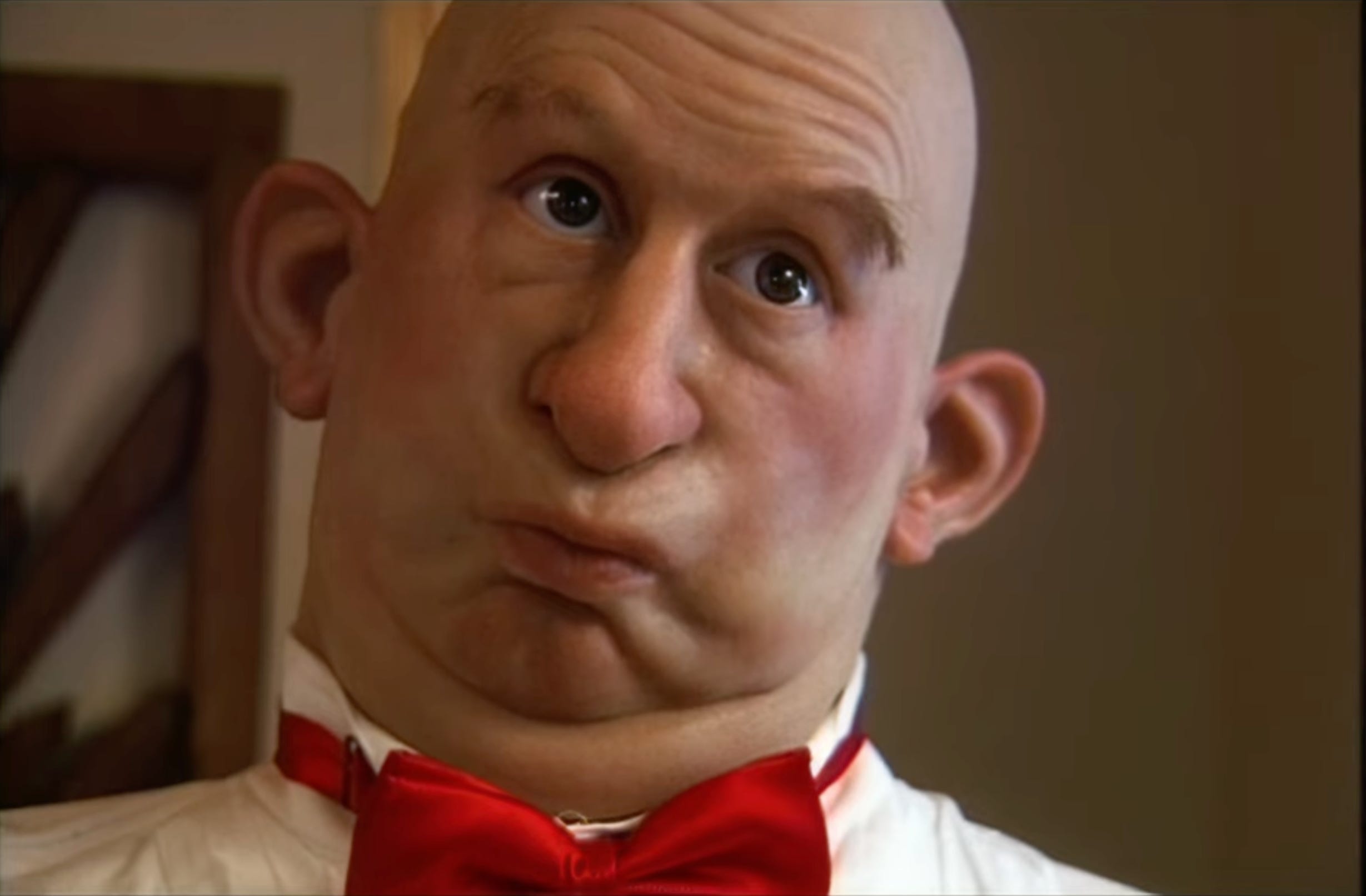
Act III: Berlin. Bashir visits Jackson just after he has dangled Blanket from a hotel balcony. Jackson is in a manic state, speaking of “poor Princess Diana” and hugging sobbing fans who scream “fuck the press.” He wants to see the gorillas, so he subjects his children to perilous crowds at the zoo. In response to public backlash to the Blanket balcony incident, Jackson argues he was just giving the fans what they wanted: a look at his son. When Bashir points out that the fans could not see Blanket’s face, Jackson says “they got to feel his spirit.” Then, whilst ranting about how he would never harm a child, Jackson shakes and forces a bottle into Blanket’s mouth.
Act IV: Neverland Ranch Revisited. Jackson gives a hand-in-hand interview with Gavin Arvizo, a twelve-year-old boy whom he insinuates he cured of cancer. He defends their regular sleepovers with this infamous quote:
Why can’t you share your bed? That’s the most loving thing…to share your bed with someone.
I don’t remember what happened next, because after this scene I momentarily lost my mind. But the film ends with Act V: Miami, where Bashir lights a fire under Jackson’s ass. To no avail: Jackson will not be shaken. When Bashir questions Jackson about why he has white children, Jackson states that “Black people were called colored people because we come in all colors.”
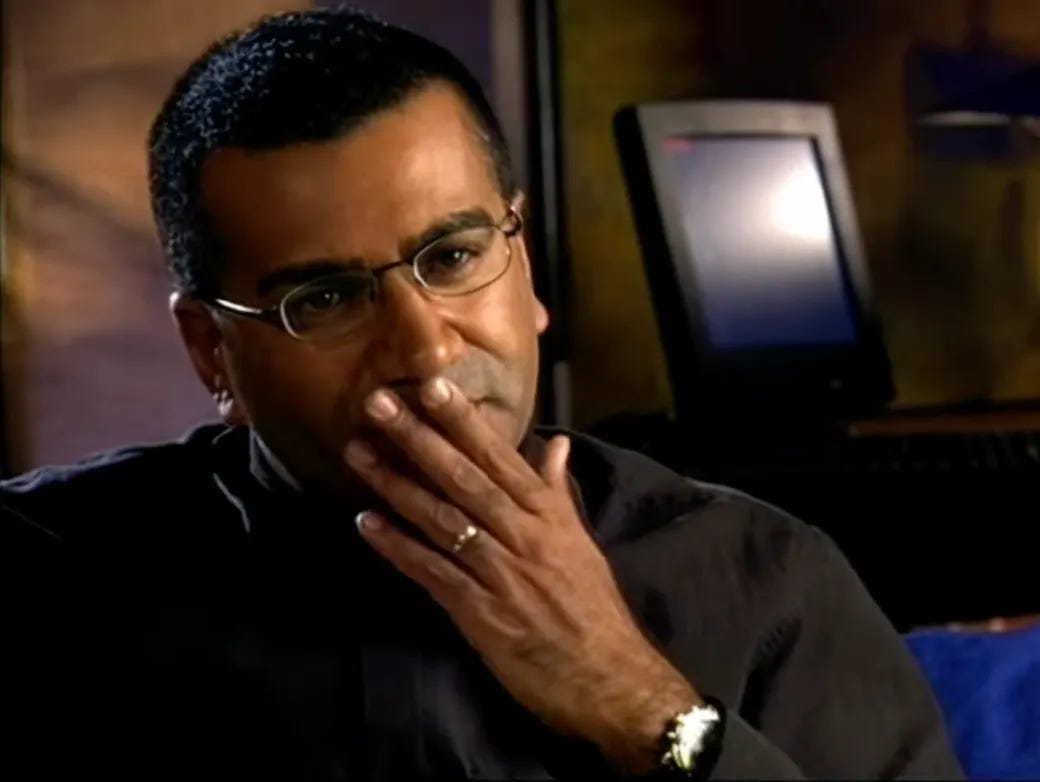
Jackson states that Debbie Rowe, Prince and Paris’s mother, gave him children “as a gift.” He offers conflicting answers about his relationship to Blanket’s mother. He says he has sleepovers with children to heal them. He says that “if somebody announced all kids are dead, I’d jump off the balcony. I’m done.” And he pulls the ol’ Bella Hadid: he only touched his nose! That cleft in his chin? Puberty. God’s will. He has one word for those who think differently: “ignorant.”
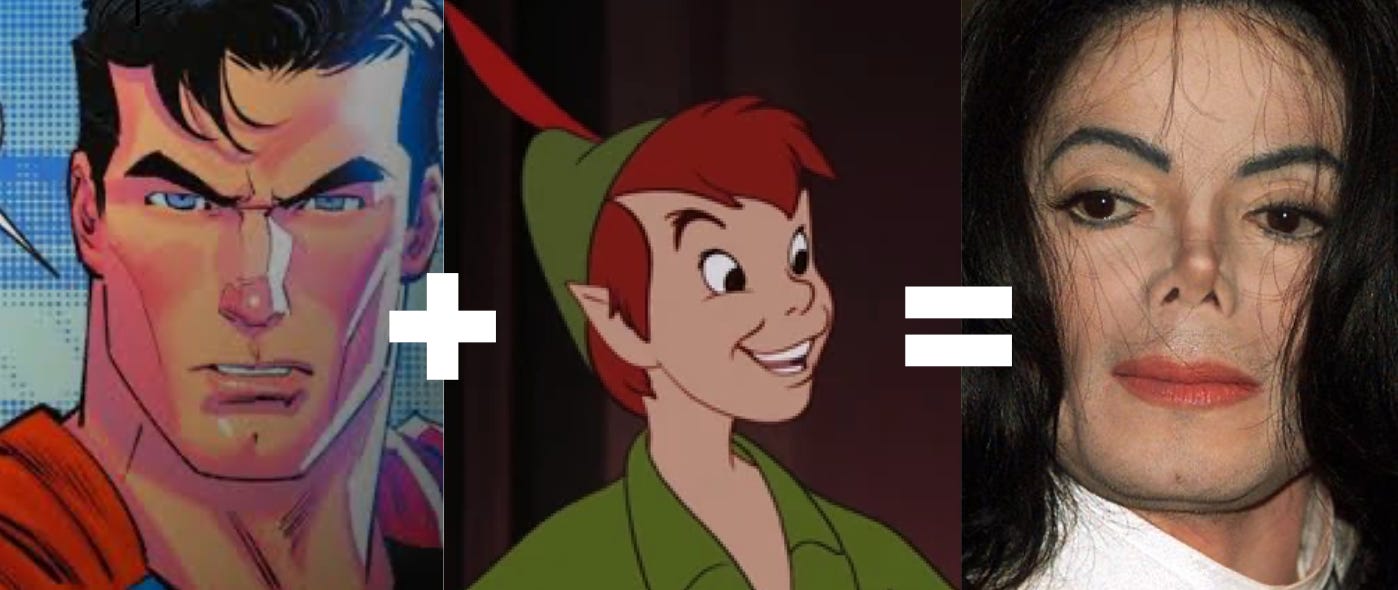
Living with Michael Jackson initially reminded me of Kanye West, another musical genius made insane by the white world from which he both sought approval and wished to dominate. At times, Jackson found solace in his blackness, particularly at NAACP awards ceremonies where he could make allusions to getting lynched and insinuate his legal struggles were equivalent to Brown v. Board of Education. Simultaneously, Jackson sought to escape his race via modeling his physicality after a Peter Pan-esque innocence and a Superman-esque masculinity: an interpretation of the self derived from whiteness and cartoons.
But as I listened to Jackson speak about his upbringing, I realized he sounded like my paternal aunt Susan. My father’s family grew up on Chicago’s South Side, just across the state border from Jackson’s hometown of Gary, Indiana. Like the Jacksons, they were forced into adulthood from the womb by their impoverished circumstances—and by my grandfather, from whom abuse was rife. I could easily imagine the sacrifices required of the Jackson siblings to ascend from this environment and the sheer talent—particularly on Jackson’s behalf—that made this escape possible. And thus, I understood why Jackson’s monstrous turn was enabled by everyone in his vicinity. Nobody wanted to touch the golden goose.
In college, I dated many golden geese: football players. Preternaturally gifted, these men carried their entire families’ hopes on their shoulders. Their physical blessings rendered moot the expectation that they learn how to read, write, socialize, or take care of themselves. All that mattered was reaching the NFL. And thus, like Jackson, they reached adulthood completely stunted.
My peak was the NFL player whose team recruited him whilst knowing he had a severe substance abuse problem. Thus, they’d drug test him weekly, and he’d fulfill his cravings by driving around the city blackout drunk. Once, after he passed his probation period, he locked me in his house. It had no food, but it was filled with video games, Jesus Juice and weed. Neverland Ranch? More like Neverland Condominium. This man was his parents’ meal ticket. He is still in the NFL and gets passed to a new team every season.2 When Mr. NFL wasn’t cutting it, I deigned to date a few Division 1 players. One of them assaulted me with a body scarred by bullet grazes: scars he acquired at fourteen years old. Another assaulter, who as a child frequently attended his father’s dog fighting ring, stalked me for years and was suspended from his university team for beating his girlfriend. His current NFL base pay is one million dollars per year.
Jackson was no flash-in-the-pan football player nor rapper-turned-slavery apologist, and unlike my family, he aimed to ascend far beyond the middle class. But Jackson’s story is a particularly grotesque mutation of a thoroughly common dynamic. Jackson’s childhood was shaped by racism, economic precarity and violence: all factors that engender current and future abuse. As his talent presented a potential escape route, his family curated his professional skillset to the detriment of his personal growth; his arrested development was both worsened and further enabled by the lecherous industry to which Jackson’s success granted him increasing access.
Jobs that fall within the remit of celebrity and athletic stardom are but cogs in massive, exploitative, and largely white-helmed enterprises. But to many, these careers present the only obvious ladder out of circumstances that will kill them young anyways. And when one successfully and maladaptively climbs up that ladder—bringing family and professional associates along for the ride—who around them will ever rein them in?
Throughout Living with Michael Jackson, Jackson sports busted wigs, Shane Dawson makeup, and fingernails that reveal a severe drug problem, though his alternating mania and drowsiness do more than enough heavy lifting. Flat on his ass off benzos, Jackson can barely explain to Bashir the charitable intricacies of sleeping with children without falling asleep himself. Jackson should not have been allowed within ten thousand feet of the world-renowned British asshole. But he was enamored by Bashir’s Princess Diana interview, likely saw himself a similar victim, and wanted his redemption moment. He didn’t have the self-awareness to realize being serially cheated on by the world’s most famous inbred was not comparable to his settling a child molestation case out of court that he likely would’ve otherwise lost. And at that point in his career and wealth, I doubt anyone in his orbit could have realistically changed his mind.
This culture of delusion and enablement is how Living with Michael Jackson and Michael got made. Jackson acted a pedophile before Bashir because for years, nobody in his circle truly addressed how his behavior looked to outsiders, much less held him accountable for what he was allegedly doing to children—and they were likely also deluding themselves. But though Jackson himself starred in the clown show that was Living with Michael Jackson, he is not calling shots from the grave. His family is responsible for Michael. They willingly injected the hagiography with montages of him lurking around the children’s ward of the ICU. They willingly made him look like a pedophile. And I doubt they even realized it. Michael is the manifestation of his circle’s collective delusion. It is a work produced by sycophants whose grasp of reality has deteriorated after decades of turning a blind eye to their meal ticket’s misdeeds.
Jermaine Jackson, one of five of Michael Jackson’s less gifted brothers, said the following in 1984:
Even though Michael is very talented, a lot of his success has been due to timing and a little bit of luck. It could have been him, or it could as easily have been me.
Sure, Jermaine. But in a way, this statement was prophetic. Because though Michael Jackson was one of a kind, his arc would be that of any other court jester. He was plucked from obscurity and made monstrous by a system whose lights he kept on. And in repayment, the system and his beneficiaries did their best to relegate his sins to the dark. The delusion engendered by such a state of affairs allowed for disasters such as Living with Michael Jackson, in which Jackson acted a pedophile out of his own free will. But Michael is not dissimilar, and it has not been a disaster. Rather, it is sending the Jackson estate to new heights.
There is clearly still a reward for choosing not to see. As always, victims pay the heaviest price.
This piece originally ran May 21, 2026 on Hilde’s Visions. Subscribe now.
MORE HILDE ON DISCORDIA
MAGA Minaj, Muhammad Ali, and the costs of Black canonization

When Nicki Minaj outed herself as the Black Queen of MAGA, my first thought was of Muhammad Ali. My second was of Barack Obama.
Fair enough.
For the NFL ignorant (lucky), this means he has behavior issues but he’s good enough that a new team will always take a chance
I tend to agree with your sanitizing method accusations. I think it’s a real problem of rewriting history through box office hits that insert a narrative in reality that’s detrimental. But I also think MJ had vitiligo, rather than pure hatred for his own skin color. As far as the other stuff; I tend to believe that the elites in the music industry unfairly painted him in a light that should’ve been cast on themselves, seeing as most were diddy and Epstein affiliates. The truth is definitely murkier and uglier than I know, though.