



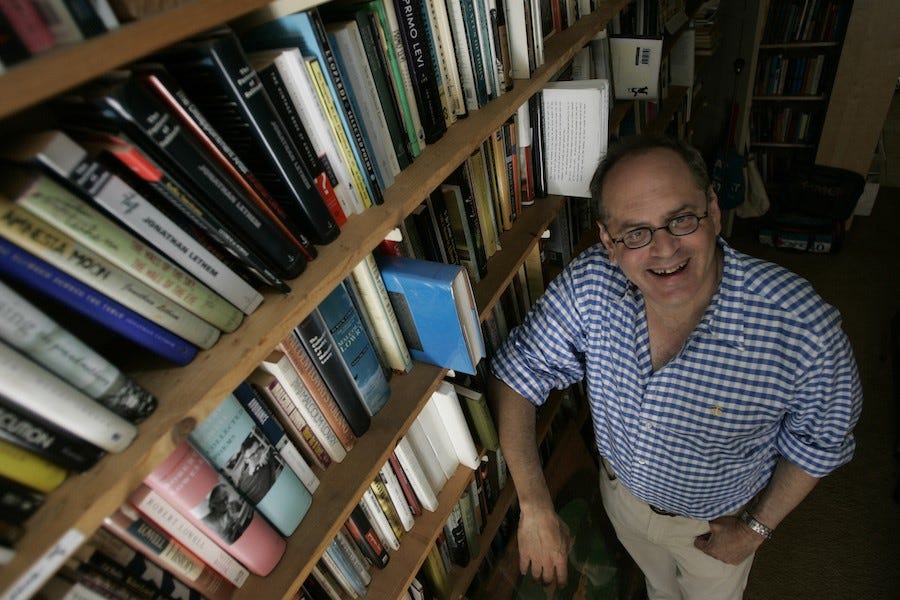
The loss of Michael Silverblatt is a monumental loss to literature.
A psychic reader, Michael was someone for whom the “Death of the Author” simply did not apply, because it seemed he could read any writer objectively through their text and was able to tap into exactly what a writer is thinking or intending. Famously, for instance, Silverblatt once scared the shit out of David Foster Wallace with his near psychic prescience when he asked him whether or not Infinite Jest had been written as a fractal (it is now well-known that Wallace was specifically basing the structure of his novel off of the Sierpiński triangle fractal, a fact which was virtually unknown at the time of the interview). This was a common occurrence for Michael. I once listened to Silverblatt so adeptly read Mark Z. Danielewski’s The Familiar that he seemed to plunge the author into a manic episode on-air.1 (I’ve embedded that episode below so you can hear Silverblatt’s infectious, heartwarming enthusiasm yourself).
Michael Silverblatt was one of my personal heroes—I know I’m not alone in holding him in that esteem. When his show suddenly came to an end without explanation, I started to get afraid. I sent him an email, thinking the end might be near, to let him know how much he meant to me.
Hi Michael!
I hope this email finds its way to you.
My girlfriend (now fiancée, soon to be wife) and I are big fans of your program. I’ve been listening to you for ages, and you’ve always been a tremendous friend on my journey as a reader. I’ve missed the show since you’ve been gone. With this last week’s retrospective show, I’ve been worried that the show could be coming to an end. I figured, then, that it might make a good opportunity to express my gratitude.
On the one hand, I am wary of over-praise, of cheapening the great work you do by attributing influence to it that it doesn’t have; I think of Dave Eggers in his introduction to Infinite Jest claiming the book will “make you a better person.” I’ve known plenty of people in my life who have read Infinite Jest, and not all of them have seemed like their relative “betterment” from the experience was all that radical. What was it John Ashbery said? If you’re here looking to improve yourself you’re confusing art with the Salvation Army? It should be enough, maybe, to say “I have enjoyed your program” and leave it at that. And that is true, I have enjoyed your program quite a lot and for quite a while; you are rightly praised as the best at what you do.
But I’m a sentimental person, and I can’t help but attach, as sentimentalists are often wont to do, more weight than that. I believe these things, in spite of my parallel jadedness. Believing Harold Bloom’s claim that Shakespeare “invented the human” certainly feels a lot more “powerful” than Jonathan Bate’s claim (in spite of the latter’s being far more reasonable, and more likely to be “true”) that Shakespeare could have been interchangeable with Lope de Vega or any other clever enough person who might have been in the right place at the right time. Regardless of their respective evidence, if placed in the Life-of-Pi-esque position of choosing which one I want to believe, I’ll choose the former every time. We once expected things to be more than they were. We are now so jaded that we accept things for less than they are. You were a bright voice that cut through that jadedness for me. You believed, and it helped me to believe.
Have you and your show made me a “better person”? Life is too complicated to say. Perhaps more specifically: you have made me and countless others like me into better readers, which may not necessarily denote better people but God knows it doesn’t hurt.
I would like to hope in my life I can learn to be as compassionate, open, and enthusiastic as you have been on your show all these years.2
With tremendous love and respect…
He never responded. Knowing what we now know about the state he had been in, it’s unlikely he would have even been able to.
Rest in peace, Michael. When you meet God, be sure to tell him what you thought he was doing in The Bible. I think he’ll be impressed.
A side note: one of the most bizarre interviews I’ve ever listened to was the one where Michael Silverblatt talked to Susan Sontag’s biographer Benjamin Moser and wound up confessing that he had been in love with her, something he had even confessed to Sontag’s partner at Sontag’s funeral. Moser seemed uncomfortable and entirely perplexed as to why he was suddenly dumping this on him.
Yes, yes, I know—I said in my life, smart asses, not necessarily my work. In that respect I will continue to be a jerk for your amusement, don’t worry.
Danielewski seems like he could probably get to that manic state all on his own.
I wasn’t familiar with Mr. Silverblatt, but I also love DFW. I will seek out his interviews. Thank you for this article.