



“The more you look at the same exact thing, the more the meaning goes away, and the better and emptier you feel.”
—Andy Warhol
The story.
In 2007, Carl Wilson released his critically-acclaimed submission to the ongoing 33⅓ series, Let’s Talk About Love, on the surface a deep-dive into the Céline Dion album of the same name, though what it actually ended being was a treatise on the nature of taste and supposed snobbery (with the later re-release of the book bearing the more illuminating subtitle: Why Other People Have Such Bad Taste). In the book, Wilson uses Céline—an artist adored by millions but dismissed by critics—as a lens to interrogate the cultural hierarchies that dictate what counts as “good” or “bad” art and what those judgments may actually represent. It’s a good book, maybe even one of the greatest works of music journalism ever written, and it effectively became the manifesto for the emergent “poptimist” critical movement. Which is a shame. That’s because, while the book may be great, it is my opinion that said movement was—and is—completely misguided.
Much like my very being, poptimism was forged in the fires of 2000s internet forum culture, with a lot of the discourse around the legitimacy of pop music coming to a head on the I Love Music message boards1 and spilled outward from there. I began frequenting music forums right around when Wilson’s book came out (though I wouldn’t read it until its re-release seven years later), and I remember the still-ongoing battles vividly. By this point, poptimism’s khanate had already established a formidable Golden Horde across much of the music criticism landscape, and eventually even I, an ardent teenage rockist, was taken by it, and learned to accept that maybe “Die Young” by Ke$ha was, indeed, “a bop.” The recusant holdovers who refused to cede an inch to poptimism without a fight were battled back endlessly, most eventually either leaving the forums out of frustration, or else even being banned—departing with the warning that we would some day come to regret our choices. Victorious, the poptimist users ignored these warnings and smugly celebrated their victories, and I, young and impressionable, celebrated alongside them.
The narrative goes that “rockism”—here defined as an elitist, even racist and sexist, critical ideology that unfairly subjugated pop music—was vanquished by poptimism in a righteous revolution of reevaluation, pushed along by a public sick of the snobbery and ready to embrace all that is fun and good and free, and we all accepted the truth that pop music is every bit as important, meaningful, and salubrious as any other genre of music, and at long last the voices of the marginalized—of women, queers, POCs—were finally being heard.
That was the story they sold themselves. The truth of it all is a lot less heroic.
The truth.
I don’t know that there’s anyone in my life I’ve disagreed with as strongly or as routinely as Matthew Yglesias, as I’m a left-wing internet guy and it’s sort of in the job description. That said, this quote from his piece on poptimism (which I got from deBoer’s piece as I don’t pay for Yglesias’s Substack) is a rather thoughtful and sober consideration of the material conditions which allowed for poptimism to rise:
The media industry moved firmly online in the wake of the Great Recession, and the predominant business model was ad-supported media on the free web. Succeeding meant getting a lot of clicks, and getting clicks meant getting shares on Facebook or search traffic from Google. And in the cultural domain, this entailed what was practically a 180-degree reversal of the primary role of cultural writing.
The key value-add of a newspaper critic — whether focused on books, music, movies, or TV shows — was to draw readers’ attention to things they wouldn’t otherwise have heard about. If you were lucky, your hometown paper employed one or more critics whose taste you respected and who covered areas you were interested in. You could then read those people in hopes of them recommending something you loved.
The logic of the ad-supported web inverted this…. Critics were now incentivized to write articles about the things that people already knew they wanted to read about…. Readers wanted positive, respectful, validating coverage of the most popular acts in music, and so such coverage started rising to the fore.
Saul Austerlitz opined over a decade ago2 about how this same “click culture,” encouraging whatever drives web traffic, made it so that methodical coverage of niche or challenging acts became subservient to pieces about someone like Drake or Justin Bieber, thus in turn creating “a closed system in which popular acts get more coverage, thus become more popular, thus getting more coverage.” He adds to this by considering the additional factors of the rise of streaming culture and the “dissolution of a musical mainstream,” a media consumption ecosystem wherein “most people prefer their iPods or Spotify playlists or Pandora stations to fusty radio programming.”
These were some of the material forces at work laying the foundations upon which poptimism was built, it had nothing to do with “the triumph of justice.” In fact, one aspect that keeps it in place is the psychopathic nature of pop music Stan culture. Insult Nicki Minaj or BTS and you might get some anthrax in the mail. Taylor Swift fans, in response to a negative piece on their idol, harassed the author, hurled slurs at him, sent him death threats, accused him of being a pedophile, tried to get him fired, and doxxed his family. The fucking UVF wasn’t this vindictive.
As for whether the voices of “women, queers, and POCs” were really being heard in the process, that too was largely overstated, as Freddie deBoer aptly points out in his recent piece that the vast majority of critics in the “poptimist fatwa,” in spite of their insistence that this movement was in the spirit of “young women and people of colour,” were in fact just a lot of white men, the aforementioned Wilson included (and, in fact, deBoer points out that the idea that big rock magazines were snubbing pop or rap outright is contradicted by the documented evidence to the contrary). “The poptimist revolution would never have happened at anything like its level of current dominance if not for the white men who became its most performative, enthusiastic champions.” DeBoer links this phenomenon to a growing anxiety, itself fueled by internet culture (here specifically a combination between its flattening effects and panopticon-like aspect), over being reduced to a “Type of Guy,” in this case a sort of arrogant and parochial rock dude.
Wilson wrote a great book, but it has largely to my mind been abused, and would best be considered great food for thought, not as the terminus of an entire ideological position on music. What is sometimes overlooked is how the whole book is framed as a personal essay resting on the man’s existential crisis following his divorce, in which he begins to take stock of all of his values and assumptions, like Descartes dumping his “basket of apples” upon the ground. Wilson’s resultant implied request for us to consider the source of our prejudices is a worthwhile endeavour, but the rather culturally-nihilistic conclusion that we ought to be so much less precious about our sense of taste is, I think, paralyzing if not outright destructive for culture more broadly. We have written before about where this kind of “well that’s just your opinion” stuff can get you, and it’s not a good place to be. Wilson himself has also at times taken the position to unnecessary extremes. I remember a piece he once wrote about how much he hates The National, which wound up being almost entirely framed as if it was his fucking problem on account of the band being so popular. After beginning to make several cogent critiques of the band—a band I like, for the record—the man completely caves in on himself: “I know that’s an unfair load to pile on a fine band that many people enjoy. It’s also probably a rationalization for a more gut-level dislike,” he claims, and ends the article by seemingly checking himself into therapy. Carl! You were making some very compelling points! It is absolutely not unfair! Your critical neurosis—framed, in fact, within anxieties about just what “Type of Guy” you happen to be, a la deBoer—is doing you a disservice!
Don’t get me wrong, it’s not like rockism didn’t have reactionary tendencies. It’s hard to see the blanket dismissals of hip hop so many rock fans used to so openly wield (“can’t spell ‘crap’ without ‘rap’!”) as anything other than racist, usually reducing hip hop to being defined by its lowest common denominators like crunk and ringtone rap, while never endeavouring to give rock the same treatment by reducing it to the likes of, say, Bad Company.3 But even if we right those wrongs, even if we do in fact allow Run-DMC to storm the rock institutions as they did in the music video for “King of Rock,” this does not necessarily stand as an endorsement for axing discussions of “what good music is” at large.
Wilson’s book goes to some interesting and thoughtful places, questioning much of his own historic contempt for certain music or genres and the biases or cultural blindspots that they emerged from, as well as complicating our engagement with art by showing its plasticity in the world and how the places it may end up can upend our cultural assumptions (the memorable section discussing how popular he learns Céline’s music is among badass Jamaican gangsters, for instance). However, his reading of Bourdieu’s work on the nature of taste, which forms much of the backbone of Let’s Talk About Love, winds up reducing itself to a moral position: it is wrong to sneer at “bad taste” because the architecture of taste mostly exists, or so Bourdieu claims, to reinforce class hierarchy. But this moralization eschews Bourdieu’s broader point. Taste operates through structural positions, not just attitudes, and disdain for bad taste isn’t some detachable personal habit of mind you can simply unburden yourself of but an expression of a whole habitus. It is an aspect of cultural production itself. “Taste classifies, and it classifies the classifier”—the judgements themselves, whether implicit or explicit, inscribe class difference. Wilson’s decision to explore the nature of taste through the work of Céline amounts to actively partaking in the very act of “distinction” that Bourdieu is talking about. “There is no way out of the game of culture,” Bourdieu reminds us. There’s a woman on GoodReads who has read Let’s Talk About Love but seems from her profile to mostly read low-brow romance and YA schlock, and here is what she had to say about Wilson’s book, which I think summarizes the catch-22 rather aptly, however unintentionally:
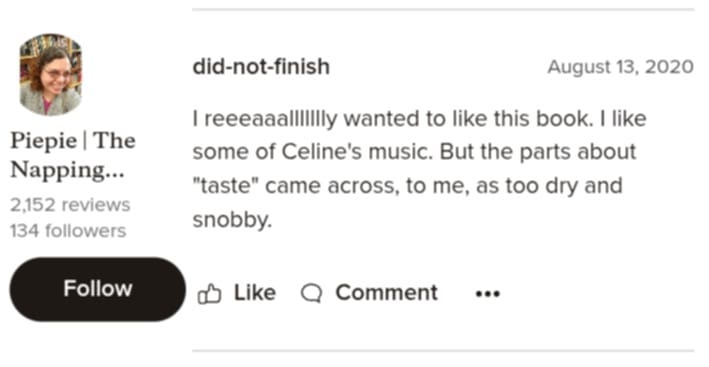
Wilson is imposing the norms of the gaze of the cultural elite in his assessment, he can’t not, and that framing still acts as class distinction, and it still alienates others outside of Wilson’s cultural milieu. By trying to cast off spite he winds up risking condescension. And while he may work to “unmask” his role in cultural production, the spread of poptimism to every corner of culture writing just proves it’s merely been adapted as yet another mode in the same process of cultural production, all to reinforce the same hierarchies. It becomes the bogus reformist rebel act that just reproduces more of the same old; the smiley face sticker over the machinations of capitalism.
It doesn’t take long to see how poptimism operates within cultural production once you take even a cursory look at any outlet that it has infected (in the following section we will point to examples from Pitchfork because they are the most egregious, but you can see it everywhere). For all of the good intentions (or Type of Guy anxieties) that drove Wilson and his cohort, the truth is that poptimism ultimately exposes its own elitist ideology, albeit one of a far more cynical brand.
The veiled elitism of poptimism.
Poptimism almost insinuates that pop music emerges fully-formed from the authentic expressions of “the people,” is predicated on their needs and desires and caters to them, and not that it is mass-produced schlock for the masses meant to keep them obedient and stupid, and by pooh-poohing any belief that stresses the importance of championing work that is more challenging or more deliberate, poptimism implies that stupid pop music is all these people will ever really understand. This ignores the fact that a better world would not be one where we all accept pop music, but one in which more people had access to the kinds of experience and education that could enrich their cultural access beyond things that are specifically made to reward shallow instant gratification. Sure, the poptimists will sometimes gesture at the lack of access to education in high art as an argument as to why their way is better (due to its alleged “accessibility”), but they lack the imagination to consider a world where such education is shared widely, nor to imagine that that would be an obviously better one.
What is deeply ironic is that these same poptimists then over-intellectualize the pop music slop they praise using the hallmarks of the exact same education they claim makes cultural “snobbery” so alienating in the first place. Just take a look at this excerpt from an appraisal of Nicki Minaj’s “Super Bass” that Pitchfork provided in their end-of-year “best songs” list in 2011:
"Super Bass" reinvents the love song as something that's never mawkish but instead contagiously gleeful. The carbonated beat and Minaj's exuberant verses find the perfect alchemy of idiosyncrasy and pop appeal.
“Super Bass” made it all the way up to #4, dozens of spots ahead of songs like “Street Halo” by Burial, “Space Is Only Noise If You Can See” by Nicolas Jaar, or “Swerve” by Shabazz Palaces. At #10 on the list, one spot above James Blake’s “The Wilhelm Scream,” was DJ Khaled’s “I’m on One.” Wow, what a… um… “populist” pick. How does Pitchfork choose to talk about that one?
The instrumental, with its atmospheric texture wedded to a memorable, addictive, slashing melodic loop, is a masterpiece of subtle confidence and understated strength that sustains through implied gesture rather than obvious show of skill. It frames some of the more evocative lyrics of the year… But it's Drake's chorus that really gives the song its power and spurs its hedonistic internal logic. As the beat's melancholy drifts along, the 25-year-old rapper mixes his past, present, and future into a heady brew.
Wow. Very accessible description. Not “elitist” at all. Love it. Thanks, David Drake.
What Pitchfork unintentionally reveals is how often it isn’t even the cultural artifact itself that is difficult, but how it is placed behind an obfuscating mask, and how the means to clearing one’s vision of it are locked up principally in the halls of higher education. If poptimists of this sort really cared about cultural equity then they could work to make their writing more accessible and help the lowly peons to gain some of their cultural education via osmosis, instead of continuing to cloister such an understanding behind said writers’ overwrought shit and pulling the items of low culture in with them instead. “I’m on One” is not a difficult piece of art to access, but the appearance that it is difficult to access is fostered by how it’s talked about. Talking about “I’m on One” in this way is, if anything, extremely insulting, because “I’m on One” is already the dumbed-down slop being force fed to the plebians, and you’re now talking about it as if even that is too smart for them to “truly” understand.
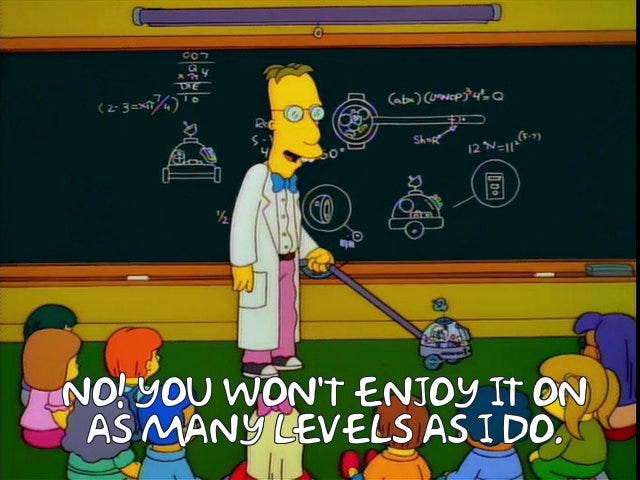
“Poor people” lacking a formal education could still probably parse the literal meaning of what is being said here if they can cut through all the purple prose. The deeper reason these descriptions might seem difficult to parse is because they are plainly not accurate assessments in any way and trying to cover for this deficit via the emptiness of the aforementioned overwrought posturing, leading to confusion when trying to figure out what the fuck they’re talking about. The instrumental for “I’m on One” is not “a masterpiece of subtle confidence and understated strength that sustains through implied gesture rather than obvious show of skill.” No it isn’t. That isn’t true.
Yet another factor worth noting in the development of poptimism is the antecedent of postmodern pop art and its derivatives, which, while highlighting what was “pop” and placing it in high art contexts, nevertheless regarded these cultural artifacts with a rather arch disposition. The ascendancy of such pop culture was framed in a dystopian light. Andy Warhol may have played the role of the superficial himbo in his public appearances, but he was secretly a very devout Byzantine Catholic who likely felt repulsed by the spiritually-empty nature of the culture around him, and works like “Marilyn Diptych” served as harsh, gut-wrenching critiques of the process of cultural production in the 20th century and what it did to its subjects. As Warhol once cynically put it: “the more you look at the same exact thing, the more the meaning goes away, and the better and emptier you feel.”
Pop culture simply did to Warhol and the pop art movement what it had already done to Marilyn (something Warhol himself of course anticipated and ironized). As Edwin Heathcote put it, pop art is about “making the banal into big art; design is about creating an image for the banal, so that it can be marketed.” The infrastructure of “the banal” digested the pop art aesthetic as its own adaptation. As an expression of this, pop music ditched the insufferable, earnest lameness of Captain & Tennille and traded it for the glossy and cool Madonna, someone whose entire schtick lampshaded its own vacuity by adopting a pop art mode about itself. Madonna has even spent most of her career deliberately invoking the image of Marilyn Monroe, the symbol of Warhol’s critique of pop culture’s hollowing effect at its apogee, up to and including simulating Marilyn’s own deathbed. By taking on aspects such as ironism and self-reference—hallmarks of high art—pop culture and pop music in particular seems to then invite art criticism to be transposed upon it as its object. And so in a sense poptimist music criticism winds up being an unwitting extension of pop art in holding pop music up in the same context. It’s just that, now, it is the Brillo box itself that is the ironist, and the one placing it in the context of the art gallery is a naïve doofus treating it with earnest reverence, like an inversion of the hapless crewman who threw Warhol’s Brillo boxes in the trash. Then, in writing about it, they retain the tone of the obscurantist art critic in turn, and reproduce the same institutions of cultural power around it all as they’ve always existed.
“The masses” would enjoy “high” culture fine if they had access to it, if it wasn’t cloistered and perverted by an educated elite for the purpose of protecting its value as cultural capital. Plenty of regular people in the Middle Ages, for instance, would have heard and enjoyed polyphonic music performed in cathedrals. What has changed is their access to it, and poptimists, whether they’re aware of it or not, are trying to take low-brow pop and co-opt it in the same way the privileged have co-opted other shit once associated with poor people, like they did with loft apartments, lobster, drag queens (we wrote about that process with drag culture here), blues music, Brooklyn, and so on. Again, it doesn’t really matter what the “thing” is in the process of cultural production that taste is attached to, it could be fucking anything. I would have told you prior to a few years ago that a Belarusian darkwave band like Molchat Doma was inconceivable as the subject of “popular taste,” but by mere viral exposure via TikTok they became an international sensation through the process of memeification. Their most popular song has over 300 million streams on Spotify now. The object of taste does not matter, it is how the object is consumed. Bourdieu identifies “popular taste” as engaging in a “systematic reduction of the things of art to the things of life,” which is the antithesis of what any poptimist critic is doing. Simply being a critic is counter to this entire process. That doesn’t mean that it’s “bad” to be a critic, just that it is by its very definition not a pursuit of “popular taste,” it is a positionality exclusively entrenched within the cultural elite.
I ultimately disagree with Bourdieu’s rather Hobbesian conclusion that taste is inherently a tool of social domination. Go back a few centuries and you could argue that literacy operates the same way as so-called “refined taste” in the very same market of cultural capital, this does not mean that the skill of literacy isn’t an inherent benefit to any person who can learn it. Cultural literacy is no different. Have you ever noticed how, very often, people you meet who grew up in certain parts of the former Soviet Bloc have a tendency to be, on average, more educated than your standard Westerner of their analogous class? That there’s a greater tendency on the whole for them to have “sophisticated” tastes in the arts? Why is that? This was achieved through not only the redistribution of economic capital, but also the redistribution of cultural capital, through a rigorous educational process and supported by countless cultural programs. This is important. Just as the redistribution of economic capital helps the downtrodden to live better lives (through access to food, shelter, health, etc.), so does the redistribution of cultural capital. A more thoughtful and engaged appreciation of the arts is a personal and societal good that leads to more enriched, deeper living and experience of the world. The ability to engage with culture is deeply important. Although it is still less important when the object of that engagement is pop music. Because pop music is bad for you.
The blatant toxicity of pop music.
Here’s where I’m really going to piss some people off.
Considering pop music with deadly seriousness, as so many music critics now do, is a bit like writing tasting notes for McDonald’s. Now don’t get me wrong, I enjoy McDonald’s—I’ll fuck up a Big Mac—but my enjoyment of Big Macs does not make Big Macs “good” and it definitely doesn’t make them “good” for me, and expression to the contrary is either in bad faith or plainly delusional. They are designed to be easily-rewarding and likable, but they are garbage. To try to sell belief to the contrary to others is in turn just irresponsible. Thinking Big Macs are as good or as nutritious as a home-cooked meal is not a matter of opinion, and if you like Big Macs more, then you are plain and simply wrong and there is something deeply, deeply wrong with you; you contain a deficit that requires addressing within yourself. We love and consume fast food because of a growing dependence on instant gratification, a lack of options induced by poverty, and an elaborate process of social conditioning.
There is a section in Clarice Lispector’s Água Viva where she describes having once had a dream about a movie star promoting a drink called Zerbino. In the dream, every time the movie star drank Zerbino everyone followed suit automatically. At one point the movie star declared that the film he was presently in, within which he was drinking Zerbino with everyone watching him and imitating him, was explicitly serving the purpose of promoting Zerbino, and furthermore that Zerbino didn’t even taste good. Nevertheless, he then drank once again from the bottle of Zerbino and everyone continued to imitate these actions in spite of hearing his declarations, they were condemned to do so automatically—“it was inevitable. Zerbino was an institution stronger than the man.” And so it is with culture. We are trained to crave the garbage they feed us. The fact is that we know this McDonald’s is not healthy, we know it has the power to kill us, but we eat it anyway, because the cultural forces have instilled it in us as habit. The cultural forces even employ irony to tell us as much but we consume it anyway because most of us have little choice to do otherwise. Many people live off of McDonald’s because their impoverishment leaves them little time to cook for themselves, and their cultural lives mirror their physical diet. Why you would celebrate this kind of impoverishment is anyone’s guess.
It’s bad for us. It’s just plain bad for us. Adorno had it straight:
In capitalist times, the traditional anti-mythological ferments of music conspire against freedom, as whose allies they were once proscribed. The representatives of the opposition to the authoritarian schema become witnesses to the authority of commercial success. The delight in the moment and the gay facade becomes an excuse for absolving the listener from the thought of the whole, whose claim is comprised in proper listening. The listener is converted, along his line of least resistance, into the acquiescent purchaser, No longer do the partial moments serve as a critique of that whole; instead, they suspend the critique which the successful aesthetic totality exerts against the flawed one of society. The unitary synthesis is sacrificed to them; they no longer produce their own in a place of the reified one, but show themselves complaisant to it. The isolated moments of enjoyment prove incompatible with the immanent constitution of the work of art, and whatever in the work goes beyond them to an essential perception is sacrificed to them. They are not bad in themselves but in their diversionary function. In the service of success they renounce that insubordinate character which was theirs. They conspire to come to terms with everything which the isolated moment can offer to an isolated individual who long ago ceased to be one. In isolation, the charms become dulled and furnish models of the familiar.
What’s worse, and also complicates much of my position, is that this system also infects a lot of what now passes for “high culture” these days, shit like “prestige” television (an oxymoron if ever there was one) which exists to sell the aesthetics of high cinema in the rewarding format of the compulsively bingeable “show” that numbs your faculties, gilded “upmarket fiction” that takes the aesthetics of capital-L Literature and marries it with cheap-o page-turner engagement, or highly-marketable “fine art” which sells a shallow and immediate approximation of sublimity, polished and removed of any friction. As Byung-Chul Han writes of the work of Jeff Koons:
It does not ask to be interpreted, to be deciphered or to be reflected upon. It is an art in the age of Like.
Jeff Koons says that an observer of his works should only emit a simple ‘Wow’. It seems that his art does not require any judgement, interpretation or hermeneutics, no reflection or thought. It intentionally remains infantile, banal, imperturbably relaxed, disarming and disburdening. It has been emptied of any depth, any shallows, any profound sense. Thus, his motto is: ‘to take the observer into your arms’. Nothing is meant to shake, injure or shock the observer. Art, according to Jeff Koons, is nothing but ‘beauty’, ‘joy’ and ‘communication’.4
Slowly, inevitably—like evolution turning everything into crabs—everything is becoming pop. Whether intentionally or not, the effect of this kind of culture is bad for us, it is cultural cocaine and it is continuously piping itself into us at all hours, shortening our attention spans and making us tired and making us weak. This constant stimulation cannot be good for us. It’s certainly not as intellectually-stimulating as other genres of music—we have studies suggesting that, on a neurological level, pop music taps into more “lower order” reward systems than something like, say, opera, and I would not be surprised to learn there are likewise some distinctions between pop music and certain forms of rock music/hip hop/country/etc. which, while nevertheless using similar structures as pop music, often lean on more complex or dissonant qualities or more thoughtful lyricism and may lead to more “higher order” stimulation. I’m not saying you shouldn’t listen to or enjoy pop music at all—I do, and, as I said, I like McDonald’s too—but let’s stop pretending it is in any way as rewarding or as fulfilling or as engaging with something heartier.5
It shouldn’t be controversial to say that the music of Rihanna is not all that deep. Yet we somehow have to put up with Pitchfork—the usual delinquent yet again—saying shit like “‘Diamonds’ added a notch of versatility to Rih’s belt for its subtlety and sentimental lyrics.” WHAT ARE YOU TALKING ABOUT??? What about Rihanna’s “Diamonds,” or any song by that woman, in any way demonstrates “subtlety”? Diamonds are “beautiful,” I guess, and her and her lover are like that? In the same article we see the complete denial of the objective fact that Rihanna’s music is made for the purpose of broad cultural appeal: “‘Rude Boy’ felt like an introduction to a brand-new artist. Before, she’d played by the rules, but something had snapped, and Rihanna now shook off any regard for other people’s opinions.” Shook off any regard for other people’s opinions? The song itself is a carefully crafted appeal to other people’s opinions you fucking moron, it is a pop song meant to be played on pop radio, it is consumer garbage. This isn’t Scott Walker pivoting from teen heartthrob to making dissonant baroque homages to Ingmar Bergman films. This isn’t even Miley Cyrus independently releasing a baffling experimental psych record without any promotion—Miley was very much dancing on the edge of complete pop career suicide with that move—those acts would be classifiable as “shaking off any regard for other people’s opinions.” Hiring a bunch of Norwegian hit-makers to help write an American-radio-friendly fake dancehall song for you to caper to as if you’re authentically expressing any semblance of your own culture was not taking any meaningful risk with regard to one’s public image. It was branding. I enjoy “Rude Boy,” but Rihanna is not an “artist.” She is more comparable to a Pop Tart. She is a cheap brand and she is junk food for your brain, she makes your brain languid and stupid, because the music she makes is languid and stupid. What’s more, she's a billionaire parasite who leeches wealth from the toil of countless peasants who exist to keep her ass high above the filth that the rest of us grovel in.
Throughout this piece I have relied on the tired writing trope of “comparing things to food,” but I do think it’s worth underscoring how consumption of food and physical health mirrors consumption of media and intellectual health. A prime difference between McDonald’s and pop music, however, is that it’s easier to recognize that the entity of the fast food company is itself evil. The people who run McDonald’s are pretty obviously evil people, there’s nobody going around fawning over its CEO Chris Kempczinski and talking about how cute and relatable he is, or speculating about his love life. But Rihanna and the rest of them—Ed Sheeran, Taylor Swift, Beyoncé, whoever—are not “good people,” they are vile exploiters of the less fortunate, they are landlords and hustlers and corporate CEOs. They are a part of the class of people who hold the rest of us down, and they participate in it willingly. Rihanna is the billionaire owner of a company that profits from child slave labour. Most of them have some hand or another in something analogous to this.

Ultimately, beyond even the ethical nature of these celebrities’ actions, Pitchfork types still know that the shit these people put out is schlock, it’s why pop songs will go on their “omnivorous” end of year songs list but pop albums seldom rank high on their end of year albums list. Music journos still ultimately revere “the album” as the highest testament to musical artistic credibility and they are still squeamish about sullying that with pop (though that move may be inevitable). We all know, deep down, that pop music is garbage, and so while poptimism may have been “victorious” it is mostly as a mode of cultural production and consumption, but not as a genuinely-held belief. Todd in the Shadows, a poptimist himself (and perhaps the only “video essayist” I watch, despite largely disagreeing with his taste judgements), made a good observation last year: in spite of poptimism’s conquest of the cultural sphere, we still understand and accept that applying the prefix “pop-” to something (aside from, say, pop-punk) is to diminish it. Pop-country, pop-metal, pop-rap, these are not labels we apply to work we hold in the same esteem as that which is not diluted by said additional preceding syllable. Kendrick Lamar calling Drake “pop” was universally read as it was intended, that is to say that it was a derisive sentiment, and, alongside the diddler allegations, it seemed to be Kendrick’s major sticking point. And the critics—most of them poptimists—seemed to agree, because they all decided Kendrick had won the feud with such ammunition. Todd for his part dubbed “Not Like Us” “a stunning defeat for poptimism,” revealing a widespread quiet acknowledgement that pop music is not equal to other forms of expression. “We don’t think that way,” says Todd, “Kendrick proved it.”
So the jig is up. Nobody really thinks pop is music of substantial artistic merit, but we’re stuck in a spiral brought about by the degraded state of culture under late capitalism and the internet, defended by the pretentious posturing of smug contrarian assholes who act like the guy from White Noise who studies the text on cereal boxes. The role of cultural curator has been surrendered by the critic and bestowed upon the mantle of the algorithm, and the local scenes suffer and die without a class of writers whose responsibility it is to champion them over the over-saturated pop slop we all already hear in the supermarket to soundtrack our bored and lifeless shuffle through aisles of processed food. But all is not lost. Not necessarily hopeful, but not lost. I think, for instance, that for a wide swathe of us, there is a desire for the return of taste in good faith.
The return of taste.
Earlier this year, Sabrina Carpenter put a new album out, and the record’s content, name, and cover all generated some serious hullabaloo. A battle erupted over whether people should take offense and what it all meant, with some taking the position that she was “setting feminism back” and some saying this was actually “a feminist statement”—but much of this debate, in its early stages, centered around questions which took for granted Sabrina Carpenter as an “auteur” and as someone who makes meaningful comments on things. This is how debates about the things pop stars do have generally gone for the last however-so-many years. This time, however, there was a very audible plea from the rest of the internet aimed directly at the writers engaging in this debate: please, for the love of GOD, shut the fuck up. Take this post by Inigo Laguda, which has thousands of likes and restacks:
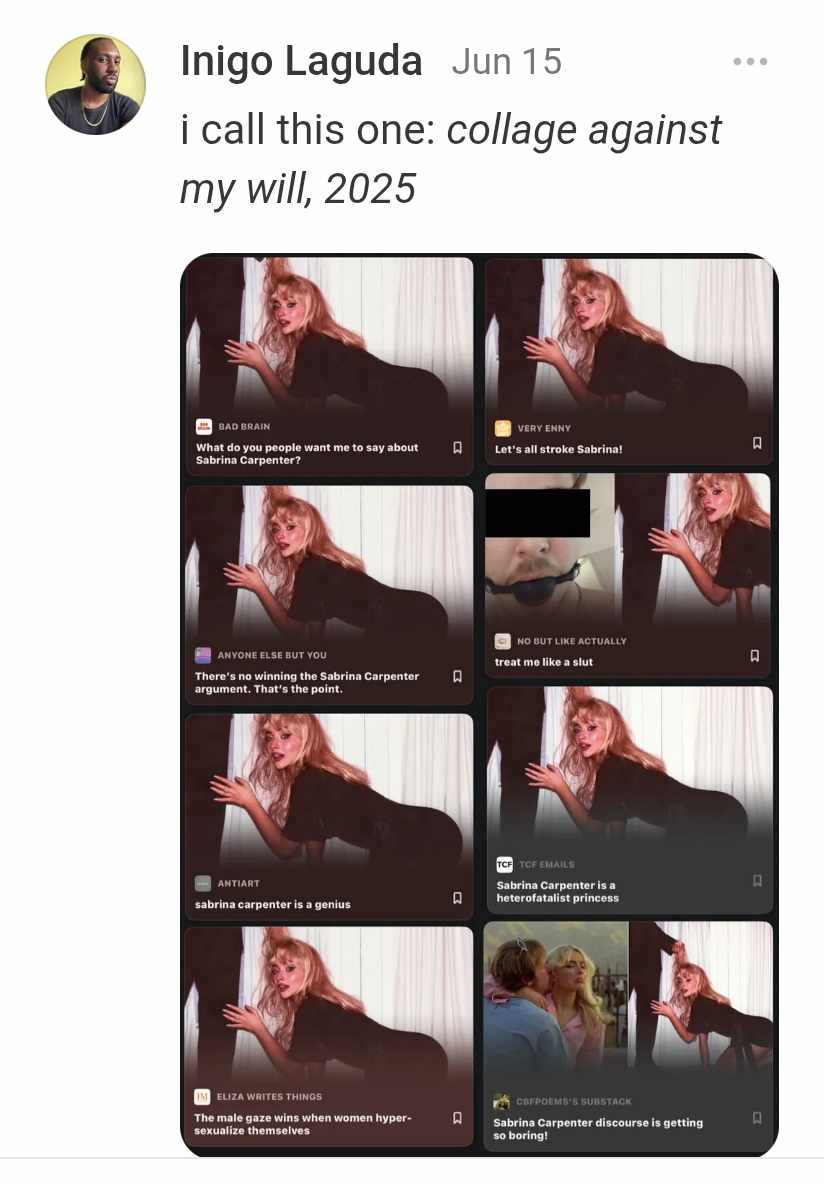
Whether the decisions of Sabrina Carpenter—or, more likely, the decisions of her label, marketing team, writers, and other handlers in line with trying to get one step ahead of the all-important algorithm, because Carpenter is a product, not an “auteur”—were feminist or not were questions that were clearly being perceived as an exhausting exercise in futility. Why does it matter so much? As Arri put it: “Sabrina Carpenter isn’t setting feminism back because she isn’t a leader or, to my knowledge, even part of the feminist movement.” But the thing is, the aura of poptimism, the justification of treating pop stars seriously, entailed taking seriously what they “say,” which makes them “leaders” in just about whatever movement you can project upon them, because if pop music is “legitimate art” then Sabrina Carpenter is not a vacuum in heels, she is an “artist,” and we have to give credence to her “message.” Except there is no fucking message. The Pitchfork writers and all of their colleagues are deluded. The only real message underneath it all is “listen to Sabrina Carpenter.” It is “let this song burrow into your brain while you shop at Old Navy and maybe its shameless over-stimulation will make you want to buy something.”
Exasperation with poptimism seems to be growing somewhat. Several pieces have arisen in the last couple years questioning its core assumptions. There is also more specifically a despair voiced about the “death of taste” and what that entails. Let’s return to deBoer, who describes the situation aptly:
Nate Patrin refers to the death of tastemakers, but what we’ve really seen is something far worse, which is the death of taste; under the relentless peer pressure that the internet enables, the idea that every individual should be in possession of a deeply personal and highly idiosyncratic taste that they are willing to go to war to defend has become deeply unpopular. In the place of taste, we have more and more people who insist that a work of art’s quality is entirely commensurate with its popularity. Which of course means that there should be no musical criticism or appreciation at all, just a single sad counter that tells us how many times a song has been played.
We have expanded on this same topic in the past, with regard to how this death in taste is in turn helping to kill the art that is its subject:
We are living in an era of aesthetic nihilism. Nothing is true, so everything is permitted. But if nothing means anything—if nothing has any relative “value” next to anything else, and everyone’s taste is valid—then why try? Why spend your time obsessing over your creation? After all, it’s just as valid as anything else… Don’t you WANT to live for more than that? Don’t you WANT to see your work as the expression of something worth taking preciously? …without a set of aesthetic principles, everything else is doomed to become pastiche.
But herein, amidst all these screeds, lies an ember. Poptimism is helping to hold down not just music but culture more broadly, as its values corrupt the qualifications of all adjacent forms of expression. It was created by a series of factors outside of our control and upheld by quite a lot of people with good intentions (as well as just as many or more with some bad ones), but there is a will to escape from all of this, and there are more and more writers voicing it. There is an ember, and all it needs is a dry place to be nurtured. In this hearth something can be made. Perhaps not much, but something, some sort of respite. And you, reader, maybe you too want something more. That alone can be enough.
LIKED THAT? THEN PERHAPS YOU’LL LIKE OUR PIECE ON THE TAYLOR SWIFT PHENOMENON IN PARTICULAR:
Taylor Swift: Immaterial Girl

Madonna's humanity was available to us through its inversion: the material of the Material Girl was a façade, and with enough licks one might find the real girl at its center. The presence of humanity was implied among the plastic. Swift, by contrast, is the Immaterial Girl. Sincerity and authenticity is her primary marketable gimmick. And that's dangerous.
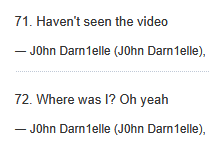
And who can forget John Darnielle’s thread on “100 reasons why ‘Ignition - Remix’ is so good,” in which the Mountain Goats frontman absolutely bit off more than he could chew and just started naming every comment he made in the thread as another “reason.”
In a piece for WaPo back in 2015, aptly titled “Do You Want Poptimism Or Do You Want The Truth?”, Chris Richards, in a moment of wishful thinking, said the article worked “to slay poptimism once and for all.” That, uhhh, sadly did not happen. Instead, writers like Maura Johnston at Vice flayed Austerlitz alive and insinuated that he was a sexist dickhead and compared him to a “men’s rights” activist. Preeminent jazz critic and historian Ted Gioia had likewise written a piece critical of poptimism around the same time and was likewise lambasted in Pitchfork for being “inflammatory, frustrating” and “wrong-headed.”
For my part, I believe Jeff Koons’s entire schtick is an elaborate satire, and I’ve touched on this in a previous post (which also happen to deal with pop music). That said, I can’t deny that the success of this satirical façade is owed to what Han describes, itself I believe an unacknowledged element of the whole satire.
I made a friend of mine who has worked as a cognitive scientist read over this section for me to double-check and clarify my readings of the linked study. Maybe you have a similar background and take issue with those conclusions. I will simply smile and nod in response.
I initially had a lengthy section about Sanneh's watershed article, "The Rap Against Rockism," the moment most point to as representative of the decisive turn against rockism, which I critiqued in-depth and then compared to his frankly almost wistful recent piece "How Music Criticism Lost Its Edge," but I really don't think I could afford to go on any more tangents.
Attentive readers will notice a confusing pattern emerge in the work where it seems as though the definitions of terms, or the contexts they are in, springboard around a lot. For instance, I rail against championing easily-digestible pop as being as valuable as something more difficult or complex, and then I later argue that cultural items are not necessarily so difficult as the way they are presented, which would imply that so-called "difficult" work is, in fact, as "easily-digestible" as anything else (the Molchat Doma example exemllifying this in the inverse, where a pop context turns something "difficult" into pop). I noticed this impression on my last read through last night but didn't want to awkwardly shoe-horn anything more into what was already more than a bit messy, so I am going to attempt to clarify some of that here instead.
First: I think it is NOT AS difficult to begin the contemplation of a work as the discourse surrounding it often makes it seem. The challenges of reading something like Ulysses for instance are not insurmountable. Second: I think that something like TikTok takes something like Molchat Doma and places it in a pop context, a meme context, whatever, and it IS through this process nevertheless degraded (like various motifs from works of classical music taken out of context in pop culture, or images of the Mona Lisa or the Sistine Chapel or whatever), but it does at least expose (as those other examples do) the base ability of most people to appreciate the beauty of these cultural items, even in their degraded context.
Excellent article. I see a similar situation with fiction, although I couldn’t speak to it as fluently as you have with the state of commercial music.