



Read a rather terrifying piece in GQ by Josiah Gogarty the other day, describing the Soho launch of something called The Toe Rag, an apparently hip London literary mag. The place sounds like it was positively stuffed to the brim with the Gentrification Vanguard. As Gogarty puts it:
Magazines like The Toe Rag and New Papers; reading series like New Work, Adult Entertainment, Deleted Scenes and Soho Reading Series—these are, increasingly, the institutional glue via which the city’s arty, cool, young(ish) community networks, parties and hunts for romantic partners.
What Gogarty describes is the kind of literary event where you might find hapless fashion victims wearing awful straight-cut vinyl trousers with the texture of garbage bags, in fluorescent orange and shiny forest green camo, draped over either jacked-up block-heeled boots for the vertically-challenged or perhaps heeled dressy sandals over magenta-coloured socks. Like here, in this photo of Toe Rag launch attendees that I’ve cropped for you:
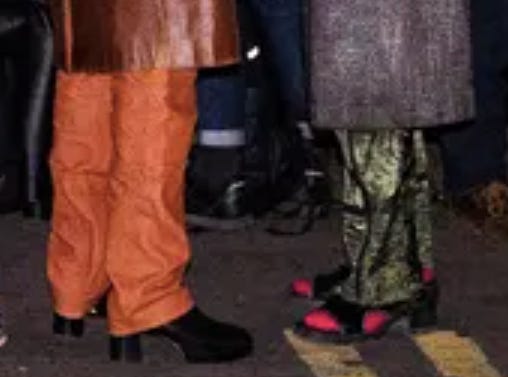
Wow… you guys look like shit... Ew. <3
After describing the bacchanalia found within the venue’s walls, where hot rich kids frolic in timely knitwear-centric outfits their children will laugh at them for and read each other poetry, Gogarty is left wondering: “Was this cool? It slightly felt like it was.” From Gogarty’s description I can conclude the answer was……. maybe. I shivered with both visceral dread and simultaneous painfully-embarrassing FOMO. Apparently the scene over there is blowing tf up. The Soho Reading Series sold five-hundred tickets to their Summer Gala. Five-hundred tickets! FOR A LIT EVENT!!!
Gogarty also comments on a few other notable developments, such as the literary collaborations put out by Dior, Saint-Laurent, and Miu Miu, as well as the apparent war for literary credibility going on in the online dating game between Hinge’s story-driven ads penned by contemporary fiction writers and Feeld’s own literary magazine (…what). I’ve been watching a number of similar developments with nail-biting anxiety: Ottessa Moshfegh put out some short stories for Prada. Ocean Vuong collaborated with Helmut Lang. KOTN did a whole line inspired by Black Mountain College. Dua Lipa has been repping Charco Press. That oh-so-tiresome Dimes Square scene1 has been heavily marked by its literary output, and of course here in Montreal you can’t walk down the fucking street in Mile End without tripping on a magazine launch. I’ve been startled to see the recognizable cover templates of books from NYRB Classics, both vintage Penguin and modern Penguin Classics, and Fitzcarraldo Editions being wielded as accessories. Discordia itself was recently tapped to do an event with the Montreal/New York-based Scatterbrain Magazine, which from my understanding mostly deals with fashion—and don’t get me wrong, I’m happy to do it, but as a general trend taken altogether I don’t really know how I feel about all this. Good? Bad? Numb?
The other arts have always felt a bit of comparison anxiety next to literature. To be compared to a poet or novelist is ubiquitously considered a sign of praise—it reflects a degree of depth and complexity that we clearly seem to think (whether true or not) is particularly endemic to literature. This sense seems to only be growing, and seems to be in direct proportion, interestingly enough, to rising illiteracy. Why did Taylor Swift refer to herself as “your English teacher” rather than the thing she actually does—you know, music? Why is her music suddenly riddled with references to Daphne du Maurier and Shakespeare?2 Why has Taylor stopped trying to reference Bon Iver for cred and moved on to referencing Dylan Thomas? (If nothing else it got Maggie Nelson to join her angelic chorus.)
Interestingly, I think Taylor was also a contributor to the shift itself, though not in the way she might have hoped—because Taylor Swift helped nail in indie rock’s coffin lid. Hoping that she might be able to gain artistic credibility by latching onto people like Aaron Dessner, Taylor largely accomplished the exact opposite, because, beyond a couple of airheaded cheugs, the move mostly worked to sap credibility from the artists Taylor collaborated with in the eyes of most hipsters I know. Indie rock had, of course, already been greatly on the wane for at least a decade, propelled by terrible “post-indie” radio acts like Hozier or Imagine Dragons, artists who may still make a ton of money but have nevertheless made the idea of “listening to indie music” no longer prima facie “cool.” And so something new had to be latched onto that could present one as being “outside the mainstream,” because the locus of hipster life is the exclusion of the outsider. It is by its very nature “exclusive.”
The erosion of indie rock’s cultural cachet was met with three primary aesthetic responses among hipsters in the last few years. The first was the rise of PC Music and later hyperpop, which seemed like the most obvious big shiny Next Thing to grab hold of. This was of course doomed from the start, because said movements just sort of front-loaded themselves with a structural defeatism, a resignation if not outright desire to eventually leak into the mainstream musical culture they were satirizing with their exuberance (and this process is of course already well underway). Second was a retreat into dissonance—turning toward harsh noise or black metal, because surely these sounds were too dissonant and unmusical to commercialize… right? I think many people would be surprised. As Brent DiCrescenzo3 reminded us in his absolutely classic (and hilarious) review of Nine Inch Nails’ The Fragile, we now live in “a pop society that has become numb to industrial sounds through ESPN2 and Surge commercials,” the sounds of musical extremity will always resort to becoming the sound effects of the basest and most embarrassing elements of macho culture with enough saturation—so this path is doomed from the start too, it’ll just take a little longer. The third route was to post-ironically accept something extremely cheesy and lame like, say, heartland rock, because something like REO Speedwagon has already been run through by commercialization decades ago—in fact was effectively so in its inception—and is too spent to be meaningfully re-coopted in the way that these guys consume it. This is probably the actual safest bet of the three. Still, you never know where the vicissitudes of TikTok will go, next thing you know a bunch of broccoli-headed normies are crawling all over your precious Bob Seger because twenty seconds of “Mainstreet” became stock background music for OnlyFans girls to jiggle their tits to, and what then? Which Way, Hipster Man?4
The meta-conclusion? Just don’t play the game. Music at this point is not a safe bet for cultural cachet, because your whole spot could get blown up in an instant, and then it’s all over in seconds. I’m making fun of the people who care so deeply about this, but I also do get it. The first time I went to a Molchat Doma show it was incredible. The second one was the worst show I’ve ever been to in my life, because by that point Molchat Doma had been so thoroughly memeified on TikTok that a ton of zoomers showed up “for the meme” and the whole thing was ruined. It was hard, as someone who had been listening to Molchat Doma since that fateful YouTube upload of their album got picked up by the Music Nerd Algorithm, to not feel indignant about it all. I remember when Pitchfork called The National the ultimate “underdog” band. Now their members collaborate with Taylor Swift. It sucks when a cool thing you like, something you felt you had some intimacy with, goes mainstream! I get it! It’s a totally sympathetic experience! Our relationships to cultural products that seem niche feel like they are “our” special thing, and then when a bunch of people latch onto it, that feels bad.5
Because the barriers to listening to certain music have been effectively shattered by stuff like TikTok, because it takes very little effort to listen to twenty seconds of a song and like it and virtually any song can be pulled into the mix, betting on your music taste to keep you cool and relevant or forge your countercultural identity is now a little like investing all your money into a business operating out of one of the most politically-unstable countries on the planet. You have to find something else. But what provides a safe investment now? It has to be something that can maintain its inaccessibility to the “normies” in the face of open internet access to basically everything and the ability of social media to channel that everything to a wider audience. Well, in a world where fewer and fewer people can read (spend more than five minutes browsing r/teachers and you might start hyperventilating whenever you think about the future), the answer is probably to get into literature. It requires all the traits most people now have a pronounced absence of! Fuck music! Music is washed! It’ll never be cool again! We read books now!
Maybe this is… good? I mean, yeah, a lot of what I described above does feel senselessly cynical and cheap, but like… if reading is “cool” then… maybe we can save literacy? Maybe we can get people to read again in the process?
…
Except that we live in the world we live in, which is a techno-capitalist neoliberal hellhole, so we will probably get some AI app instead with a subscription service that reads books for you and makes them into like… TikTok post infographics or something. I see a pale horse! These people will not read and if they do read they will do it badly and they will not get better at it because that’s not why they’ll be doing it. And then they’ll all just find something else to do for clout.6
Ross Barkan believes Mamdani may have “killed” Dimes Square though I believe we have yet to see the ugliest monstrosities which will spawn from the fruit of that tree.
Yes, yes, she had a Romeo & Juliet reference early on in her career, but that’s barely a Shakespeare reference. It recurs as a reference mostly disconnected from its source material throughout pop culture—and, infamously, Swift’s song doesn’t even reference it properly. Referencing Ophelia from Hamlet is a different matter entirely. Though she still fucks it up and it sort of seems like she’s confusing Ophelia at points with “The Lady of Shalott.”
Yes, there’s also been retreats into jazz or outlaw country, but I had fewer jokes about those and the bit was already running too long.
Here’s one for my Toronto readers: yeeears ago one of my favourite bars in Toronto was Cold Tea. Talk about normies completely ruining something sick.
Sire: I think you were maybe just 19.
P.S. I bought and read an issue of Toe Rag. S’alright. Was sort of reminiscent of “Golden Age” New Yorker but with a more ultra-contemporary aesthetic.
Aron's comment is quite insightful, because much of what you are describing is the loss of the private self. Our self-surveillance culture demands that we turn everything into public spectacle, all for the financial and cultural benefit of tech moguls. Having a genuine experience with art, most especially literature, requires solitude, in practice and acceptance.
Simultaneously, the death of the private self in favor of the a public "brand" spells the end of cool. When I asked David Jemilo, the owner of the Green Mill jazz club in Chicago, for his definition of "cool," he said, "Whatever it is, if you're trying too hard, you ain't it."
Social media insists on everyone trying "too hard" all the time.
Here's how I have held on to music: I play it. Privately. For myself and my family.