

Reading Samantha Harvey's 'Orbital' will make you a liberal (pejorative)
The 2024 Booker winner is crypto-centrist propaganda


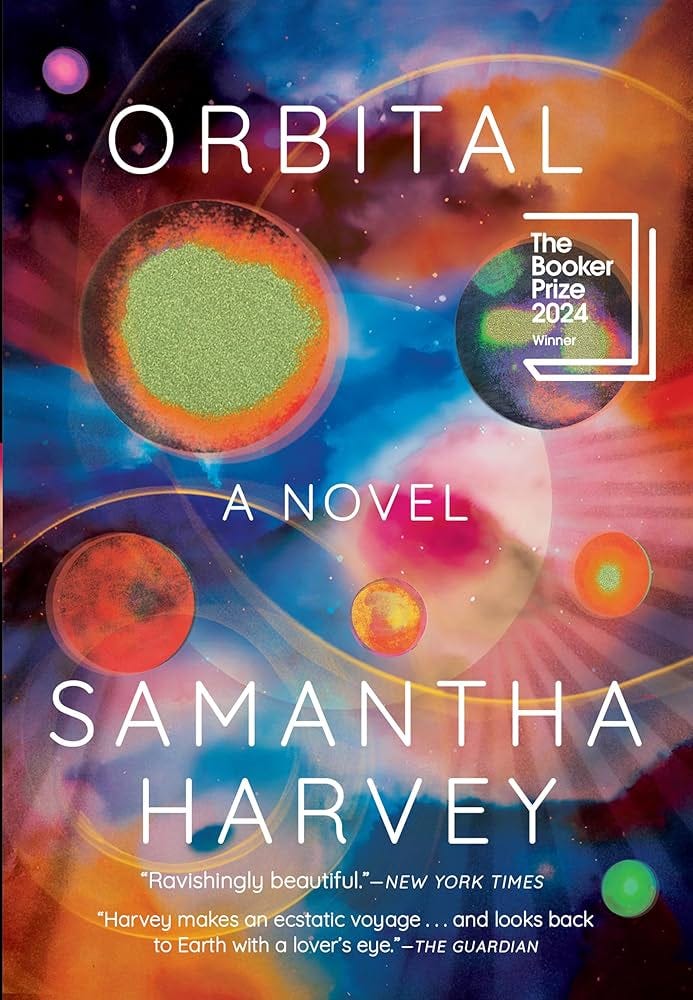
Orbital
Fiction by Samantha Harvey
Jonathan Cape, 2023
Reviewed by DJ Sandler
In 2024, upon winning the Booker Prize for her book Orbital, Samantha Harvey dedicated her award to “all those who speak for the Earth and not against it; all those who fight for the Earth and not against it.” Among the ranks of people who believed they were fighting for the Earth and not against it we might include Martin Luther King Jr., Ronald Reagan, Tony Blair, Elon Musk, Vladimir Lenin, and Jesus Christ. This sort of language, which affects an aesthetic of progressive politics but lacks its substance, is not confined to Harvey’s speeches: it is also an essential component of Orbital, which details 24 hours in the lives of six astronauts aboard the International Space Station and is riddled with platitudes about our collective humanity. The book has received near-universal acclaim: Alexandra Harris of The Guardian writes: “Russian, Japanese, American, British, Italian: [these astronauts] offer themselves as emblems of human cooperation,” and James Wood of The New Yorker describes Samantha Harvey as “writing like a kind of Melville of the skies.” Personally, I think that the best encapsulation of Harvey’s prose is a quote from Orbital itself. In a reverie about Carl Sagan’s Pale Blue Dot, Harvey writes, “Every single other person currently in existence, to mankind’s knowledge, is contained in that image; only one is missing, he who made the image. Anton has never really understood that claim…in truth, nobody is in that photograph, nobody can be seen.”
In Orbital, Harvey sets out to render all of humanity from the Philippines to Cape Town to the Irish countryside—to restate the clichéd premise that all of humankind is a family, that we’re not so different after all. But, in practice, Harvey leaves out the very humans she seeks to portray: though her writing thrives when she describes landscapes, it falls flat whenever she considers her characters. These shortcomings largely stem from Harvey’s poetry-prose stylings, which serve to make her protagonists’ realities abstract. She continually schematizes the astronauts’ thought processes and describes their relationships with each other and the Earth without any physical grounding. She seems to delight in making language intangible, in using abstract similes and metaphors, and generalizing concepts like war and climate change to the point of vacuousness. Harvey is far from patient zero of the poetry-prose epidemic: her contemporaries (Kaveh Akbar, Ocean Vuong) are also attracted to vague similes and clichés, and also use these devices to Weekend at Bernies their inert books to life. But while Akbar and (even more so) Vuong have their detractors, Orbital has been met with universal praise. One has to wonder why at a time when the literary world was turning on poor Ocean, Harvey’s book was lauded as the single best English-language novel of 2024.
It is a shame that so few critiques have been made of Harvey’s writing, for it is rife with clichés and vagueries—empty language used to cover for its lack of true humanism. Take, for example, Harvey’s fixation on the novel premise that the Earth is, if you really think about it, a bit like the mother of humanity:
…the earth [sic] is a mother waiting for her children to return…
They look down and they understand why it is called Mother Earth.
…[her] only mother now is that rolling, glowing ball that throws itself involuntarily around the sun once a year.
Maybe there’s another parent planet—earth [sic] was our mother and Mars, or somewhere will be our father.
Repetition can be an effective literary tool, but what Harvey chooses to repeat is arbitrary and insubstantial, and she does little to augment, complicate, or reconsider those clichés she is so ready to reiterate ad nauseum. This device reveals nothing about the astronauts and nothing about the Earth; rather, it serves as a neon sign reading Theme Here, a sign which we markedly do not need in a book whose plot is essentially: six astronauts look at the Earth. Instead of fleshing out her characters and their relationships, Harvey leans heavily on thematic and “poetic” language which sounds nice but is essentially devoid of meaning. Harvey doesn’t always pull her metaphors and similes out of a phrasebook, though. From her mind we get such gems as, “Raw space is a panther, feral and primal; they dream of it stalking through their quarters,” an instant cliché that, for some reason, the author still finds it necessary to explain after the fact. (What then, we might ask, is the point of a simile?) Or, “a person is not beautiful because they’re good, they’re beautiful because they’re alive, like a child”, which brings to mind Shakespeare’s famous quote: “Shall I compare thee to a day, because a day is beautiful because it is like a summer’s day?”
All this said, the presence of inane similes and repeated clichés isn’t disqualifying on its own—rather, it is Orbital’s superficial pretense of humanism and lack of depth which raises my hackles. Orbital is rooted in an aesthetic of meaning but says nothing of substance. Throughout, Harvey writes about her characters with dripping sentimentality to obscure their obvious one-dimensionality. An example of the cloying yet deeply impersonal conversations which take place aboard the ISS:
Do you know what I’ll look forward to getting back to, when the time comes? he says. Things I don’t need, that’s what. Pointlessness. Some pointless ornament on a shelf. A rug.
Roman laughs. Not alcohol or sex or – just a rug.
I didn’t say what I’d do on the rug.
True, Anton says. You did not, and don’t please.
What would you do? Nell asks.
Chie winks. Yes, Pietro, what would you do?
Lie there, Pietro says. And dream of space.
I’ll give Harvey credit here: there is a romance to the idea of a character returning from space only to lie on the rug, continuing to dream of his celestial journey. This idea becomes markedly less romantic, however, when “space” is all there is to him—given how little interiority Harvey gives Pietro, it would be surprising if he did anything other than dream of space. Taking a cue from the large number of lists in Orbital, I’ve compiled what the reader knows about Pietro by the end of the novel:
He loves space
He has a daughter
He went to the Philippines for his honeymoon
He is a nice man1
Lists play a surprisingly large and unsurprisingly arbitrary role in Orbital. Just as “niceness” and “the Philippines” serve to characterize Pietro, so too does “list making” serve as characterization for the Japanese astronaut, Chie (some examples of Chie’s lists: Reassuring Things, Surprising Things, Maddening Things, etc.). Even the use of “thing” here demonstrates Harvey’s refusal to deal with the physical world, and the undefined and non-committal nature of the book as a whole. Harvey describes Orbital as a space pastoral—indeed, every beautiful passage in the book is either a depiction of Earth from above or a description of the mundane activities which the astronauts and cosmonauts partake in aboard the ISS. But even these moments are marred by empty questions and Harvey’s indecisive writing style. For instance, this description of a spacewalk Nell, the Irish astronaut, goes on:
She was outside for hours – almost seven, so she was told. You have no idea at all of the passing of time. You install or repair whatever you are tasked to install or repair; you photograph some of the hatches, the external tools, you do a litter-pick of debris, plucking from space a few of these tens of thousands of remnants of jettisoned or exploded satellites and launch-vehicle stages and craft; wherever mankind goes it leaves some kind of destruction behind it, perhaps the nature of all life, to do this.
Putting aside the vagueness of “whatever you are tasked to install or repair” here, Harvey demonstrates her ability as a choreographer. She puts Nell in a specific location which is visually comprehensive and brings the reader in beside her. Then, pulling the rug out from under the reader, she retroactively tacks a moral onto Nell’s spacewalk, though not a definitive one: the amount of times Harvey writes “maybe” or “perhaps” makes perfectly clear how little conviction she has in her own aphorisms.
In addition, the second person (as seen above) is used as a synecdoche throughout Orbital, though not in the way that I believe Harvey intends. Harvey’s intent in using the second person is evident in the context of Orbital’s constant moralizing—the “you” serves to put the reader in the shoes of these astronauts, to show that we aren’t so different after all. But the second person also offloads the work of creating characters onto the reader, insisting that we backfill these empty shells of people with our own hopes and dreams. Instead of showing that we are all similar, the second person shows how easy it is for us to pin our personal desires onto empty vessels—how easy it is to write on a blank page.
Every one of Orbital’s astronauts is a series of signifiers and shortcuts. Early on, Harvey writes,
They have talked before about a feeling they often have, a feeling of merging. That they are not quite distinct from one another, nor from the spaceship. Whatever they were before they came here, whatever their differences in training or background, in motive or character, whatever country they hail from and however their nations clash, they are equalized here by the delicate might of their spaceship. They are a choreographing of movements and functions of the ship’s body as it enacts its perfect choreography of the planet. Anton – quiet, and dry in his humour, sentimental, crying openly at films, at scenes outside the window – Anton the spaceship’s heart. Pietro its mind, Roman (the current commander, dextrous and capable, able to fix anything, control the robotic arm with millimetre precision, wire the most complex circuit board) its hands, Shaun its soul (Shaun there to convince them all that they have souls), Chie (methodical, fair, wise, not-quite definable or pin-downable) its conscience, Nell (with her eight-litre diving lungs) its breath.
This is a perfect example of Harvey’s inability to do more than sketch her characters. She distills her protagonists into a series of attributes, a list of adjectives, but only rarely is she willing to consider their actions (and even then, only to reinforce those attributes she has already given them). Harvey’s claim that space collapses these characters into one being is ineffective as she has provided very little differentiation to collapse. It’s fitting, too, that in this paragraph each character is described as a body part, for none of them are full-fledged human beings. Each astronaut stands in for their function, both in the spaceship, and in the text.
Harvey’s heart is clearly in the right place in critiquing the inanity of war, the malignity of borders, the importance of coming together despite differences of nationality, religion, ability. But in having these astronauts stand in for their countries in a project of universalism, the astronauts and cosmonauts become nothing but their nationalities. Instead of transcending borders, Orbital reinforces them, so much so that in reviewing the book, it is necessary, for lack of other notable characteristics, to distinguish the astronauts by their home countries.
While I think that Orbital is undeserving of critical acclaim, the book’s vague language and humanist aesthetic make it more than just a mediocre book (albeit, one which describes the Earth beautifully). Rather, Orbital serves as a vehicle for expressing a Western centrist agenda— the one espoused by US Liberals, the current UK Labour party, and the Renaissance party of France among others. Harvey’s characters are the perfect subjects for these centrist ideologies—they are empty, easy to cast in over-simplified narratives about race and nationality while ignoring the complicated realities of colonialism and poverty. Harvey repeats over and over the liberal party line: all human beings are the same and what is good for one is good for all. In Orbital conflict exists without a cause: it is no different than the hurricane which the astronauts watch passing over the Philippines. Harvey’s greatest political enemy is the concept of evil, and her politics are vague, moralistic, and unimpeachable (war is bad, racism is bad, climate change is bad, we are all a family).
In this way, Orbital and its cohort mimic the self-congratulatory nature of center-left parties, allowing its reader to feel a sense of moral superiority while believing only in vagueries. This sort of liberalism is notably non-humanist, as it turns political struggles into internal ones; it turns the consideration of others into a consideration of one’s own virtue. And reading books like Orbital makes liberals out of us all. Harvey evinces a worldview where anyone can cast themselves as the hero. Take for example, the quote above which describes each astronaut as a part of a body. The issues with this quote don’t end with its ineffectiveness—Harvey is essentially restating a political vision created by Mussolini. Fascist corporatism viewed different corporate groups as part of a body which worked together to forward the interests of the tyrannical state. The fact that Harvey’s writing can affect an aesthetic of humanism, while staying palatable to those who maintain the most brutal political ideology there ever has been is further proof of the emptiness of her language.
This strategy runs parallel to the center-left rhetoric so popular in the West now. Liberal parties increasingly rely on vague, moralistic language to obscure their hypocrisy. Each of these groups claims to be their country’s peace party while supplying aid to genocidal regimes and committing massacres abroad (Gaza, Yemen, place a pin anywhere in the Middle East and you’ll undoubtedly hit the site of a bomb dropped by a Western liberal powers). How do they do this? These parties abstract the idea of “war” to the point of meaninglessness, where one can be against the “war” that Hamas is waging against the Israelis while supporting the “defense” of Israel against Hamas. They can cry “racism” whenever it’s convenient and simultaneously take money from corporations like Amazon, Uber, and Google whose racist practices are well-documented. These abstractions are so ubiquitous it’s no surprise we find them in our literature and that books like Orbital are propped up by our mainstream literary institutions as timely and humanistic. This is not to say that Samantha Harvey is attempting to justify Western evils—I have no doubt that she is well intentioned, no doubt that she believes in the power of peace, the power of cultural exchange. But because Harvey espouses these ideals in a way so abstract that nobody’s actions could possibly be challenged, all her moralizing is arbitrary. Harvey lives in a world in which we are all subjects, she writes, “And now maybe humankind is in the late smash-it-all-up teenage stage of self-harm and nihilism, because we didn’t ask to be alive, we didn’t ask to inherit an earth to look after, and we didn’t ask to be so completely unjustly darkly alone.” And this is the whole problem with Orbital. What Harvey needs to understand is that in the real-world human beings can be actors; that when we talk about exploitation, climate change, and war, these are not instances of humanity angstily or accidentally shooting itself in the foot, rather these are imperialist decisions made for monetary gain. With Orbital, Harvey flattens humanity to the point of exculpating those most responsible for our current situation and, in doing so, overlooks the fact that we do not all suffer equally for the injustices of the few.
—DJ Sandler
DJ Sandler is a writer living in Brooklyn. He is currently working on his first novel. Follow him on Substack.
Mona Gendron's alien stories posit untelligent life on other planets

These are, quite frankly, the filthiest abduction narratives we have ever read.
Shown to us through the naturalized perspective of a Filipino fisherman, a stand in for all those underprivileged enough not to live in the global North. A quote from Nell, one of the astronauts aboard the ISS who has also been to the Philippines: “the people are amazing…so warm and open” would be equally well suited for a teenager returning from their voluntourism trip in some impoverished country in the global south.
Thanks for this review. It effectively articulates what I found so flat about Orbital: the repetitive, clunkily poetical prose; the barely-there characters; the empty paeans to Our Shared Humanity as a substitute for actual emotion.
I was genuinely baffled not only that Orbital received such rapturous praise, but that Harvey wrote such a shitty book. The Wilderness, Dear Thief, and The Western Wind are all sharply written novels with well-defined characters and sustained narrative momentum. The Western Wind in particular has one of the most creative temporal structures I've encountered in a work of recent literary fiction. It's hard to believe that the same author was responsible for Orbital.
I guess I shouldn't be surprised that Harvey's critical breakthrough came from a piece of weakly written centrist pablum rather than, you know, a good book, and I don't know whether that was a cynical calculation on her part or she just got lost in the sauce and/or lobotomized, but still, sad to see. Her other novels are worth checking out, anyway.
Such a clever, well-done and totally damning review! I am so tired of these treacly “humans are awesome” tree-killers. Thanks for the expert commentary. May I use it in my editing class? I keep telling students that characters need depth, need to be portrayed as imperfect and occasionally nasty, even if the writer feels they are themselves nice. Because we aren’t.