



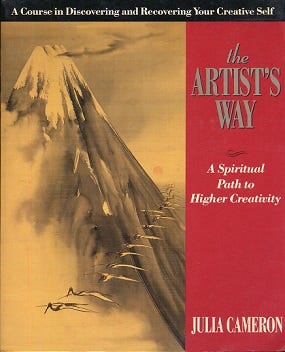
The Artist’s Way
Nonfiction by Julia Cameron
TarcherPerigee, 1992 (Publisher’s Site)
Reviewed by DJ Sandler
The Artist’s Way, Julia Cameron’s best-selling self-help book for aspiring creatives, is having a resurgence. With the advent of TikTok and the boredom and self-isolation of COVID, the past six years have brought an influx of readers to the 1992 handbook which claims to cure “artist’s block” and to free “shadow artists” from their non-artistic purgatories. Cameron’s new and groundbreaking theses are:
that everyone has the capacity to be the artist.
that to be an artist you have to continually do art.
But I didn’t know anything about Cameron’s project when I picked up The Artist’s Way. What I did know was that many of my more artistically inclined friends found the book transformative and, after going through Cameron’s 12-week program, began to look at their art differently. My friend did the artist’s way, and it totally changed her life, I would hear. I’m in an artist’s way group and now I’m writing like I’ve never written before.
Obviously, I had to try it. So, I joined two close friends in an Artist’s Way group and took up the 12-week program hoping to further my creativity and with the expectation that I would come out of the book transformed, overflowing with artistic enthusiasm. What I got instead were 200 pages of batshit ramblings, promotional material for the Julia Cameron brand, and inane therapy-speak. The Artist’s Way has caused many people I love and respect to ask questions of themselves that advanced their artistry. The only question I came out of the book asking was: how is this not snake oil? How could this book possibly work for anyone?
While a terrible self-help book, I wouldn’t call The Artist’s Way a bad book. When read all at once, The Artist’s Way takes on the feeling of an avant garde novel in the way that Cameron’s insanity is revealed to the reader over the course of twelve chapters. Take, for example, Cameron’s claim that if you are an artist, you are in direct conversation with God. Even atheists, she claims, are in conversation with G.O.D.—Good Order and Direction:
The heart of creativity is an experience of the mystical union; the heart of the mystical union is an experience of creativity. Those who speak in spiritual terms routinely refer to God as the creator but seldom see creator as the literal term for artist. I am suggesting you take the term for creator quite literally.
Being a creator like me brings you closer to God, Cameron says, and she spends much of her book trying to convince us of her godliness—The Artist’s Way is bogged down with low impact anecdotes of strangers approaching Cameron to tell her how amazing she is. The entire introduction of the 25th anniversary edition is a conversation between Cameron and a stranger at a café. “‘Oh my god,’ [the stranger] exclaims, ‘your book changed my life. It made me a novelist…I bet you hear stories like mine all the time.’” After the woman goes on to laud Cameron’s work for a page, Cameron happily agrees to sign a copy of The Artist’s Way for her boyfriend: “I ask his name and write a simple phrase, ‘May our words be friends.’” The Artist’s Way is filled with inanities like this, including continual invocations of God and comparisons between artists and prophets, which make Julia Cameron’s outsized ego a centerpiece of the book.
In Cameron’s claim that artists are conduits to God, she also implies that if you are not a creator, you are further away from divinity. Working two jobs and you’re too exhausted to spend your off-hours writing a novel? You’re a godless heathen. Living in poverty? Don’t have computer? These are just excuses. Simply have no desire to write a book, movie, or play? FALSE. You are a “shadow artist”, a coward, a plague on all of your friends. Don’t take it from me, take it from Julia. When comparing couples therapy to artist dates—a homework assignment in which readers are asked to spend a few hours each week experiencing art alone—Cameron writes:
“Do you spend quality time with each other?” troubled couples are often asked by their therapist…Do you go on dates? Just to talk? Just to listen to each other?”
“Dates?...But we’re married, too busy, too broke, too—”
“Too scared,” the therapist may interrupt. (Hey, don’t sugarcoat it.)
It seems doubtful that a couple’s therapist would compare a couple’s monetary problems to cowardice, but it’s completely believable that Julia Cameron would. Cameron talks constantly about money, although she seems to have no practical awareness of it:
There are as many ways to avoid [going on an artist’s date] as there are days of your life. “I’m too broke” is the favored one, although no one said the date need involve elaborate expenses…a visit to a great junk store, a solo trip to the beach, an old movie seen alone together, a visit to an aquarium or an art gallery—these cost time not money.
We cling to our financial concerns as a way to avoid not only our art but our spiritual growth. Our faith is in the dollar. “I have to keep a roof over my head,” we say. “Nobody’s going to pay me to be more creative.”
All too often we become blocked and blame it on our lack of money. This is never an authentic block.
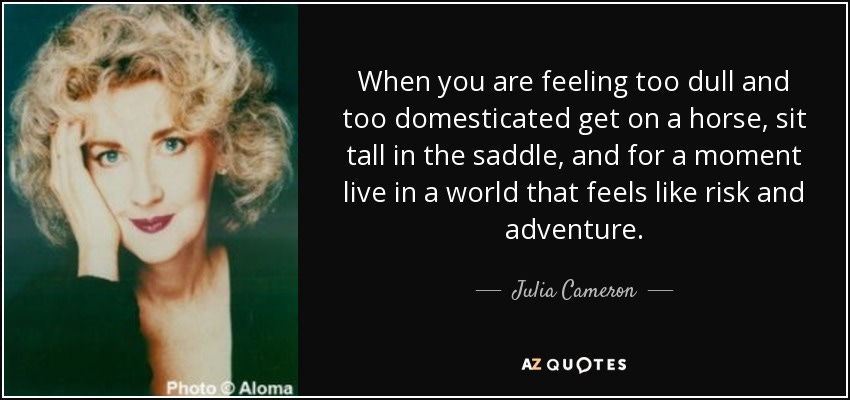
One of my friends is a world-famous artist…Nonetheless this is an artist suffering in the throes of artistic anorexia…Because he has denied himself luxury. Let me be clear the luxury I am talking about here has nothing to do with penthouse views, designer clothes, zippy foreign sports cars, or first-class travel. This man enjoys all of these privileges, but what he doesn’t enjoy is his life…Recently, I bought myself a horse for the first time in a decade.
Famously, one can buy a horse with time, and a ticket to the museum, the aquarium, the theater, these are matters of self-care and have nothing to do with money.
Cameron’s inability to see two feet beyond her own nose is clear throughout The Artist’s Way—and it doesn’t only have to do with money. Julia Cameron hates your friends. She constantly calls them blocked artists, says that they are trying to tear you down, asks you to make lists of people you should abandon. Nobody can be genuinely selfless, Cameron thinks:
Bent on being good husbands, fathers, mothers, wives, teachers, whatevers, they have constructed a false self that looks good to the world and meets with a lot of worldly approval. This false self is always patient, always willing to defer its needs to meet the needs or demands of another. (What a great guy! That Fred gave up his concert tickets to help me move on a Friday night…”)
The best thing for one’s artistry, Cameron claims, is to always follow your own wants and whims. Sacrifice is fraudulent, helping your friends is never artistically fulfilling. In this way, she tells on herself and rationalizes all her psychotic actions: whether this is issuing “death threats” to her children when they interrupt her art1 or going no-contact with her friends for being boring. If this book is good, it’s because of these elements of Cameron’s psyche—and her psyche is Jackson Pollocked across the pages of The Artist’s Way. Cameron never ceases to surprise you, whether it’s with her complexes around criticism (Cameron says a teacher insulting your art is a betrayal on the level of a parent’s sexual abuse and calls it “emotional incest”); her feelings about food and the body (she is constantly calling food an anti-artistic numbing agent or comparing artist’s block to anorexia); or her thoughts about addiction.
Julia Cameron is a recovering alcoholic who spent a good amount of time in AA and then decided to make a sort of AA of her own: The Artist’s Way’s 12 weeks are clearly meant to mirror the 12-step program. But in case you didn’t pick up on this, Cameron is always ready to remind you that artistic discontent is an addiction—though the comparison is clunky and nonsensical. Cameron writes:
Ordinarily when we speak of withdrawal, we think of having a substance removed from us. We give up alcohol, drugs, sugar, fats, caffeine, nicotine—and we suffer a withdrawal. It’s useful to use a creative withdrawal a little differently. We ourselves are the substance we withdraw to, not from, as we pull our overextended and misplaced creative energies back into our own core.
Clearly Cameron has not thought through the central metaphor of her book. If it is only useful to think about creativity as a withdrawal if we reinvent the English language, then what is the point of thinking about creativity as withdrawal at all—aside from Cameron’s seeming obsession with viewing artistic lack as addiction. This obsession serves a particular function in Cameron’s book, as Cameron views anyone thinking her stupid book is stupid as a sort of artistic relapse, a thing to be discounted. She speaks on this numerous times:
This choppy growth phase [brought about by The Artist’s Way] is followed by a strong urge to abandon the process and return to life as we know it. In other words, a bargaining period.
If you think this sounds stupid or that you will never be able to afford the time, identify that reaction as resistance. You cannot afford not to find time for artist dates.
You are likely to find yourself avoiding your artist dates. Recognize this resistance as a fear of intimacy—self-intimacy.
If this still sounds airy fairy to you, ask yourself bluntly what next step you are evading. What dream are you discounting as impossible given your resources? What payoffs are you getting for remaining struck at this point in your expansion?
The dynamic between Cameron and her readers is a tense one. Throughout The Artist’s Way it is implied that an artist can do no wrong, that critics are bitter and jealous and are to be discounted completely.2 But, while Cameron views her readers as artists, she also seems to view us as potential critics of her art, which leads to a volatile push and pull. You can do no wrong unless you insult Cameron’s transformative book and then you’re just a cynic, a blocked artist refusing to take the next step in their artistic journey.
AA’s effect on The Artist’s Way is patently obvious, as AA encourages participants to be God-fearing, dogmatic, and, most importantly, to subscribe to an ethic of personal responsibility—a common critique of AA, as the program encourages participants to feel guilty for the program’s failings. In a 2015 NPR interview, journalist Gabrielle Glaser says of AA,
It causes people to blame themselves for failing and, consequently, spending more time in the program feeling worse about themselves. Families also blame their loved ones if they don’t do well or if they drop out rather than realizing that AA might not be the best approach.
Much like Cameron, it seems that AA enthusiasts are unable to conceive of a reality where their program doesn’t work for somebody. Instead, it’s easier to blame the participant, to preemptively say that if you relapse it’s an issue of character, an issue of spirituality.
Cameron doesn’t only believe in a Western God (or Good Order and Direction). Throughout the book, she invokes Eastern practices, whose popularity in America emerges from 20th century rejections of Western materialism, though she does her best to combine the two. In The Artist’s Way, Cameron compares doing morning pages to Hatha Yoga and physical exercise to Zen Buddhism, although she draws the line at condoning meditation as this is something Westerners use to “bliss out and render ourselves high but dysfunctional. We lose our grounding, and with it our capacity to act in the world.” While The Artist’s Way claims that meditation makes us lose our grounding, there are things which leave you far more divorced from reality—namely, being Julia Cameron.
Despite everything, though, The Artist’s Way continues to gain popularity. Maybe, this is because in some ways Cameron’s thoughts are prescient, particularly in her deployment of therapy speak, a very 2020s, TikTok phenomenon. Therapy speak takes something legitimate—in this case, the recognition of declining American mental health—and turns it into an identity marker and a way to fuel one’s self-obsession, so of course Cameron uses it constantly to encourage selfishness:
Your artist child needs to be taken out, pampered, and listened to.
Judging your early artistic efforts is artistic abuse.
The process of identifying a self inevitably involves loss as well as gain. We discover our boundaries, and those boundaries by definition separate us from our fellows. As we clarify our perceptions, we lose our misconceptions. As we eliminate ambiguity, we lose illusion as well. We arrive at clarity, and clarity creates change.
As our artist’s protective parent, we must learn to place our artist with safe companions. Toxic playmates can capsize our artist’s growth.
This language serves to stroke our egos, to set us apart from and above other people. This is not uncommon in therapy speak, as the misuse of concepts like boundaries, toxicity, and gentle parenting can encourage us to pamper and focus on ourselves and leave our friends and family by the wayside. Julia Cameron is the perfect avatar for ignoring the wants and needs of others. She urges us to be selfish and directs readers to think of non-artists as NPCs—another phenomenon that she seems to have been ahead of the curve on.
In The Artist’s Way, art is not something you do, it’s something you are. Cameron can’t see any value in a person who doesn’t want to be an artist—to her these people have a spiritual deficit, are lying to themselves, and are conniving to destroy your confidence, to bring you with them into their pit of godless despair:
If [your friends] are having trouble with your recovery, they are still getting a payoff from remaining blocked. Perhaps they still get an anorectic high from the martyrdom of being blocked or they still collect sympathy and wallow in self-pity. Perhaps they still feel smug thinking about how much more creative they could be than those who are out there doing it. These are toxic behaviors for you now.
As a reminder, Cameron’s idea of “recovery” involves cutting off all friends who you find boring, who you think are below you, who critique your art. It involves locking yourself away from your family, spending most of your time alone, refusing to help those close to you because this doesn’t aid your artistry. In an activity later on in the book, Cameron asks her readers to cut seven strips from a piece of paper and write down what she calls The Deadlies, addictions which artists use to avoid their craft: alcohol, drugs, sex, work, money, food, and family/friends. It’s no surprise that Cameron sees family and friends as an addiction; she seems to isolate herself more and more throughout the pages of The Artist’s Way, digging herself further and further into artistry as an identity as the book goes on.
There’s no discounting that this book does work for people—I have no doubt that some of the self-aggrandizing stories Cameron tells are true. However, it seems that the most helpful part of The Artist’s Way is not only trite but could be reduced to a sentence: write three-pages every day and never look at them again. Everyone I’ve talked to about Cameron’s book mentions the morning pages as the essential component of their journey. But Julia Cameron doesn’t own journaling, you are welcome to do that without reading 200 pages of insanity. My advice to those considering reading The Artist’s Way: read it all in one go, you’ll get a kick out of it. But, if you’re going to follow Cameron’s 12-week program for artistic recovery just try to remember that the people around you (yes, even the non-artists) are not a part of some cabal trying to undermine you and destroy your art. Despite Julia Cameron’s claims to the contrary, by cutting off your friends and family you are not setting a boundary or pampering your artist child. You’re just being selfish.
—DJ Sandler
DJ Sandler is a writer living in Brooklyn. He is currently working on his first novel. Follow him on Substack.
MORE FROM DJ SANDLER
Reading Samantha Harvey's 'Orbital' will make you a liberal (pejorative)

in 2024, upon winning the Booker Prize for her book Orbital, Samantha Harvey dedicated her award to “all those who speak for the Earth and not against it; all those who fight for the Earth and not against it.” This sort of language, which affects an aesthetic of progressive politics but lacks its substance, is not confined to Harvey’s speeches: it is also an essential component of Orbital, which details 24 hours in the lives of six astronauts aboard the International Space Station and is riddled with platitudes about our collective humanity.
If you’re thinking this must be an exaggeration, certainly Cameron was saying this in jest, here’s the full quote: “In the early stages [of artistic recovery], these death threats are issued to our intimates. (‘I could kill you when you interrupt me…’) Woe to the spouse who doesn’t take the hint. Woe to the hapless child who doesn’t give you solitude. (‘You’re making me very angry…’) Over time, if our warnings are ignored and we deem to stay in whatever circumstance—marriage, job, friendship—requires threats and warnings, homicide gives way to suicide. ‘I want to kill myself’ replaces ‘I could murder you.’”
In all fairness, Cameron does pay lip service to the idea that good criticism is out there: “Even the most severe criticism when it fairly hits the mark is apt to be greeted by an internal Ah-hah! if it shows the artist a new and valid path for work,” but while Cameron has myriad examples of artists destroyed by negative criticism, she has no examples of artists who have benefitted from positive criticism. Throughout The Artist’s Way, Cameron claims that critics are just jealous shadow artists and discourages readers from sharing their work with friends or teachers, which seems a bit ironic coming from a woman who writes: “I myself have considerable critical gifts, and have in fact won national awards for practicing them.”