



BOOKS REVIEWED
Rebecca Lawrence Lynch on Worthy of the Event: An Essay by Vivian Blaxell (nonfiction)
Sire on Footnotes: Case Studies in Small Press Bookmaking by Cameron Anstee (nonfiction)
Sire on OPERATIVES by Monty Reid (poetry)
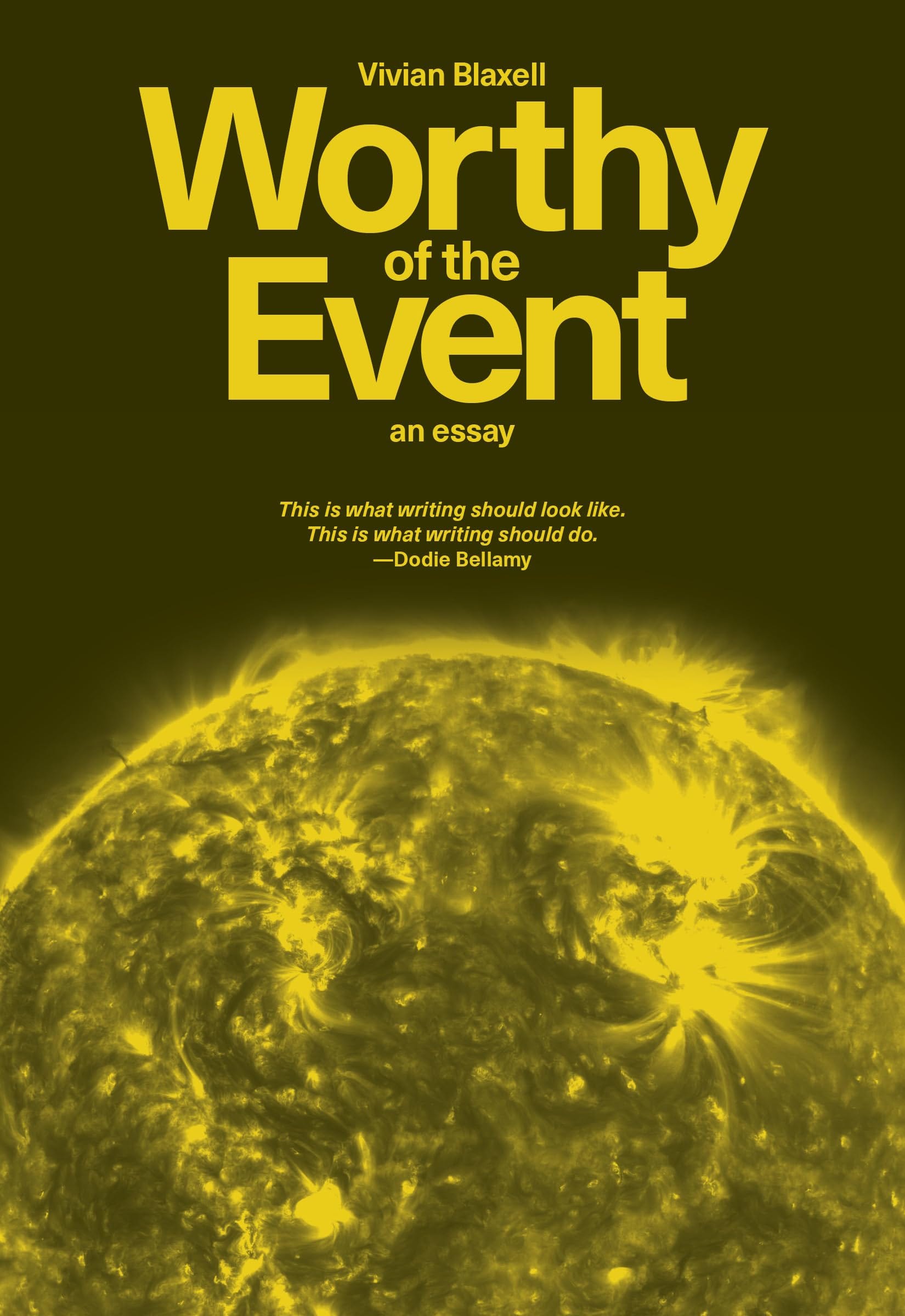
Worthy of the Event: An Essay
Nonfiction by Vivian Blaxell
LittlePuss Press, 2025 (Publisher's Website)
Reviewed by Rebecca Lawrence Lynch
“This is the world that must be endured,” I say.
O says, “Or these are the events of which we must be worthy.”
My only meaningful engagement with beloved icon of the intentionally oblique, Gilles Deleuze, was under the influence of cough syrup. It was the late 2010s, I had a nasty cold and a section of A Thousand Plateaus to read for a seminar. This was before most of us considered the consequences of being seriously ill in public, so off I went to my favourite Ottawa bookstore/café, Black Squirrel Books with two bottles of store-brand dextromethorphan in my bag.
During those fuzzy hours I spent poring over polymorphic prose I didn’t have the context to understand, I became certain that I had discovered something transcendent and True. I had the sense that the translated French washing over me had brought me to some higher state of understanding. Upon waking the next morning, painfully sober and still quite ill, I went to my seminar with not much that I was willing to contribute.
So, a little less than 10 years later and no more knowledgeable about Deleuze, I was unfamiliar with the text taken from his “Leibniz and the Baroque” seminar that Vivian Blaxell chose as an epigraph for her book Worthy of the Event:
...self-enjoyment is being worthy of an event, knowing how or managing to be worthy of the event... Whatever the event might be, be it a disaster or falling in love, there are people who are unworthy of whatever happens to them, even when these are not very prodigious events. Being worthy of what happens!1
This little snippet of text serves as a useful entry point to an essay divided into seven sections of memoir-esque vignettes, each one challenging the reader to engage with the author’s relationships with people that have names like a.k.a. Viktor Mature and Big Denise, along with more or less loosely defined concepts such as transsexuality; disappointment; being and becoming; the transient nature of beauty; disaster; Blaxell’s own writing practice; and, in a culmination that felt quite natural, literal shit. The Deleuze quote expands on the promise made by the title: the following book will tell us something about what “the event” is2 and how to be worthy of it.
However, Worthy of the Event is not straightforwardly a memoir, nor is it a piece of queer theory or a self-help book. Rather, it is the work of a writer who knows that in order to truly understand anything as complex as lived experience, you must be willing to let go of limiting structures like the traditional essay format. Blaxell repudiates the burden that is often placed on trans writing: to be immediately scrutable, easy fodder for someone else’s argument. Indeed, if Blaxell is at all interested in her reader coming away with what it means to be worthy of the event, if she would like for them to glean some real insight into what it can mean to be trans, she first expects them to immerse themselves in the delightful effluvium of her run-on, comma-filled sentences.
This was something I was more than happy to do and, although I was mostly sober while reading Worthy of the Event, I can say that my encounter with it was of the order of my encounter with A Thousand Plateaus. It took me a dozen or so pages to wade in but, once submerged, I found myself gliding through stories about Blaxell’s childhood into reflections on Waray poetry and the uselessness of originality, all the while guided by a structure that is certainly rhizomatic. Each part of the book begins with either a story or short meditation which, in effect, anchors the reader just securely enough to prevent them from being swept away by the torrent of occasionally connected, but always conceptually overdetermined, fragments of prose that make up the, to use her term, “demolished essay.” Blaxell finishes each section with something that could be called a conclusion, but more accurately is a place to pause for a moment and reevaluate what you’ve just read before continuing. More than once, I found myself at the end of a chapter feeling a satisfying internal click which reoriented my thinking about what I’d just read and made me want to read it all over again.
As much as it’s about anything else, Worthy of the Event is a book about relationality. Sometimes this is stated explicitly but even when it’s not, most of her reflections involve an encounter with another person. Naturally then, I talked about it a lot while I was reading it. While discussing the book with Gwendolen Aube, a Discordia editor and a woman dear to my heart, she said something along the lines of wanting to chuck out all previously existing trans theory and replace it with this book. I tend to agree and, though no one has ever accused either of us of shying away from hyperbole, I think the crux of this feeling is Blaxell’s careful avoidance of moralizing on any subject.
So much queer writing tends towards a kind of strident assertion of resistance that is fundamentally aimed either at our oppressors or our allies. There’s nothing wrong with that per se, but there is something awfully tiresome about reading books about you, written by someone like you, that are clearly aimed at someone other than you. I am so fucking tired of pretending that I know what it means to be trans, and Blaxell’s stubborn refusal to do so while simultaneously giving an account of trans life that both includes and so vastly exceeds my own experience is quite refreshing.
She never sets her own life up as a shining example, never tries to occupy the position of victim even as she describes the gross indignities that she’s endured as a result of being trans and trying to date or of being trans and navigating the medical system. She flatly juxtaposes her own dehumanization at the hands of a doctor with the dehumanization she inflicted upon others while working in a psychiatric hospital. She compares the theft of her own agency with the theft she perpetrates against her cat when she tries to interpret his meows.
This is not to say she is shy about what she thinks. Even as Blaxell avoids the kind of holier-than-thou attitude that is all too common in queer writing, she isn’t afraid to be controversial and she is never coy. Her treatments of Rachel Dolezal, McKenzie Wark and—for some reason—Miriam Margolyes, among others, are all quite unflinching without being self-righteous. She doesn’t dismiss Dolezal’s story as an annoying gotcha but neither does she omit a meditation on white privilege. When she describes Wark’s social media presence at length, she acknowledges the possibility that she might have a weird obsession with the woman. She indirectly addresses Margolyes as a “white skank.”

What makes these passages work is that Blaxell’s willingness to judge never hardens into a system of judgment. She is, above all, interested in drawing the reader into whatever points of tension she can find in order to explore where they can take us. She doesn’t care if you’re convinced by her perspective, and she doesn’t tell you how to become worthy of the events of your own life. Instead, she presents a series of events and lays out how they manifested in her life, where she failed and succeeded to be worthy of them and how she sees this struggle playing out in the wider world.
Finishing Worthy of the Event, I was left with this feeling of having my perspective elaborated rather than overturned or erased. This is not something that would have been successful had she simply spent thousands of words expounding the advantages of Buddhist non-attachment or the uselessness of disappointment. Rather than writing an instruction manual on how to become worthy of the event, Blaxell has given us an event to be worthy of.
—RLL
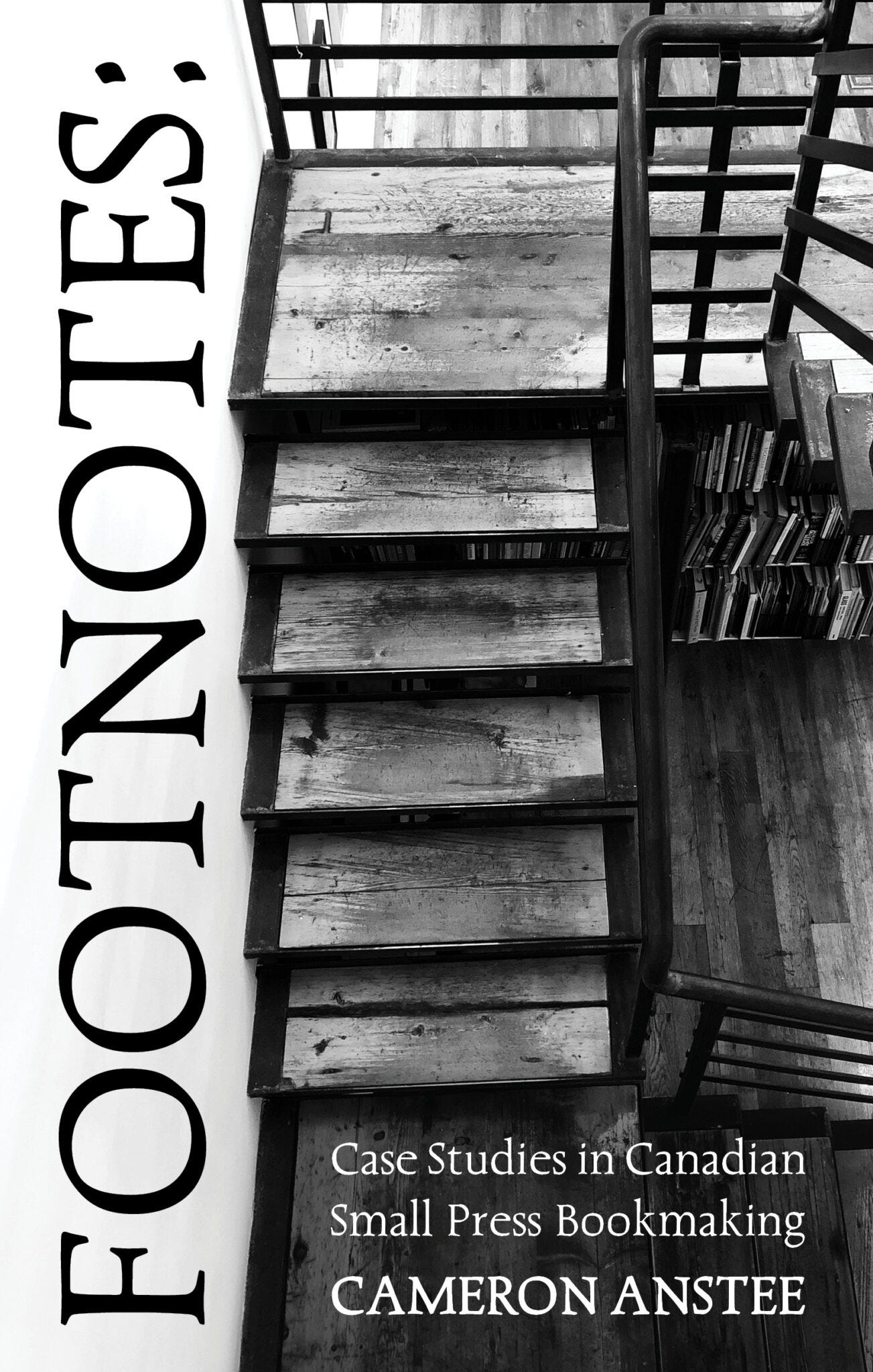
Footnotes: Case Studies in Canadian Small Press Bookmaking
Nonfiction by Cameron Anstee
Palimpsest, 2026 (Publisher’s Website)
Reviewed by Sire
Do you know who Nelson Ball is? How about Glenn Goluska? Jay Macpherson? Jeff Blackman? Alright, if not this one might be a tough sell. Essentially an academic monograph on five examples of Canadian small press publishing (or, as the title more specifically indicates, bookmaking) from the 1960s through the 2010s, Footnotes is niche even within a niche subject area. As Cameron Anstee notes in his introduction, the book is “attuned to activities outside of the dominant centre of small press publishing in Canada—that is, outside of Toronto,” and most of its case studies specifically consider the work of female bookmakers and designers—historically an important minority within the field, but a minority nonetheless. While Footnotes will hardly be unreadable to a neophyte, a certain degree of familiarity with the scene and its history is nonetheless assumed.3 The case studies are presented more or less chronologically, and as such they do provide some sense of the evolving trends and conditions of their times, but for the most part the focus here is narrowly on the bookmakers and the physical books.
Despite this, the essays, both singly and collectively, do advance general arguments about the distinctive nature of small press publishing, and about the print/book object as an artwork of which the text it contains is only a portion. To Anstee, “the small press is constituted in part by the intimate relationship that it posits between writing, publishing, and reading.” In this framing, the insularity of the small press community (and therefore of the intended audience for this book4) is an essential feature: the press runs of these objects are not necessarily small because of the limited interest of the general public, but because these publications are meant for (and are sometimes literal gifts to) specific audiences of friends or kindred spirits whose numbers are by nature limited. The chapbook, for instance, is therefore not a stepping stone to the higher plane of achievement of the trade collection5 but an end unto itself. Anstee advances this point via some extreme examples: Barbara Caruso, whose primary background was in painting, issued her concrete poetry booklets in editions of as few as 10 copies after the fashion of artist’s prints; Jessica Bebenek’s k2tog book, which invites the user to use an included ball of yarn to knit “poems,” has to be partially dismantled to be used as intended, each time effectively reducing the number of intact copies in existence; Ejecta, Justin Million’s sole trade collection to date, published by Anstee himself through his Apt. 9 Press, collects only that minority of the 500 poems he composed via typewriter during his long-running live KEYBOARDS! series in Peterborough, Ontario that weren’t taken home by audience members.
In doing so he abuts on a fundamental question of the nature of literature in the era of mechanical and particularly digital reproduction: why, besides the fetish of habit, consume text in the form of a physical book? (I for instance first read Footnotes for this review as a PDF ARC.) Anstee stops short of saying that reading a given text in a format other than its original edition is not actually reading it (can one have “seen” the Mona Lisa without having been in its physical presence?), but he does argue quietly but strenuously that, as each edition of a book is a distinct artistic object, how one reads the text is significantly mediated by that object’s physical properties. This is most pronounced in poetry that, to whatever degree, is composed by field—you can hear the typographer’s lament whenever Anstee refers to anthologized work that has suffered alterations to its look on the page to economize on space.
Regarding Robert Kroetsch’s long poem “Seed Catalogue,” a visually sprawling work of rural postmodernism that mixes lyric memoir with excerpts from a promotional seed catalogue mailed to farmers in the early twentieth century, Anstee writes:
“Originally published by Turnstone Press in 1977 as Number Seven in their Poetry Series One, the first edition was designed by Eva Fritsch, with screen-printed reproductions of seed catalogues beneath the text of Kroetsch’s poem, emphasizing the already intertextual nature of the work. Fritsch’s design underscored the complex relations of the poem to the seed catalogue as a historical document by rendering the catalogue present in the visual codes of the book. The particular successes of her design have never been reproduced, and this is to the detriment of our ability to read the poem.” (Emphasis mine)
“Seed Catalogue” is by some distance the best-known text explored in Footnotes (it’s a staple of college CanLit reading lists, and probably the poem that’s had the greatest effect on me personally as a reader and writer), and it’s a strong claim to make that most people haven’t read it as it was intended by the author and designer to be read, not merely as “Seed Catalogue”: The Poem but as Seed Catalogue: The First Edition of the Book—most people here including myself. Anstee lovingly describes the book’s tactile and visual elements at length, though it is always shadowed with a sense of its fragile impermanence: “the ink has faded in the four decades since publication and we can now only imagine—or remember, for some—how the colours once looked. However, this loss of visual information through the gradual degradation of the printed book feels aligned philosophically with many of the concerns of the poem.”
I am not yet sure if I am all the way with Anstee in terms of the primacy of the original edition (I think you will have a fine experience of the poem reading the digitized version here if it’s your only access to it), but as I continued to read his descriptions of the Turnstone edition I found my hands almost autonomically fishing around in my pockets for my credit card to order a first edition of my own to consider the question further (it’s in the mail), and also to get my hands on the book before it fully dematerializes. Though Anstee isn’t hamfisted enough to make the comparison directly, it is true that the model of the traditional bookmaking small press in Canada is also fading: even as zine fairs remain popular, there is little literacy among younger writers about their radical forebears (particularly here in Montreal); bookmaking craft has declined; and trends in poetry have swerved away from the sensibilities that led Robert Bringhurst to declare in his 1992 Elements of Typographic Style that, “Letters are microscopic works of art as well as useful symbols. They mean what they are as well as what they say.” Anstee’s done a fine job of documenting some very specific histories here, but one hopes these case studies also give some contemporary artists a few ideas of what is possible in the discipline.
One of the pleasures for any sicko of reading a specialist book about your special interest is that sense of having your passion reillumined by a fellow obsessive. While Footnotes can be a little dry at times, it is a welcome contribution to the literature of the Canadian small press by one of its most stalwart mid-career scholars and practitioners.
—S
OPERATIVES
Poetry by Monty Reid
sider0xylon, 2026 (Publisher’s Website)
Reviewed by Sire
Canadian poets and Canadian spies have at least one thing in common: their true achievements are generally only known to their colleagues. Over the past 50 years Monty Reid has quietly built one of the country’s more formidable bodies of work, though it has been decades since he was last nominated for a major award.6 Throughout the ‘80s and early ‘90s his national profile steadily rose, but after his move from his native western Canada to Ottawa in 19997 he may have become more noted for his able administration of the city’s poetry festival (VERSeFest) and journal (Arc) than his own writing. Despite this, Reid’s poetry has continued to flourish in its local terrain. Much of this later work has first appeared in chapbooks, an occurrence that owes something to Ottawa’s enduring fondness for the format (above/ground press’s output alone exceeds that of most major metropolitan areas) and Reid’s own longstanding predilection for writing ten to twenty page sequence poems versus individual units.8 Whether it’s the inherent scrappiness of chapbooks, or his having reached an enviable state of contentment as a retiree and occasional nudist backyard gardener, I’d put Reid’s 21st century work up against that of nearly any working poet’s for sheer consistency and readability. Always an acute observer of fine details, he’s developed a lightness of touch (and an earthy perversity9) that frequently puts an admiring grin on my face.
Reid’s latest chapbook is OPERATIVES, published by the new New Brunswick-based sider0xylon press. Inspired by the construction in the 2010s of a pair of massive new facilities for Canada’s spy agencies (CSIS and CSEC) near the poet’s home, this short sequence echoes the lengthy “Intelligence” series that ran previously on Reid’s twitter account and in various small publications (see such here). In “Intelligence,” Reid adopted the posture of a miffed, justifiably paranoid gawker peering over his fence at the construction take place and pondering what might be happening behind the new facades; there is a more existential cast to the poems in OPERATIVES. Throughout, Reid riffs on espionage terminology (“Dead Drop,” “Honey Trap,” etc.), retaining something of the sense of subterfuge and paranoia of the intelligence world even as it often ambles off into more suggestive, lyric territory inspired by a more literal reading of the terms:
1. Brush Pass
You never know what you’ll be given.
You might not feel the slightest touch
as the messenger passes.You never know where it came from
although you suspect a source.Your job is not to know. You are the form
the message takes, every time.
Perhaps it is inevitable that spending years watching a house of spies results in one feeling they know even less than they did before they began—or that what one has learned isn’t directly expressible. Over and over the poems caution the reader not to expect closure; that the ramifications of their own actions will never be fully known; that even what is known is subject to destruction. Under the pressure, some topple over into pure image, the figurative mole become literal:
8. Mole Hunt
In our deep tunnels the air takes root
and everyone gets suspicious.Some see the moon emerge
from an excess of wordsand then the mole comes out
with a star on its nose.
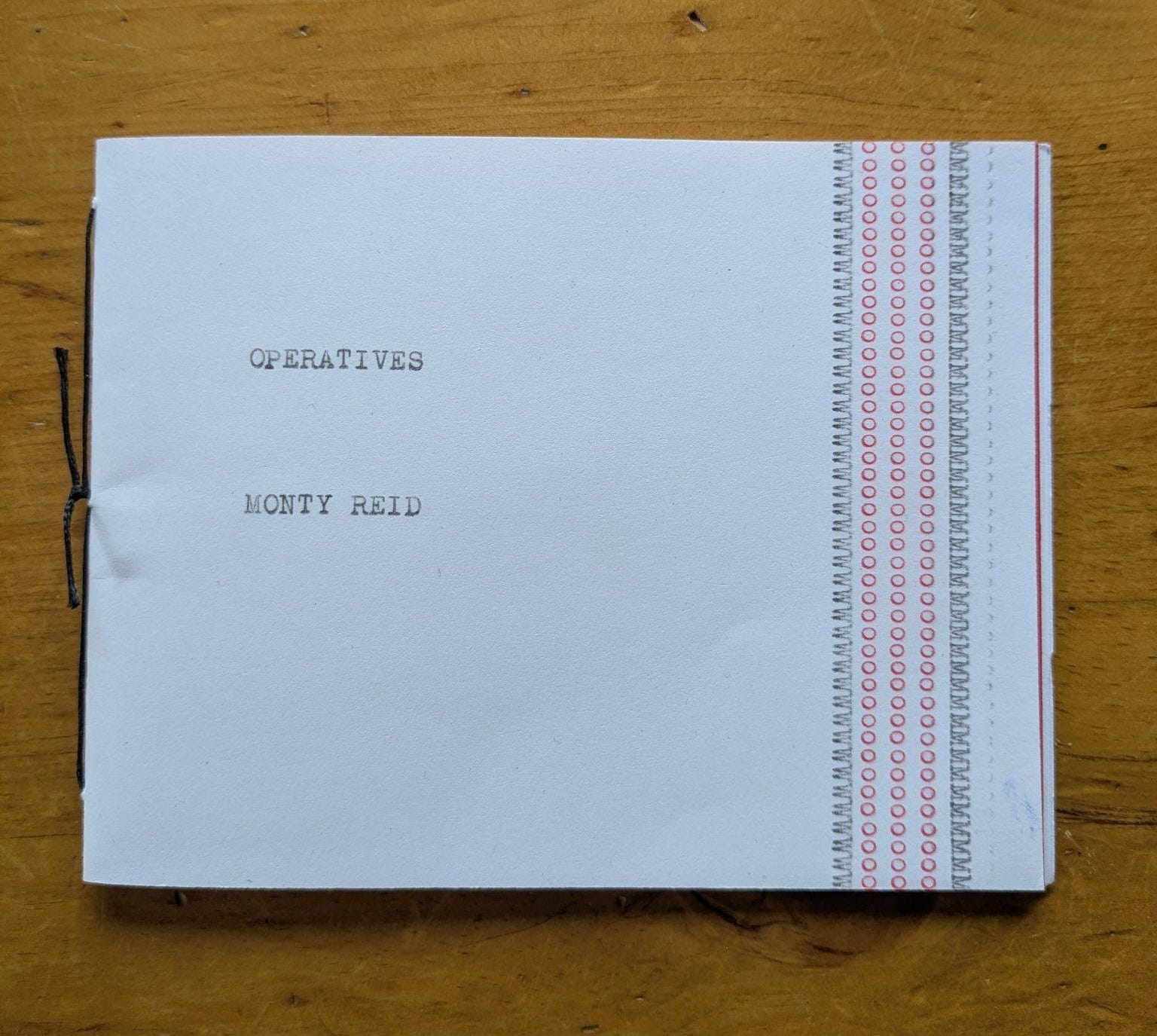
sider0xylon specializes in small typewritten chapbooks, which makes for a good formal match to these poems’ content—while it’s likely been decades since any spy agency used a typewriter, our collective image of secret files is inevitably a multiply-reproduced, heavily redacted document still stinking of carbon. The design is tasteful, hand-cut and sewn, and appropriately rough-hewn. Copies can be ordered directly from the publisher via the link above.
—S
CONTRIBUTORS
Rebecca Lawrence Lynch is a Montréal-based poet, editor, and database slut. Her work appears four times on the Airtable database she built for Discordia’s notorious story on local publishing. Follow her on Instagram at @alliterativebychoice.
Sire is don’t get me started on Sire.
Interested in reviewing for Discordia Review? Check out our review guidelines and then email us a pitch.
Doing poetry wrong, confusing suicides, chronic pain, and Jane Birkin

Reviewing Derek Beaulieu's annoying guide to being a 21st century poet, Édouard Levé's haunting posthumous novella, a self-published gem by Ev Ricky, and Marisa Meltzer's quarter-assed Jane Birkin biography.
Note: Regarding that oddly fragmentary final sentence, the original French reads, “Être digne de ce qui arrivé!” (roughly, “Be worthy of what comes your way!,” which could also be expressed as, “Be worthy of what happens!”) but the translation Blaxell uses renders it as “Being worthy” for some reason.
As far as I can tell from skimming James Williams’ Gilles Deleuze’s Difference and Repetition: A Critical Introduction and Guide, along with the transcribed and translated text of the April 17, 1987 seminar from which Blaxell pulled her epigraph, “the event” for Deleuze is an occurrence which shatters or shifts whatever paradigm we’re using to make sense of our lives, apparently in such way that is unlikely or inexplicable. Or maybe it’s something else. All I know is I need a cigarette after trying to figure that out.
To give you an idea of what we’re dealing with here: at the end of his chapter on Barbara Caruso’s Seripress and presspresspress, he provides a bibliography for presspresspress but notes that “No checklist of Seripress is presented as it has already been documented bibliographically” in a 1986 issue of the defunct journal Open Letter. Cameron!
The ideal approach for a non-specialist reader might be to pretend these essays are Borgesian flights of imagination: the poem excerpts and pictures of ultrarare print objects cunning forgeries concocted by Anstee himself; the portrait of a gifted poet sitting in a bar week after week in a small Canadian city who writes his work on a manual typewriter and hands the results out to whoever might happen to be standing there an evocative fiction.
See also derek beaulieu’s recent cocktail napkin math analysis of the economics of trade publishing in his essay collection Do It Wrong.
He was nominated for the Governor General’s Award in Poetry in 1994 (Dog Sleeps) and 1993 (Crawlspace: New and Selected Poems), and for Young People’s Literature in 1991 (The Last Great Dinosaurs).
Presented without comment: his first trade collection after moving to the capital was 2006’s Disappointment Island.
“As with most long poems, a sequence comes from the desire not to find an end, but to find a way to continue. For me, the sequence accommodates interruptions more readily, it stops and starts, tries to hold it together, begins again, and is probably as much a result of my easily interrupted working habits over the years. These days, my easily interrupted memory may have a role. Or maybe it’s just an understanding that time in a poem is often not linear, or at least not experienced as linear.” — Reid, in a 2025 interview with rob mclennan
To cite one example, 2014’s Kissing Bug, a delightfully gross limited chapbook about parasitism which publisher phafours press has thoughtfully made available as an online PDF (see link).