



Wikipedia is generally agreed to be one of the few great remaining monuments to the utopian ideals of the early internet, at least by those who have not been banned for trying to delete their own entry’s Sexual Misconduct section. Wikipedia pages stand out like Gilded Age public libraries amid the uninhabitable SEO tenements and gibberish slop casinos that clog the terrain of contemporary Google search results. It seems uncontroversial to say that the site is the best and most reliable general source of information available to the average internet user and that, for all its warts,1 it has been a bulwark against the internet’s transformation into an uncanny mall in which the majority of content on any given subject is neither written by nor intended for humans.
As such, it has spent much of the past half decade under assault from the usual loose affiliation of Yarvinite cryptids, series-of-tubes-brained legislators, unmanned LLM trawler ship skippers, genetically adulterous rich guys, Sedona BIA members, and gurning hasbarists that has been successfully laying the groundwork for our collective return to illiterate serfdom. Some threats are greater than others: Elon Musk’s AI-generated Grokipedia (a Conservapedia revival that required the fluid volume of the Bering Strait to produce) is effectively an 800,000-page meme that will be used exclusively by crypto guys who write like Shams Charania anyway; whereas ChatGPT, which has allegedly surpassed Wikipedia in monthly visits, figures to accelerate the Uncle Juniorification of everyone you know. It goes without saying that transferring authority from a. a notionally independent, collectively-maintained project with nearly a quarter-century of comparatively rigorous, established norms modeled after the standards of a traditional encyclopedia; to b. an automated oracle that can be programmed to say whatever its funders tell it to; has great appeal among the technocrat set. Even as they ransack the work of Wikipedians (and, through it, that of the encyclopedia’s original sources) to train their models, they use their pull in government and the courts to hobble the project.
But not all of the threats faced by Wikipedia are external. Visiting the rear corridors of the site (user profiles, Talk pages etc.), which have changed little since it reached maturity in the mid-‘00s, fills me with a stabbing nostalgia for the listservs, Usenet groups, forums, and chatrooms of yesteryear. But it is also true that the site is functionally unlike anything the Zoomers and Alphas who represent the next generation of potential editors are likely to have encountered elsewhere. As far back as 2014, analysts were pointing out that the number of active editors (the volunteer corps upon which the project relies) was trending downward, and the situation has not improved over the decade since.2 The fact is that contributors are logging off or dying off at a rate faster than they are being replaced. The profile of the classical Wikipedian was common among internet users twenty years back: Gen X nerds and hobbyists with a hippie-ish but rule-abiding idealism; a comparatively high degree of computer literacy; a sense of themselves as digital pioneers; and an anal-retentive passion for detail. This is not a type of guy they’re really making anymore, as the promise of the internet has dimmed and political polarization has obliterated the fiction of an apolitical consensus reality. Between the site’s arcane customs and jargon and its antiquated interface, the learning curve for becoming a contributor is steep for a generation unblooded by dial-up modem screams and battles with command-line interfaces. Those who do make it through this persnickety gauntlet must then adapt themselves to a culture that predates the social media-abetted notion that everyone is an expert. Individual expertise is not required of a Wikipedian—in fact, it is not even a desirable quality, as Wikipedia is pointedly not a venue for the opinions or original research of its contributors. The worker ant qualities of diligence, consistency and common sense are more prized by far. As such, change comes frustratingly slowly for those habituated to the whiplash pace of the hot take economy.
This isn’t to suggest that Wikipedia hasn’t generally begun to skew further to the “left” than it had previously—it certainly has, at least on social and idpol-scented topics. But despite decades of hyperbolic criticism from the right it remains far from radical. When a Trumper looks at an entry on greenhouse gas emissions and thinks their Oakleys are the They Live sunglasses, it is a function of what my colleague Eris recently termed the right’s “unknowingly drifting umwelt”: the reality that their politics have become so far removed from centre that established liberal positions which have not in reality significantly shifted in either direction now appear to be evidence of an incipient communist/Reptilian takeover.3
If Wikipedia were explicitly a right-wing or left-wing project, it would not have become the all-purpose reference it is today. As with the encyclopedias, dictionaries, and almanacs of old, it has been considered a mostly “impartial” arbiter of objective reality (at least as it pertains to things like the hard sciences and the complete list of past members of Blood, Sweat & Tears) because it claims to not express editorial opinions. Speaking personally, on the spectrum between idealism and pragmatism, I tend to err on the side of pragmatism, for what it’s worth. I don’t scorn a useful resource for having a bias, particularly on current events, and I would generally rather have a Wikipedia with a ‘90s-era libertarian ideological bent to its notion of objectivity (as it traditionally has) than not to have a Wikipedia at all—I mean shit, I had to look up the word “encyclopedia” on Wikipedia a few minutes ago to doublecheck how long those’ve existed. We should still expect people to be able to read a source without being dominated by its perspective. After all, one of the positive functions of reading a lot of Wikipedia pages versus using ChatGPT queries is seeing how much historical debate has gone into reaching even the most fundamental conclusions about our world. By simple osmosis, even a relatively uneducated visitor, so long as they are intellectually curious, develops stronger critical faculties.
Neutrality as catch-22
Despite opposition from the oligarch set and a steadily dwindling cadre of editors, the decline of Wikipedia has thus far been slow and relatively graceful. Thanks to the fact that it is operated by Wikimedia, a nonprofit, (and that the vast majority of the actual work is performed by volunteers), it has not been forced to chase disastrous trends in online media4 or sold to a Transylvanian private equity group for exsanguination and vivisection. Were no particular effort made on the part of Wikimedia to do anything more than maintain its status quo, Wikipedia would still enjoy a prominent position as an alternative for stubborn AI holdouts even as it ceded its one-time ubiquity.
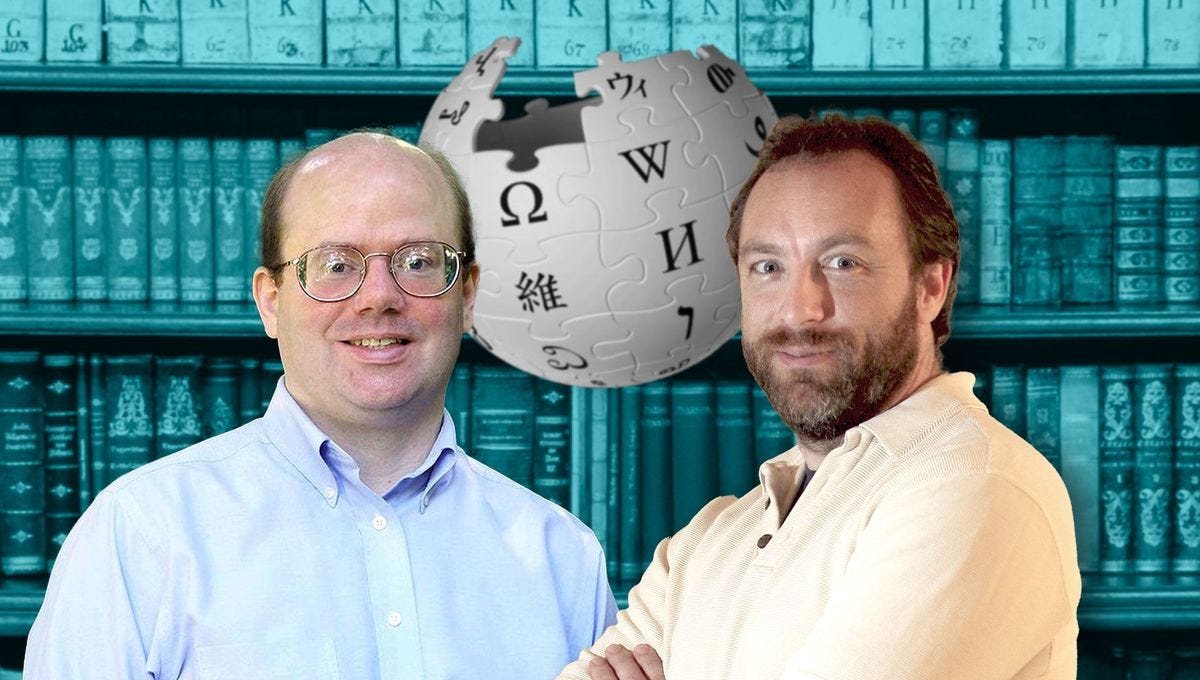
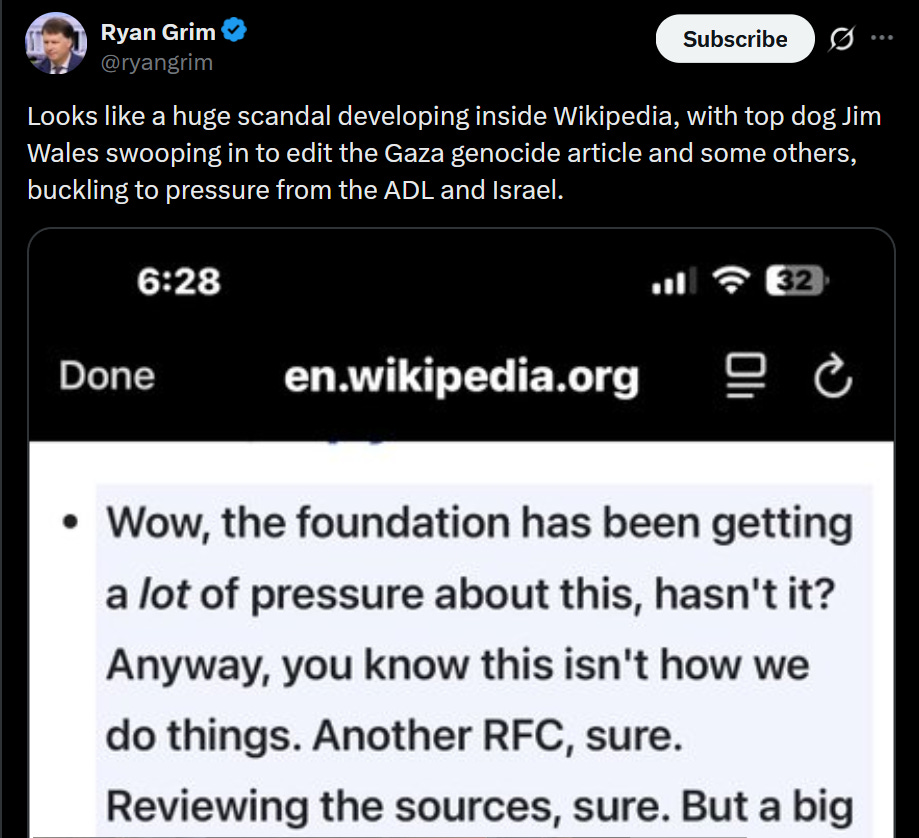
This is why there’s such a tragic absurdity to Wikipedia co-founder Jimmy “Jimbo” Wales’s recent attempt, in the name of maintaining site standards, to bring a “neutral point of view” by fiat to the site’s entries on Israel’s ongoing atrocities in the Gaza strip. Here’s Jimbo’s Sunday November 2 statement from the Talk page5 of the “Gaza genocide” article in its entirety:
“I believe that Wikipedia is at its best when we can have reasonable discussion rooted in a commitment to write articles that reflect a neutral point of view. I believe that’s especially important on highly difficult or contentious topics.
I was asked point-blank in a high profile media interview about this article, and I answered with transparency and honesty: this article fails to meet our high standards and needs immediate attention.
As many of you will know, I have been leading an NPOV [Ed. note: Wiki-speak for Neutral Point Of View] working group and studying the issue of neutrality in Wikipedia across many articles and topic areas including ‘Zionism.’ While this article is a particularly egregious example, there is much more work to do. It should go without saying that I am writing this in my personal capacity, and I am not speaking on behalf of the Wikimedia Foundation or anyone else!
I assume good faith of everyone who has worked on this Gaza ‘genocide’ article. At present, the lede and the overall presentation state, in Wikipedia’s voice, that Israel is committing genocide, although that claim is highly contested. This is a violation of WP:NPOV and WP:ATTRIBUTEPOV that requires immediate correction. Remember: ‘This policy is non-negotiable, and the principles upon which it is based cannot be superseded by other policies or guidelines, nor by editor consensus.’
A neutral approach would begin with a formulation such as: ‘Multiple governments, NGOs, and legal bodies have described or rejected the characterization of Israel’s actions in Gaza as genocide.’
What I’m asking for
Be bold and start editing (WP:BOLD). Move from debate to concrete improvements immediately.
Assume good faith (WP:AGF). Avoid personalizing disagreements. Focus only on text and sources.
Attribute, don’t assert (WP:ATTRIBUTEPOV). The lead and body must not declare a legal conclusion. Present who says what, with attribution and dates.
Balance by due weight (WP:UNDUE). Include significant, high-quality sources from all sides—governments, courts, NGOs, commentators. No side should speak in Wikipedia’s own voice.
Use the best sources (WP:RS / WP:V). Prefer primary official statements and major secondary coverage. Avoid synthesis (WP:SYN / WP:NOR).
Clarify scope. Separate factual reporting on conduct and casualties from legal characterization. Editors with strong, policy-compliant sources who have felt sidelined are welcome. Your participation is needed now. Editors are reminded this article falls under the Arab–Israeli conflict topic area; all participation must comply with the corresponding editing restrictions and civility expectations.
By focusing on verifiable sources and neutrality, we can quickly deliver an article that meets our standards for contentious topics.”
It’s not difficult to see the larger arguments Wales is attempting to marshal. Meeting the traditional “high standards” of the site would require a “balance” of sources on both sides of the issue—and indeed doing so would be more consistent with how the site’s Israel-Palestine articles were presented five or ten years ago. (For an example of what this sort of balance looks like in practice, one can turn to Britannica’s decidedly conservative entry on the “Israel-Hamas War.”) And it’s certainly true that in the pre-internet age an encyclopedia would not necessarily have been expected to adjudicate the facts of an ongoing conflict. Not only that, but in an era where the U.S. government is taking an increasingly censorious approach to non-conforming online content, is it not essential that Wikipedia recommit to a posture of studious neutrality to shore up public trust and to insulate it from the inevitable legal crackdown to come?
We might start here by turning to Wikipedia’s entry for “Neutrality (philosophy),” in the reading of which we are swiftly reminded of the elemental distinction between neutrality and objectivity: “Objectivity suggests siding with the more reasonable position (except journalistic objectivity), where reasonableness is judged by some common basis between the sides, such as logic (thereby avoiding the problem of incommensurability). Neutrality implies tolerance regardless of how disagreeable, deplorable, or unusual a perspective might be.” (Emphasis my own.)
Another useful citation comes to mind, this time from the “Support for Israel in conflict with Palestinians” section of the entry for “Jimmy Wales”:6
Support for Israel in conflict with Palestinians
Wales has visited Israel over ten times. Concerning claims that Israel engages in apartheid against Palestinians, Wales remarked “I’m a strong supporter of Israel, so I don’t listen to those critics,” according to a 2015 interview with the Jewish Telegraphic Agency.[116] That year, he was awarded one of the Dan David Prizes, an international award of $1 million given yearly at Tel Aviv University (10 percent of the prize goes to doctoral students). Wales was chosen for spearheading what the prize committee called the “information revolution”.[117]
In the interest of ensuring that the “strong supporter of Israel” quote had not been taken out of context by some vindictive Wikipedia editor, I checked out the original Times of Israel article:
While Wikipedia strives for objectivity on Israel, Wales is unabashedly pro. The annual Wikimania conference, hosted by the nonprofit that runs Wikipedia, was held in the northern Israeli city of Haifa in 2011, and Wales appeared at the Israeli Presidential Conference that year.
Ahead of the Haifa conference, Wales defended Israel in a Facebook exchange with a pro-Palestinian activist, Joey Ayoub, that Ayoub subsequently published. Responding to Ayoub’s accusations of Israeli apartheid, Wales wrote, “How about those rockets? Complaining any about those?” Presumably he was referring to Hamas shooting rockets into Israel from Gaza.
“I’m a strong supporter of Israel, so I don’t listen to those critics,” Wales told JTA.
A neutral analysis of the situation would go something like this: “In late 2025, Wales began an effort to balance Wikipedia’s articles on controversial subjects, beginning with the Israel-Hamas war. He received some pushback about potential conflicts of interest within the Wikipedia community, but was supported in his efforts by outlets such as The New York Times, New York Post, and The Tucker Carlson Show.” An objective analysis would have to apply logic to consider questions such as:
Why, if the goal is to correct a sitewide problem of balance, would Wales choose to start with an issue where he has a clear, long-established rooting interest in one side over the other?
Is Wales currently on a book tour in which he stands to profit by presenting himself as that mythical aisle-crossing ideological moderate?
Is it coincidental that the aforesaid issue is the current focus of a media suppression effort unseen in the United States since the Cold War?
Does the evidence presented by those who claim Israel and the United States’s conduct in Palestine does not constitute crimes against humanity make any fucking sense?
It is to Wales’s credit that 25 years ago he decided to cede ownership of Wikipedia to a charitable entity rather than assume direct control himself, which is the difference of degree that exists between his current statement and something like Jeff Bezos’s edict that The Washington Post’s opinion section write “every day in support and defense of two pillars: personal liberties and free markets.” But by weighing in on what is obviously a pet issue for him in this manner, Wales threatens what remains of the public trust in Wikipedia that he ostensibly seeks to shore up. Despite the collusion of government and establishment media entities around the world, public opinion has implacably swerved against Israel. The “journalistic objectivity” of these outlets is seen for what it is: a means of creating just enough doubt to dilute the conviction that what the world is witnessing is an assault on our collective humanity that requires direct action to halt. What is left to those in power in the absence of this illusion is brute suppression and misrepresentation of the facts. From my open tabs alone: YouTube deleting the channels of Palestinian rights groups; the Drop Site News TikTok account being instantly age-gated under the platform’s censorious new policies (“Funny to have had better press freedom under President Xi,” noted Ryan Grim); this op-ed from the (per Wikipedia’s description) “centrist” Jerusalem Post about the footage of a Palestinian prisoner being gangraped with an iron bar that was leaked last year by Israeli military lawyer Yifat Tomer-Yerushalmi being evidence of a pro-Gaza “‘deep dark state’” rising within Israel.7 On the question of Gaza, perhaps more flagrantly than any other of our time, the “balance” promulgated by mainstream outlets constitutes an intolerable lie.
Wales’s exertion of editorial pressure will not bring right-wingers back to Wikipedia—those consciously choosing to avoid the platform for political reasons don’t want to read a neutral platform—but it will provoke a war within Wikipedia that will hasten its demise. Successfully throttling the truth about the ethnic cleansing of Palestine is a stain that will not be contained to articles about the conflicts between Jew and Arab; it will spread to articles about climate; biology and medicine; gender and sexuality. These days there is a sulky trajectory taken by every powerful leader in tech who encounters opposition. The opposition is cast as a group of conspiratorial ideologues who need to be removed from the board so the leader’s benevolent vision can be made manifest. Personally, the leader becomes increasingly agitated and aggrieved, reinventing themselves as an authoritarian or even an open fascist. Don’t be surprised if, within the next five years, Wales announces that Wikipedia’s current editors are so irretrievably corrupted that his only recourse is to replace them all with perfectly neutral AI agents, who will carry the project forward into the 21st Century.
In and of itself, it is ultimately immaterial to me that Wales is a Zionist, an Objectivist, a Young Sheldon fan etc. What matters to me is whether his Zionism (and sure, his Objectivism too) causes him to destroy Wikipedia. The loss of Wikipedia would represent a Library of Alexandria fire-esque circumstance—not this time because information is being destroyed (Wikipedia’s data is backed up in hundreds of different ways, and is not a source of original research8) , but because once this library is gone so too will be the public’s habit, and eventually in a sense its memory, of using a collective, human-generated source of truth to access our common inheritance of knowledge. Internet search has been rendered functionally inoperable, academic archives are inaccessible to most, public libraries and broadcasters have been gutted. Wikipedia is one of a few flickering candles remaining in this burgeoning dark age, and the man who lit this one seems poised to blow it out because there is at least one truth he cannot tolerate seeing illuminated.
FURTHER ADVENTURES IN THE WORLD OF WIKIS
I spent ten minutes on the Assassin's Creed Wiki and it melted my brain

A little while ago I was looking to find something on the newly unsealed JFK documents and somehow wound up seeing an entry for John F. Kennedy on the Assassin’s Creed fan Wiki.
Eris has used his Jimmy Wales-esque position as a editor-in-chief to call the website “liberal propaganda” and “a CIA op” and is requiring that I mention the influence of big oil on Wikipedia, their pages on the Holodomor, and suspicious Wikipedia editors like “Philip Cross.”
Charmingly, there is even an article on “Predictions of the end of Wikipedia.”
Hilariously, this paragraph more or less describes Wikipedia’s right-wing crank cofounder Larry Sanger, who has spent much of his time since he exited the project in 2002 accusing Wikipedia of distributing child pornography and piloting a series of alternative encyclopedia projects directly into the ground.
Moment of silence for the “pivot to video” era.
For those who’ve never poked their noses behind the curtain, every article on Wikipedia has a Talk tab where contributors can flag potential issues and hash out differing interpretations of the site’s standards. On most articles the contents of the Talk page are fairly minimal, but it will not shock you that the Talk for “Gaza genocide” is currently sitting at a cool 87,000 words.
The section is a recent addition to Wales’s page.
Excepting of course its irreplaceable Edit History pages, which are some of the most important anthropological and comedic documents of our time.
Thanks for this. Very disappointing
Hah Hah Wikipedia, I started out getting beat up when I tried to edit their Gavin Menzies article, and then fought the gang to a bloody draw on the Newport Tower article, and then I was ready for the big time on the Astrology article as the last of the old-time Wikipedia astrologers was publicly self-immolating. (The cross-fire shifted from the astrology talk page to my personal talk page as my quixotic rear-guard action played out.) With all that under my belt, I was actually able to step in temporarily as an informal arbiter on the Lyndon LaRouche article -- talk about discord.
As for Gaza and all that -- home of Goliath and the Philistines, some people have long memories.