

"Zoomer" culture is actually for Millennials
Escaping the Zoomer Zoo. Also Lena Dunham???


This post is too long for email, so if you’re an email sub you’ll want to open this up browser-style or app-style or however style you style.
There I was, dusting my hands off after having dealt with that Lindy West shit, ready to write about something less Online, something less immediately topical or content mill oriented, when suddenly I started to hear something. Quiet at first, but getting louder and louder, until I could just make out... BAH GAWD, THAT’S LENA DUNHAM’S MUSIC!!!

LENA DUNHAM’S NEW BOOK HAS DROPPED AND EVERYONE’S ARGUING ABOUT LENA DUNHAM AGAIN!!! IS ERIS GONNA DO IT??? IS ERIS GONNA TACKLE LENA DUNHAM???????
No.
Moving on:
Who is “Zoomer” culture actually for?
A few years ago I went to see 100 gecs. And why not? I’m still hip and with it. I’m not closed-minded. I like what the kids like. I’m aware of it, I understand it, and I like it. Right? 100 gecs is one of the most exciting acts in contemporary music, one of the few that legitimately feel like they’re doing something “new” and “different,” even though they’ve spawned countless imitators. 100 gecs, a band that boldly embraces bad taste and merges some of the most heinous and reviled musical trends of the last thirty years (ska punk, brostep, nu-metal, etc., alongside doofy cartoon sound effects and deliberately cheap-sounding MIDI instrumentation, all boiled in the same soup) into a cacophonous blend of brainrot music that perfectly encapsulates the experience of modern hyper-culture. Right? It’s specifically made to be saturated; unlike previous counter-cultural music trends, the hyperpop 100 gecs represents deliberately, fatalistically, nihilistically prepares itself to be co-opted by mainstream culture. Right? I understand it. I get it. I like it. Here I am writing about it, here I am thinking about it, here I am explaining it. I’m in my thirties, but I understand and get and like 100 gecs. I even wrote a zine1 about my experience. I’m still hip and with it. Right?
A peculiar observation startled me at the 100 gecs show: I spent some time in the pit, which was mostly occupied by young transes in fishnets and cis girls who dress like porcelain dolls, and then I made my way up to the balcony, from which a bunch of paunchy Millennials were gazing down at the youthful frenzy. There’s an experience I think a lot of young men have of getting changed in the gym in the vicinity of old men—there’s a way old men look at young men’s bodies, nearly leering, envious, hungry. I don’t think it’s a sexual thing, at least not in the way you might think; it’s a desire to have a young man’s body again. There was a similar hunger I sensed in this crowd of gawkers, even though they were what may still be characterized as “young” in many contexts.
How do we characterize a Millennial? In North America I would say that a “real” Millennial is someone who has no real memories of the Cold War, someone for whom 9/11 was formative, and someone whose emergence into the adult world and employment was defined in and around the ‘08 recession. (Obviously these experiences are culturally-specific—for example, for most Millennial Arabs I know, the Arab Spring was a similarly defining experience. I was talking to Aamar about this very subject in the bar literally last week.) Perhaps more than any other, they are, infamously, a generation of people who desperately sought to extend their adolescence—this is the first generation to really embrace adult video gaming or to openly take an interest in shows ostensibly for children, beginning with Adventure Time and continuing to this day with shit like Bluey. (I have no idea if Millennials in the Arab world are watching Bluey or a Bluey equivalent, but maybe some of my Arab followers can fill me in.)
Millennials like me though, we’re above all that. Right? I don’t watch TV shows for babies. I don’t watch TV shows at all! There is no point in my life that I am clearly trying to regress to. Right? Right? Right? Right? Have I mentioned that I used to look like this and groom like this and dress like this and take photos like this with other guys who looked like and groomed like and dressed like this?
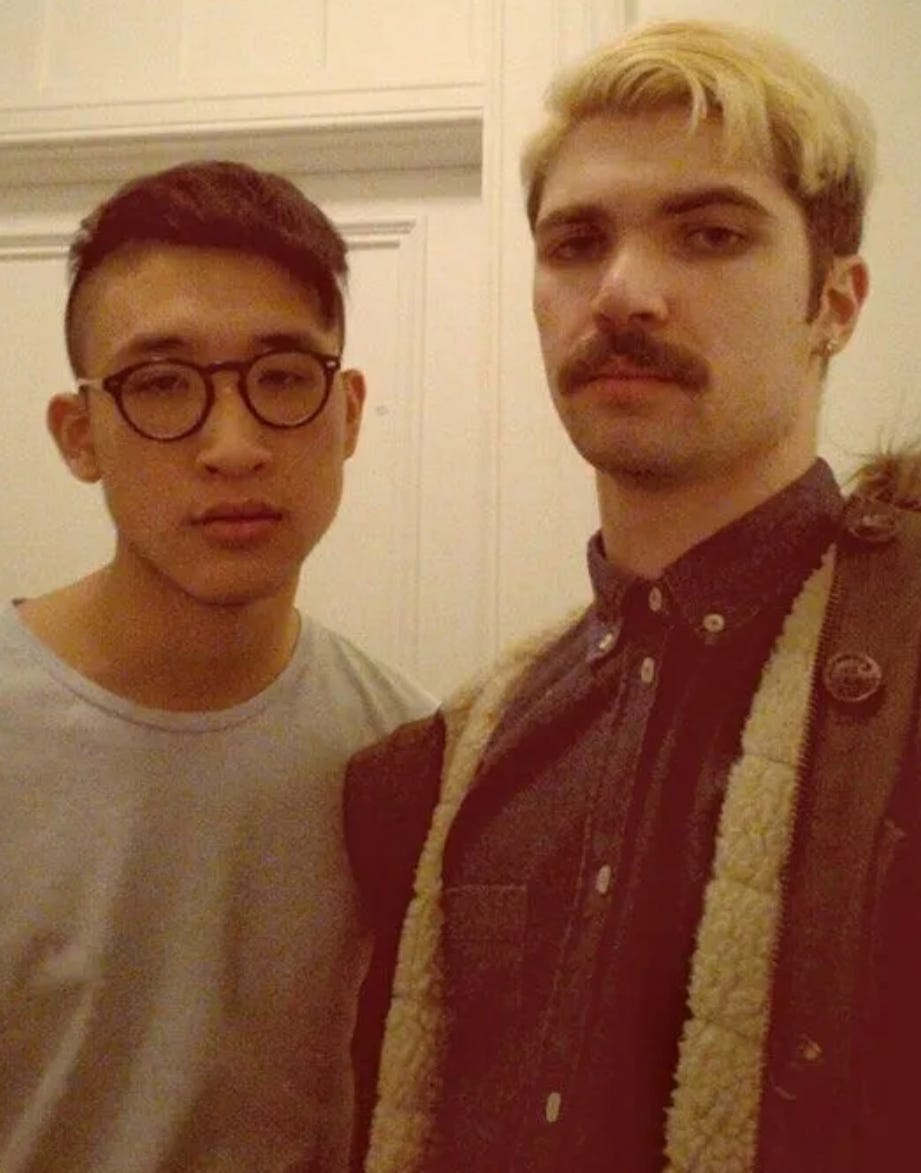
So anyways, Geese.
Geese is allegedly Gen Z’s “first great band.” That’s so fascinating, because Geese sounds like every trendy Millennial band I listened to growing up. I spouted off something to this effect back in November:
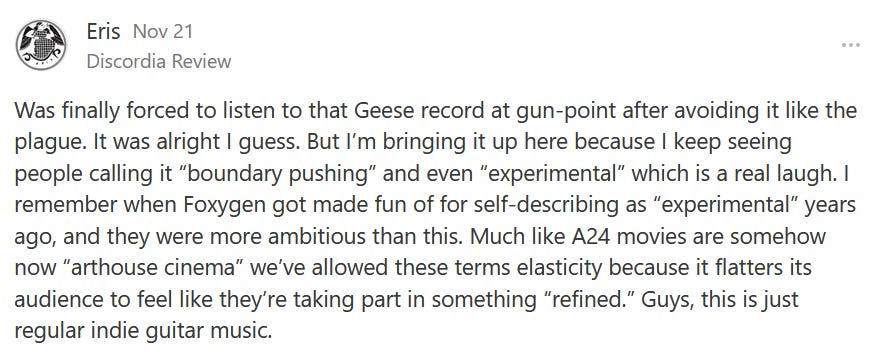
TONY PRICE wrote a blog post recently—easily ranking among the best I’ve ever read—about the Geese phenomenon, which ties the hypebeast band into the history of psywar, Satanic forces (Michael Aquino makes an appearance), and the intelligence history of the internet and the nature of information dispersal/collection/control in contemporary life.2 He made a similar observation about Geese to the one I did:
Watching the Geese™ spectacle is amazing.
Look at how the American Millennial™ media class are trying to stay relevant with the kids while propping up a band that literally sounds like the condensed amalgamation of every heinous Best New Music™ album they were swindled into pretending they loved in the 00s. “This is the best new band of a generation, and they just so happen to sound like the music that I also cried to in my dorm room.”
Geese just kind of sound like The Walkmen, only the guys from The Walkmen really changed music in part cause a bunch of them were from Jonathan Fire*Eater, a watershed NYC indie band that can take a significant amount of credit for everything that developed over there after that,3 but never had the post-break-up promotional support to make their legend go very far (their label went defunct in 2005), and so they’re not on t-shirts and shit and the music hypebeasts don’t know who they are. Maybe Geese will be influential too, who is to say? I’m to say. Geese cannot and will not change music because Geese is not changing music, nothing they are doing is a “new idea in rock and roll” as America’s Worst Magazine dubbed it. They are re-packaging music, which is different from “reinventing” by the way. Whatever your feelings about the “post-punk revival” of the 00’s, it wasn’t actually jacking the swag of what came before it—do The Strokes or the Yeah Yeah Yeahs actually sound anything like Television or Joy Division?4 The influence is obvious, but the product is distinct.
Another thing Geese sounds like sometimes is Radiohead. Listen to this song. It’s like an outtake off of In Rainbows.
Don’t take my word for it, listen to Geese’s Max Bassin himself: “I feel like I'm always really scared that we're just going to sound like Radiohead.” Yeah I’d say that’s a well-founded concern. And I’ve got bad news!
Obviously most stuff doesn’t exist in a vacuum and people of all ages will consume stuff that’s ostensibly for one generational demographic, whatever and ever and ever, and there will always be a portion of the extra-generational audience that is excited to use this media as a peephole into a different generational experience, often out of envy at youth and desire to be “with it.” Consider HBO’s Girls (SIKE! I’m talking about Lena Dunham after all), about as “Millennial” a work as could be made. Of course there were glowing reviews of the show from critics outside the Millennial bracket (which figures, considering we were hardly old enough to go potty for ourselves, let alone write for major magazines). The New Yorker’s Emily Nussbaum, a Gen X-er just two years younger than my parents, spoke favourably of the show, and failed to conceal her excitement about the generational transference when she enthusiastically called it a “powerful vision from a very young woman.” But it was clearly made for Millennials. Geese feels like something made for Millennials to watch Zoomers consume from behind glass. Is the meat given to the tiger in the cage before an audience for the tiger or for the audience to watch it dig into?
Geese feels like a product that has identified a niche: Millennials who would have liked to have been on that balcony watching the Zoomers listen to 100 gecs, but who tried and failed to like 100 gecs itself, because it was too alienating. That’s okay you boomer fuck. Here’s Geese!
What about all that Dimes Square shit? Is Honor Levy the voice of Gen Z? Well, is she? Well, is she? Well, is she? Why does it feel like it’s mostly Millennials asking that question or having that conversation or citing that title? Can Zoomers even read? When we say someone like Levy or the other Levy or Madeline Cash is the “voice of their generation,” who is that voice speaking to? Who is that voice addressing, and what does that audience want to hear? Why is that most of the “voice of a generation” Gen Z lit I’ve read reads so much like the alt lit I grew up with? I remember Common once asking whether “gangsta rap” or “crunk rap” was legitimately the “voice” of Black America or whether it was more specifically the “voice” that White America—that larger, more lucrative audience—wanted to hear. But that’s okay, because now we have the “real” voice of Black America, guys like Kendrick Lamar. That’s surely not just the evolved form of what White America wants, right? Right?
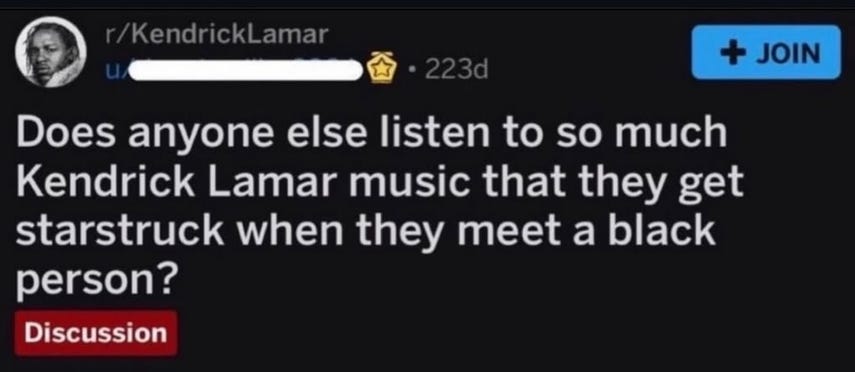
(You can read my expanded take on Kendrick Lamar here)
Courtney Love (not to be confused with Discordia’s Courtney Loathe) said of Geese: “Do you feel like their team might be, like, elder Millennial Brooklyn people? Like, very Girls-y?” and this made Stephen Andrew Galiher at Vice very defensive, writing: “OK but most Geese fans are easily 17-30 years old, so miss Elder Millenials with that nonsense,” and adding, “I enjoy Geese. But that said, I feel like the makeup of their fanbase leans way more towards young Millennials and Gen-Z than Elder Millennials… Geese is more of a nice addition to our musical journey at this point.” Why so sensitive? Why does it obviously matter to you so much that people acknowledge Geese’s fans as being Zoomers? Discordia’s Courtney Loathe (not to be confused with Courtney Love) teaches post-secondary and says this is pretty overblown. “The kids at my school who listen to rock are listening to Deftones. They’re not listening to Geese.”
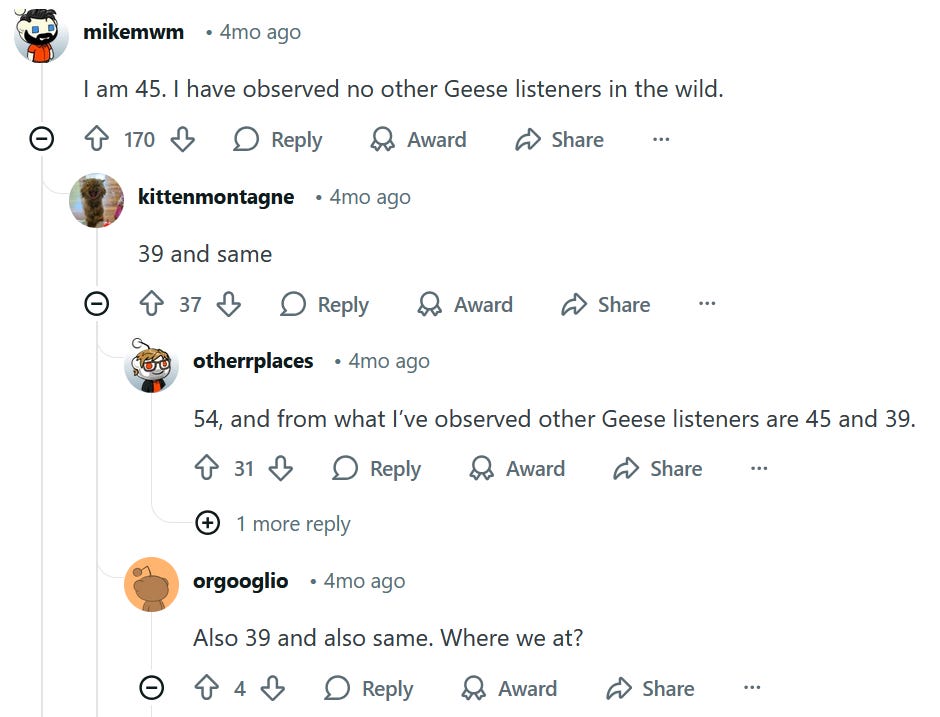
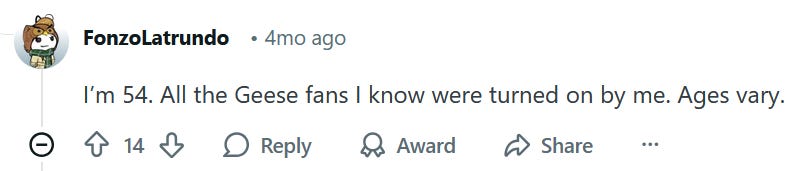
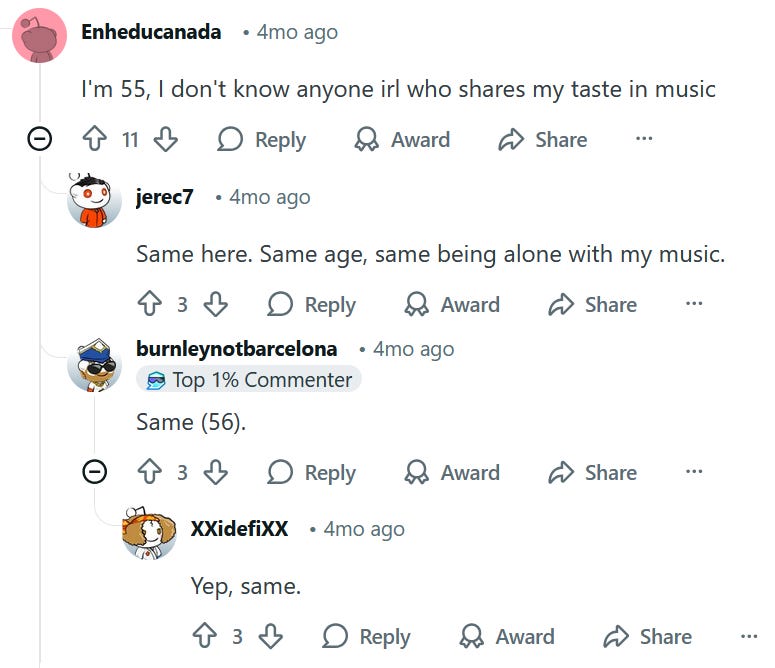
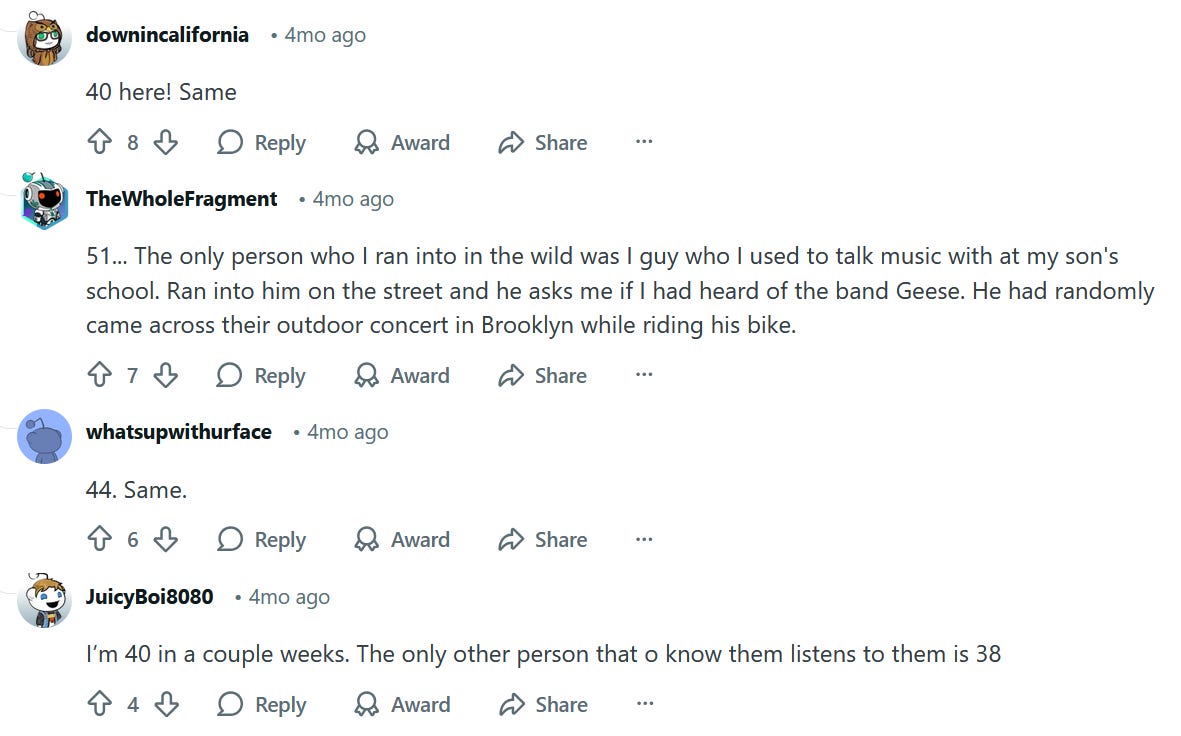
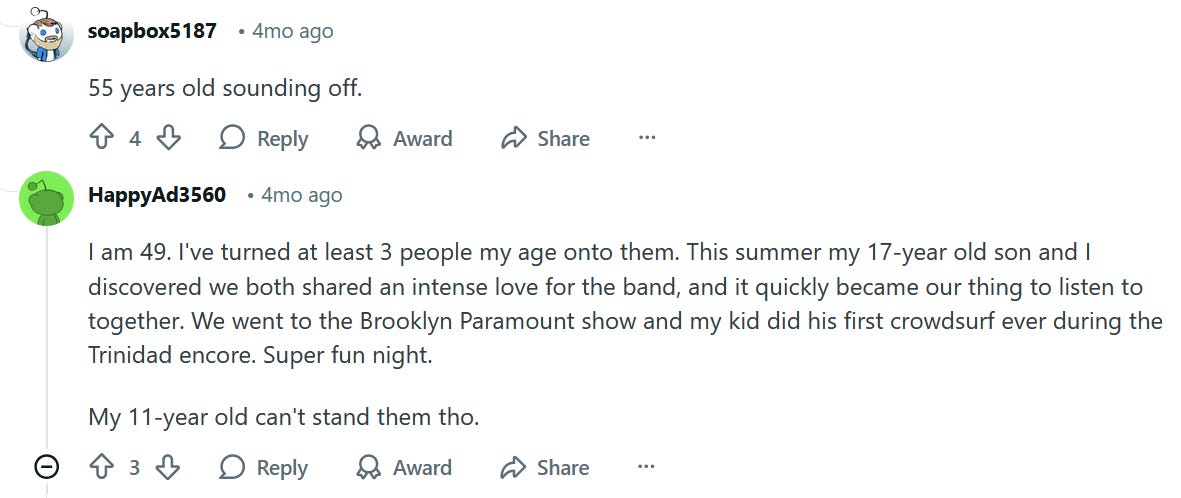
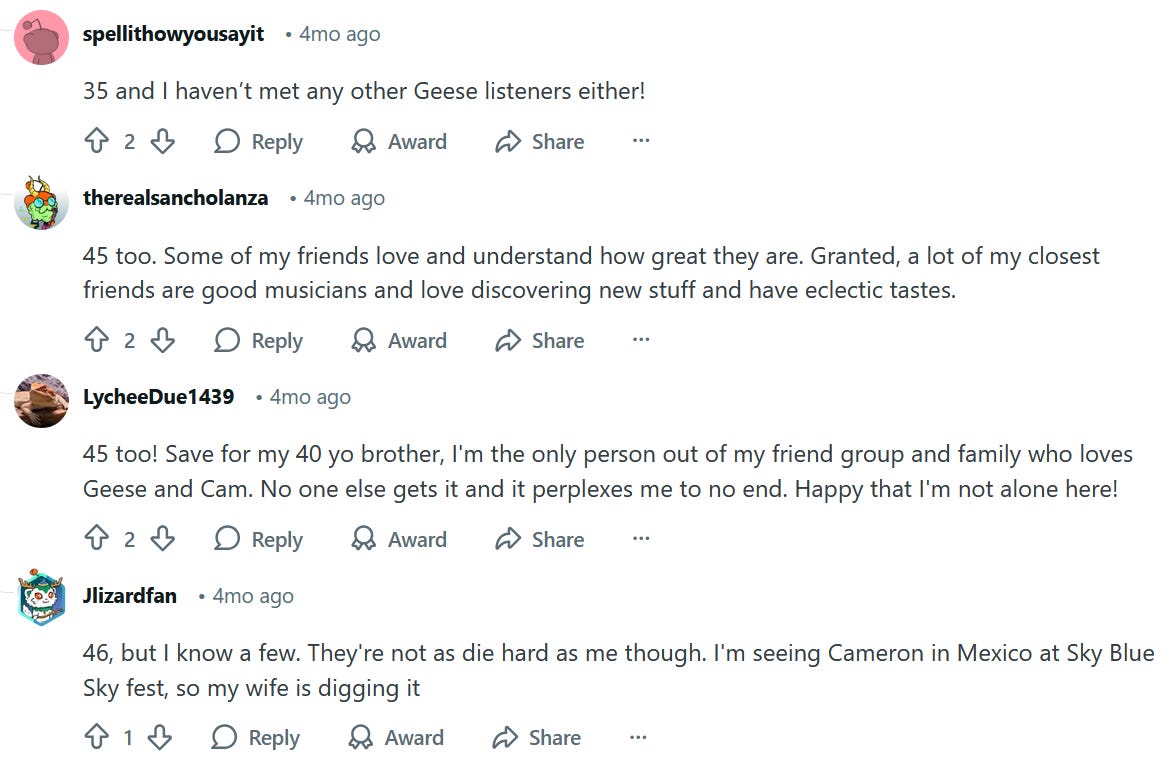
Are Zoomers even listening to Geese? Surely some are, but how many? I found a Reddit thread that asked for the ages of Geese fans. Obviously Reddit is going to skew a little Millennial/Gen-X, but this is ridiculous:
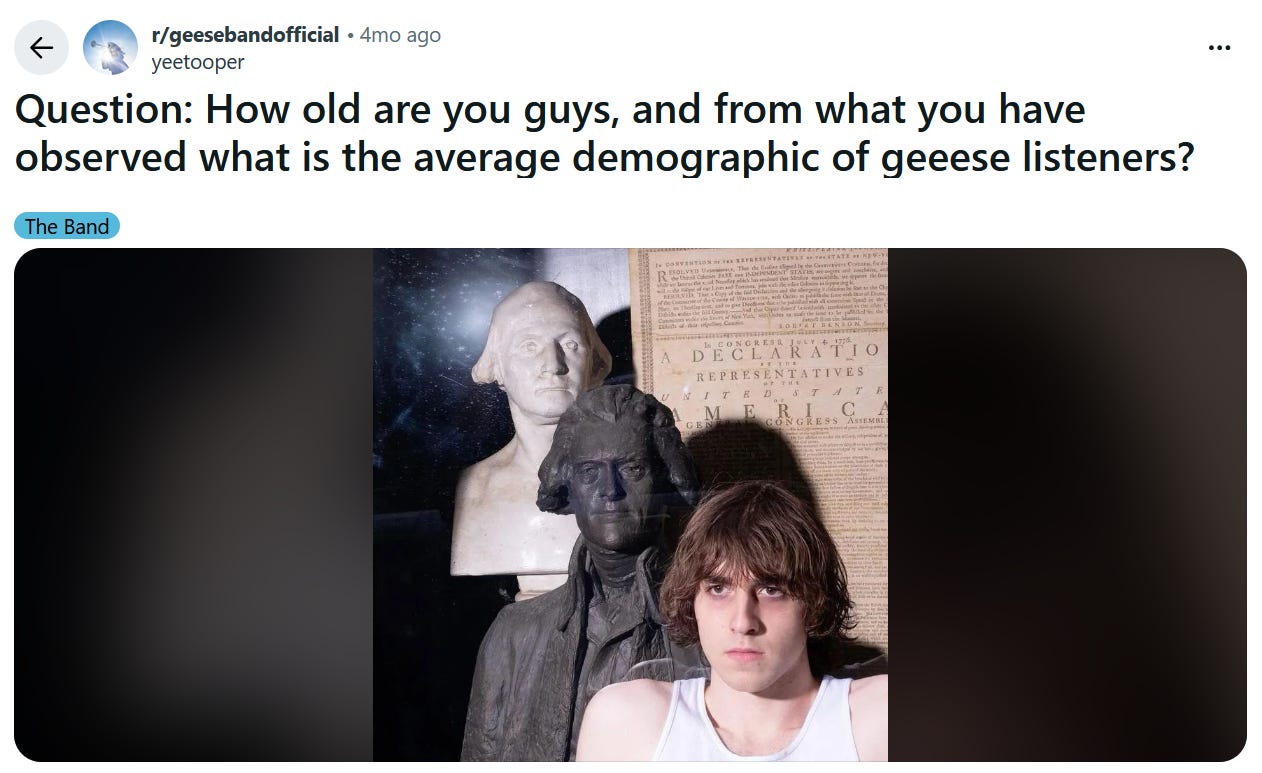
Look at this photo of Geese playing live:
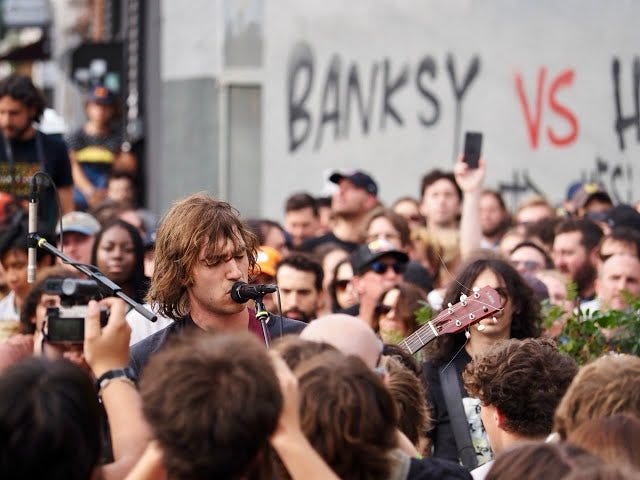
Are these guys Zoomers?
Are they??? ARE THEY??????? I don’t know. I really don’t.
Millennials invented the “Problematic Age Gap.” Yes, people have raised eyes at May-Decembers and the like before, but it was Millennials who became totally obsessed with it. Here’s the thing: I don’t believe this for a second. It’s always sounded to me like a little too much protesting. The psychosexual once again rears its head. Like how a lot of racists harbour dark desires to fuck The Other, like how a lot of homophobes wind up on Grindr, I suspect that a lot of Millennials who say this kind of shit are repressing a burning desire to fuck Zoomers (if they aren’t already). I think this goes hand-in-hand with the whole age regression thing, some super-ego ratchet is being triggered that arouses a deep sense of shame about it all. Should Justin Trudeau have gone to Coachella??? Isn’t he TOO OLD????? REEEEEEEEEEEEEEEEEEE!!!!!!!!!!!!!!!!! We’re talking about a man who supported massacring babies here.
Anyways, everything old is new again, maybe not so much just to placate insecure Millennials as it is a function of post-algorithmic content, which is predicated on recycling, pastiche turned totally systemic, and Millennials are trapped in an infinite loop of repeated cultural trends that reinforce their own nostalgia and that more and more closely approximate their referents until we’re all unstuck in time.
Or go read:
Honor Levy at the end of the wor(l)d

Burroughs was right, the word is a virus. Reading 𝓗𝓸𝓷𝓸𝓻 𝓛𝓮𝓿𝔂’s stupid fucking book, the nauseatingly-titled My First Book, gave me something akin to Long COVID. Now, I used to think a lot of people who said they had Long COVID were just attention-seekers, which is why they so often overlap with the non-specifically “queer” and with people who self-diagnose mental…
Catalogue item K no. 6; it’s sold out!
This probably isn’t the first time I’ve recommended readers pick up a copy of Yasha Levine’s Surveillance Valley (on how the internet from its very inception up and through almost all of its developments, to social media and beyond, are tied in with intelligence operations, often at the ground level) and it probably won’t be the last. Other relevant reads would be Thomas Frank’s Conquest of Cool (how “counter-culture” identity has always been playdough for nefarious ad men; the very people who got the “anti-war” hippies to start identifying themselves with “the Nazi car”), as well as David McGowan’s Weird Scenes Inside the Canyon and Tom O’Neill’s CHAOS (both tying “counter-culture” to developments in psywar and brainwashing).
For more on this, read Lizzy Goodman’s oral history Meet Me in the Bathroom: Rebirth and Rock and Roll in New York City 2001–2011.
Sire: [says nothing about the band Interpol]
I think there’s also something to the idea that Millennials, perhaps more so than earlier generations, are aware of what gen z is doing and interact with them because of the internet. There’s always been generational mixing within certain scenes and sub cultures but the way people consume algorithmic content these days means the average 40 year old can and does get into flame wars with the average 25 year old more often. That, plus the fact that nostalgia is cool now and everything is backwards looking, might be part of the reason it’s harder to tell what’s being made for who. Instead of pretending it’s 2005 and they’re 20 again, Millennials can, in a way that is at least confusing if not convincing, cosplay what they imagine being 20 is like now, and some of that is being into a band that has some gen z cred that still reminds them of music their own past.
That being said Geese did kind of sweep my gen z friend group. So I think there’s some genuine gen z fans. Plus there’s plenty of aging millennials who seem pretty crotchety about them, which is always a reliable sign it’s for younger people. Myself, I don’t really have any substantial critical opinions about music but I think they’re fine.
THANK YOU SO MUCH FOR READING MY PIECE AND THANKS FOR THE SHOUTOUT!