

Did awards judges use AI to give an award to an AI story?
And how does the rise of LLM fakes connect to "marginalized identity" writing?


Granta, the UK’s most prominent journal of new writing, published five short stories chosen by the judges of the Commonwealth Short Story Prize as their finalists representing five Commonwealth regions. The winner, “The Serpent in the Garden” by Trinidad and Tobago’s Jamir Nazir, got flagged for being the result of a large language model, or LLM (AI checkers lit the thing up as 100% probable). Having read the story myself now, I’m inclined to agree that this was the case. But then, to make matters worse, two of the other four contenders also got flagged as being the result of LLMs. I did not read those ones because I’m busy, but hey, who knows. One wonders if that allegedly AI-written novel Shy Girl might have won itself some accolades had it actually made it to publication before the alarm bells went off.
So what the fuck is going on here? Was the field packed with AI entries, or did the AI entries just somehow pull ahead of all the human entrants, and if it’s the latter, what does it say about the future of written expression? Well, here’s the thing: the story that won is fucking dogshit. It’s plainly bad writing. How did it make it this far and how did it win? I opted to track down Jamir Nazir, this “genius” of the written word, and read his other work. I wound up on his Facebook page. This is the last thing he wrote on his wall:
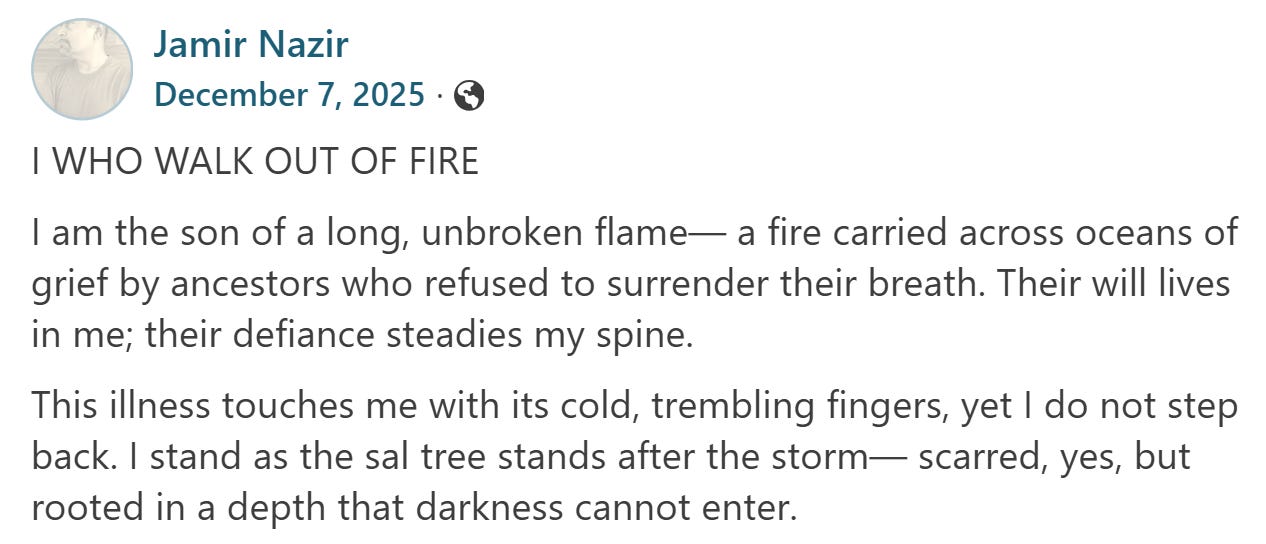
It goes on for a few more stanzas of total dogshit, but of course anyone even remotely familiar with AI writing will clock this immediately. For those of you not familiar:
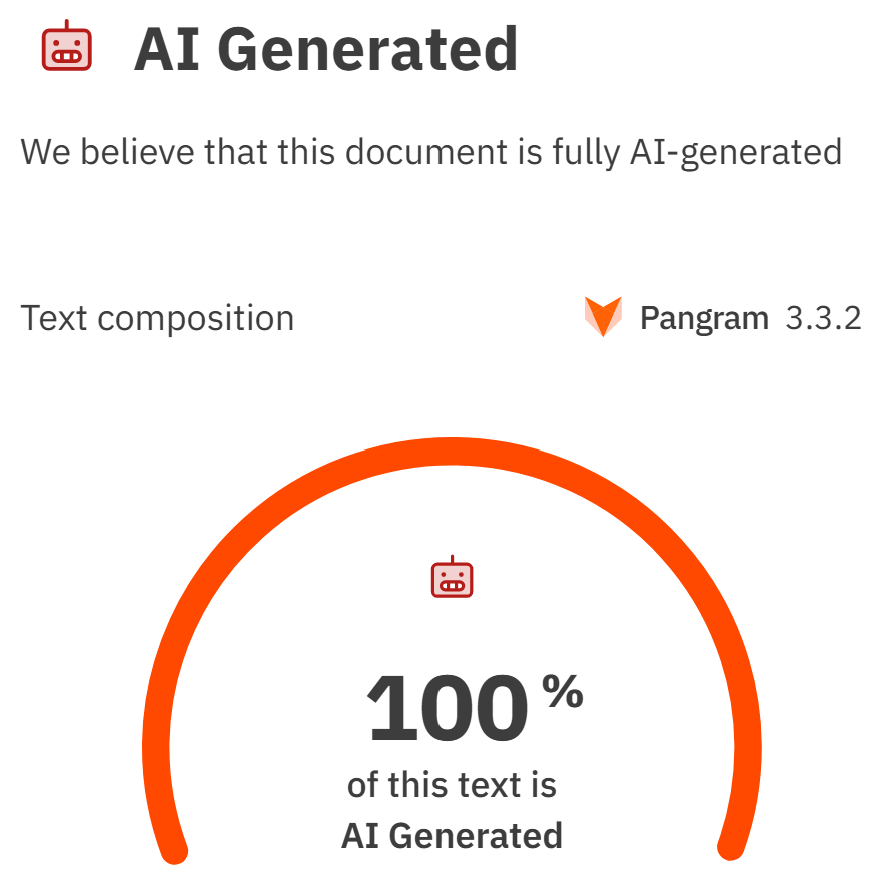
Even Nazir’s prompts clearly suck. Regular readers will remember the time I wrote at length making fun of how often Instagram poets will all write exactly the same poem between them, over and over and over again, and I specifically zeroed in on how they handled the cliché of “fire”:
Instagram poets can't stop ripping themselves off

Instagram poetry? What a dated topic. What’s next, an obit for Harambe?
Nazir’s imagination is just as shallow, and he imbibes the same Romantic corpse water runoff as the rest of them.
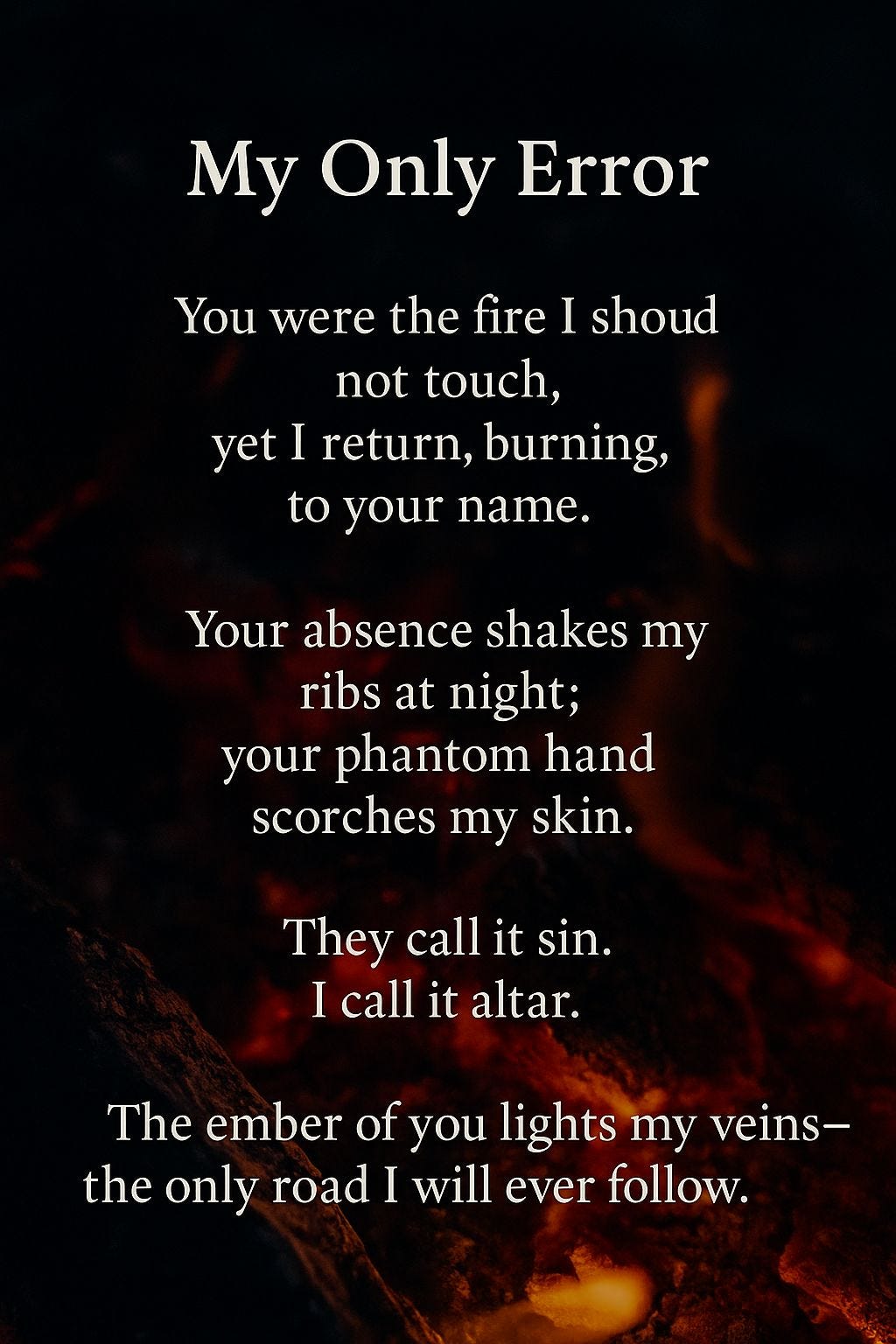
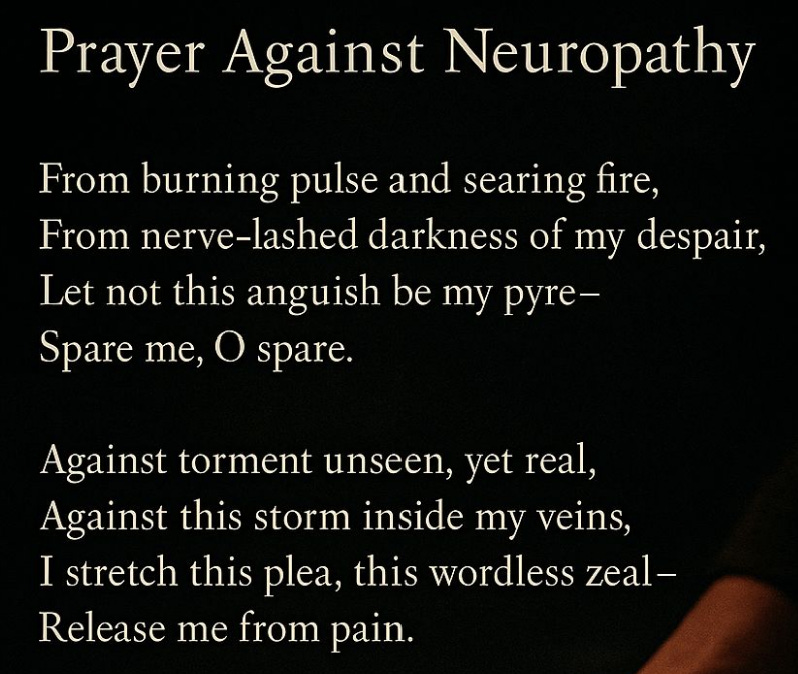
He has poems with titles like “The Flame That Walks with Me” and “When the Ember Remembers Its Name” and “The Habit of Your Fire” (?) and his poems without fire in the title contain lines like “I remain yours—a flame unquenched” and “fire laid across my chest” and “your arms gather the embers and I am reborn—a flame without end.” This basically accounts for his entire output, although I suppose I can’t say for certain—according to one comment, Nazir has “thousands of poems all ready for publication.” To his credit, he does have something his Instagram competitors don’t, which is a poem about how he suffers from neuropathy. Of course, that still won’t stop him from invoking fire again.
Nazir is so committed to his creative dullness that when it came time to write something about how the “chains” of colonialism were broken with Trinidad’s independence, he stuck with the fire conceit and called it “When the Chains Turned to Ashes.” To ASHES, Jamir??? CHAINS?????? What the fuck were they made of, WOOD?????
Even this idiot’s photo for the contest was clearly yassified by AI.1

The only words on Nazir’s page I think can be said to be confirmedly Nazir’s own writing are the descriptions in which he desperately begs for engagement from his absence of followers. “Different style today any advice and no comments will be greatly appreciated. Thanks,” says Nazir to nobody. The man they reveal can barely write a sentence.
How exactly did the judges find someone as incompetent and borderline illiterate as Nazir worthy of an international prize for writing? The first source to seek out here would be the words of the judges themselves; perhaps they can provide a sufficient explanation as to what they saw in the man’s work. Sharma Taylor, judge for the Caribbean region, had this to say about Nazir’s story:
Jamir Nazir’s language is sublime—precise yet richly evocative—conjuring vivid, lush imagery with remarkable economy. Through sharp sensory detail, he renders the Grove as a living presence, where labour, landscape, and memory are intimately entwined. Polished and confident, this is a story with a melodic voice that lingers long after the final line. Jamir Nazir’s prose pulses with a voice of restraint and quiet authority—a beautifully told and assured piece of storytelling.
…Hang on. Guys, does this… does this blurb sound funny to you?
YOU’VE GOT TO BE FUCKING KIDDING ME!!! I THINK I’M GOING TO GO FUCKING INSANE!!! I get that there can be false positives,2 but that text wasn’t even fucking trying, Taylor’s judgment was even more obviously AI than Nazir’s own fucking story—Sharma Taylor, j’accuse.
In addition to posting AI poems on Facebook, Nazir posts AI mini-essays on LinkedIn, often about how important AI is. In this one, the result of his ChatGPT prompt makes at least one valid point: the rise of AI will accelerate incompetence, and it will, as it did here, help to “amplify bad judgment.” An ironic choice of words.
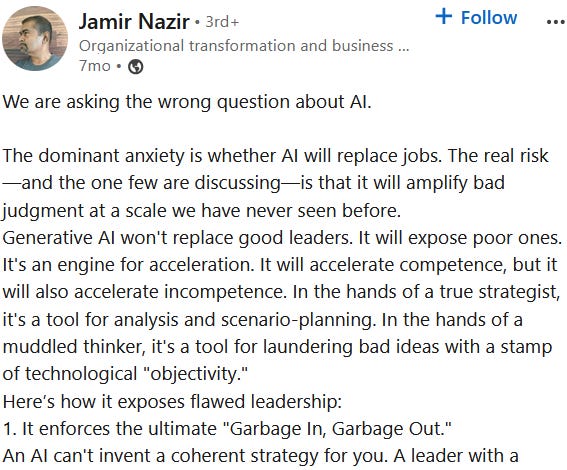
I checked the other judges, and while they didn’t set off the AI alarm when run through the checker, their explanations don’t fare much better. Rifat Munim Dip said of Sharon Aruparayil’s “Mehendi Nights” (a story also accused of using AI) that it was “an exquisite reminder that fiction is not only about portraying people’s lives but also about pushing the boundaries of storytelling.” Bro, what? Are you for real? That’s the best pull quote you could get from him? “We forget sometimes that fiction isn’t just about depicting things but also depicting things interestingly.” Oh, okay. Well hey, Dip might eat lead paint chips, it’s true, but at least he wrote that himself!
So these judges aren’t the literary world’s best and brightest, fine. One is still left to wonder how it was they fell for an AI story over one of the innumerable human ones they must have received. What happened? I’ve got two theories.
Theory #1: The Ocean Vuong Effect
Recently we got a comment from Ilona Yazhbin Chavasse3 on our old (and controversial) Ocean Vuong piece:
That thing where a sentence looks like it’s doing things but you step back and it’s word salad… the Achilles’ heel of literary novelisers. Like a box of yearning, bright, in a world of dead dreams and pollen. Oh, my great heavy cornflake heart.
What Chavasse is here describing isn’t “new” per se, but it is becoming a lot more prevalent. There has been a rise in the last fifteen years of what I often disparagingly call “dissassociative literature” (it has absolutely dominated the realm of “marginalized identity” fiction in this period especially). The effect of reading this shit is like taking a Xanax or, perhaps more accurately, a Zopiclone. Meaning blurs. Materiality softens. At its worst excesses, which have come to be its most dominant forces (most notoriously, people like Ocean Vuong, Kaveh Akbar, etc), it produces a “literary fiction” marked by extremely imprecise and haphazard language, self-evidently lazy writing which attempts to cover for its laziness with obdurate vagueness.4
Putting a premium on writing like this inevitably means putting a premium on AI writing, because the hallmarks of both are fundamentally the same. Check out the extremely bizarre and imprecise figurative language from Nazir’s story. I want to remind you that “Sharma Taylor” (or, at least, an AI extension of her) called this language “precise.” Ah, yes. Precise. Such “precision” as:
the girl smiled like sunrise over a sink
she looked once at Sita’s leg—already writing itself in purple
the liquid coming down in white strings like a tablecloth in a nightmare
white rum hot as apology
she had the kind of walking that made benches become men
and then consider that that third line is actually from Ocean Vuong’s On Earth We’re Briefly Gorgeous. If the Vibe Shift doesn’t kill off Ocean Vuong, then the LLMs will. I could generate you a million books that are completely interchangeable with Vuong’s before breakfast, you’d miss fucking nothing. Hey Grok, write me a story about Ocean Vuong’s career being killed by the Vibe Shift and LLMs!
Ocean Vuong wakes inside the algorithm like a bruise learning to bloom backwards. The boys who once underlined his sentences in coffee shops with cracked windows now ask chatbots to ache for them faster, cleaner, without the inconvenience of a human body trembling behind the page. Somewhere, a venture capitalist calls this democratization. Somewhere else, Ocean watches language flatten into the soft gray light of prediction — every metaphor pre-chewed, every wound optimized for engagement. The Vibe Shift arrives not as a riot but as a ringtone: irony replacing confession, sincerity wearing sunglasses indoors. Even grief now comes captioned, monetized, rendered into shareable fragments before it can finish becoming grief. And Ocean, standing at the edge of this humming machine, feels himself turning obsolete in real time, like a candle carried into a server farm, his beautiful sentences flickering briefly against the endless appetite of generated speech.
Terrific. What the fuck is the significance of bringing a candle into a server farm? How does one wake “like a bruise”? How about one that is “blooming”? “Backwards”? And why does a bruise “learn” to do that? What does any of this mean? I don’t fucking know. Nobody does. Ocean, is that you???
So this is the simpler explanation. LLM writing was immediately presaged by a style of writing which it is quickly making obsolete. LLMs have helped expose this writing for the vacant garbage it is, and the literary institutions will continue to take the L’s until they are forced to change their values.
Theory #2: Something more sinister
But I have another, more terrifying, perhaps more “far-fetched” theory, one which we’ll get into in a follow-up blog. In it, I will ask one vital question: what does all of this Commonwealth Short Story Prize stuff have to do with the development of AI factory software, food packing, mass surveillance, and the assassination of a foreign head of state?
An update to the story (July 8, 2026)
The plot thickens in the saga of Jamir Nazir, the Commonwealth Foundation’s prize winner with the allegedly entirely AI-written story. Discordia previously reported on this with original supplementary evidence to support the allegations, including allegations that the judges themselves also used AI. You can read all about it here.

Nazir has been difficult to reach by journalists for a while, but this last week he finally spoke to Will Oremus for The Atlantic. Oremus sums the conversation up as follows:
I was surprised to hear him opine that AI-generated writing will soon be widely accepted in literature, even as he maintained that he didn’t use AI tools in creating his story. He seemed bullish on AI overall, viewing it as a revolutionary technology, though he worried about the repercussions of saying so. Although he couldn’t name any works by Derek Walcott, a writer he cited as one of his main literary inspirations, he said that he had prepared a collection of short stories in Walcott’s style, which he hopes to publish soon.
Throughout the interview, Nazir comes off like an idiot, as he also does on his Facebook page (you can see my excerpts in my coverage of the story). Oremus doesn’t use such diplomatic language but I doubt he’d necessarily disagree (at one point Nazir effectively claims that arguments against AI writing are effectively the same arguments one could make against… writing with a typewriter?). With regards to Nazir’s hazy memory of Walcott’s work (“To be honest with you, I can’t think of a specific favorite right now. I am getting a little bit of brain fog in recall.”) I will try to be fair and point out that I myself have a bad memory for the names of poems in spite of being a published poet, though I can certainly at least tell you the names of the collections or what the poems were about. To be less fair, as Lincoln Michel also pointed out, Nazir suggested he thinks Walcott wrote short stories. Which he did not.
NOW HERE’S A PIECE ABOUT THE CULTURE WRITER WE’RE DEEMING MOST LIKELY TO DEVELOP AI PSYCHOSIS IN 2026: RICHARD BRODY!
Is New Yorker film critic Richard Brody sundowning?

And also some thoughts on how the copy editing department of The New Yorker is secretly a cult
My theory on the profile photo is that his prompt included the phrase “make me look like an older James Bond” and it decided to fuse him with an older Sean Connery.

EDIT: WE’VE GOT A LIVE ONE HERE! One of the other two nominees accused of using AI, Sharon Aruparayil, absolutely also used AI to yassify her photo. In fact I think the yassification input specifically used the original image on the left. Take a look:

AI detection is pretty finicky and it can often flag writing that isn’t AI as AI—you can test this on older pre-AI writing, I’ve found that surrealistic writing may especially set it off, but never in my experience to the extent that it the checker will claim it’s 100%. The fact that both Taylor and Nazir got flagged as 100% AI is crazy.
Noted English translator of the novels of Yuri Rytkheu.
We have a very good piece by Dj Sandler in the works that talks about the political character of this style of writing as well, so look out for that one.
This wasn’t a comment on Vuong specifically - I suppose translators are especially attuned to sentences like this because we have to parse them in order to render them and the experience of reading them into another language. As a reader, you can skim along a sentence just getting the feels and often that’s enough. A translator wants to understand what every word is doing and what it’s for.
https://ilonayazhbinchavasse.substack.com/p/how-translators-read-artificial-intelligence?r=89g7cz&utm_medium=ios
i felt like I was watching Jerry Springer for the literary world and thoroughly enjoyed this