

Katie Kitamura's 'Audition' doesn't land the part
One of last year's most lauded books also has some of last year's worst prose


Recently an incel tried to shoot up PornHub here in Montreal. His would-be rampage had him kill just one person other than himself, while the other victim was allegedly actually accidentally shot by the police. TIE GAME! Very apropos as Canada’s World Cup was debuting.

The incel’s manifesto was executed with about the same level of competency as his killing spree. The thing is not only completely ideologically incoherent—the shooter complains that capitalism is the source of “hypergamy” (the incel belief that women get to date men who have “higher partner value”—better looks, more money, etc.—than men do), believes women should be kept out of the workforce (wouldn’t this make “hypergamy” worse because most women wouldn’t have their own finances at all?), and some belief that trans women are part of some sort of a pipeline of driving men to suicide—but also simply badly written. At one point the author complains that women “[allow themselves] to become flagrantly corpulent and/or generally unclean.” This kind of laughable thesaurus-speak is how a lot of incels write, generally with the assumption that this verbosity comes off to make them sound like a sophisticated gentleman rather than revealing a mostly clumsy handle on language.
Katie Kitamura may write better than an incel shooter, but only just barely.
Kitamura’s acclaimed novel Audition was named a “Best Book of 2025” by The Washington Post, The New Yorker, NPR, Vogue, TIME, The Los Angeles Times, Marie Claire, and Barack Obama (…why are we still paying attention to that man?), and is about a successful actress who encounters a boy who claims to be her son, an impossibility as she has never given birth. Thrills ensue, minds are bent. Riverhead Books’ press material calls it a…
…compulsively readable, brilliantly constructed novel […] rewriting our understanding of the roles we play every day—partner, parent, creator, muse—and the truths every performance masks, especially from those who think they know us most intimately.
However, like the incel dope, Kitamura aims for a kind of grandiloquence that sounds like it’s trying to be “sophisticated,” only to come off as incredibly forced, even gauche. When Kitamura’s protagonist walks through a door someone held open for her, she does so “according to the imperative of mere courtesy.” When she doesn’t notice something, it’s because she “was thus discombobulated.” An affair becomes a “sexual entanglement.” Five dollar words are great and all, but you shouldn’t rack up too much of a debt if it’s not necessary. Kitamura does not have that restraint—women be shopping!!!!1!!!1!! Where a mere “approval” would do, she opts for “approbation.” Where she really ought to reach for “clear,” she grabs “delineated.” When it’s time to say “flattery,” she goes for “blandishments.” It’s not that something “lacked for complexity,” it’s that it “did not have the requisite dimensionality.” Remember when people on Reddit or 9gag or whatever used to write “fancy” versions of rap lyrics? This sounds like that.

I get the sense that this is what Kitamura thinks writing “is”: knowing a lot of big words and then using them to construct wordy sentences. As a result she produces some truly terrible prose. Take for instance:
I heard a teasing note in my voice, perhaps because I was not comfortable talking about Murata and I wanted to direct Xavier’s attention elsewhere. The flirtation was a habit, one that had quieted over the years as I grew older, but that could still at times awaken.
It was a habit, and it quieted. But then it… awoke? It would make more sense to say it had grown dormant, and then awoke. And then there’s the decision to call it “the flirtation.” “The flirtation”? Not only does that just sound bad to the ear, but “flirtation” usually refers to an instance of flirting, or a flirtatious relationship someone has with another person, it does not refer to someone’s disposition. Check Cambridge, Webster, Dictionary.com—that’s just not what that word means. It’s just Kitamura trying to make the sentence sound wordier—the correct phrase would be “the flirting was a habit.” Beyond correctness, it just sounds better. Or she could opt for “coquetry”! Or how about the line
Evidently sensing this—our desire to please, and perhaps even more, for continuance, we were only trying to maintain the equilibrium that we had attained—Xavier made his demand
“our desire to please, and perhaps even more, for continuance,” which has a lot of the same problems, right down an extremely ugly and awkward choice of form for a rather common word—“our desire for continuance”? How about “our desire for continuity” or “our desire to continue”? All of which is to say nothing of her awkward parallel between an infinitive (“to please”) and a preposition (“for continuance”). This is supposed to be a verbose, sophisticated narrator with heightened language, right? Why is she eating shit in nearly every sentence like this?
Kitamura loves to take normal words like “flirt” and “continue” and add unnecessary affixes to them to make them longer and sound smarter (I hear lawyers in court attempting this same gambit all the time, and it just makes you sound like an idiot). She’ll call something a “small act of domesticity”1 when it could just be called a “small domestic act.” But, see, the former “sounds” smarter because “domesticity” is a fancier word than “domestic,” and Kitamura is willing to sacrifice rhythm just to insert it here—“small ACT of do mes TIC i ty” vs. “small do MES tic ACT,” like with the previous example, her prose drags. The whole time I read this thin yet simultaneously bloated novel I felt the desire to reach for hedge trimmers. Trim “the similarity between us, which was more than the fact of our shared race” into “our similarity was in more than our shared race,” or “a period of extraordinary concordance in my marriage” into “a harmonious period in my marriage,” and so on. Listen, I’m not a minimalist—I love piles of adjectives and adverbs and long descriptions and digressions and meandering sentences and embedded clauses and parentheticals and I even love big fat words…2 but this is just bad writing. This is a high school student trying to sound smart in an English class essay.
How about this: “I had not been so closely attuned to Tomas in years, to the subtle weather of his moods, the cartography of his expression.” I find the comparison of his moods to “subtle” weather hackneyed on its own (and she could have used that “big vocabulary” of hers to choose a more suitable adjective like “equable”), but then she pairs it with “the cartography” of his expression. Weather is a natural phenomenon, cartography is making or studying maps. The weather analog to cartography, for instance, would be meteorology—since she is the one studying the natural phenomena in this sentence, it would make more sense to say she’s attuned to the weather of his moods and the geography or maps of his expressions, or otherwise to say that she’s a meteorologist of his moods and a cartographer of his expressions.
The book is filled with mixed metaphors like these. Kitamura describes “the apparatus of our marriage growing rickety”—when would anyone ever call an apparatus rickety? Yeah, I get that in a sense a “bridge” or something could be an “apparatus,” but then why not just say bridge? “The current of intensity running between Xavier and me. Its source was an imbalance of want.” “Currents” have sources, so I sort of get tripped up finding that the source of the current was… an imbalance? At one point the protagonist’s husband is “transformed by the breadth of his emotion, stepping outside himself and extending the boundaries of his being” and his enthusiastic wife thinks, “I wanted nothing more than for Tomas to stay inside the container of this feeling.” Wait, hold on, he’s stepping outside of himself… into a container? Man, even the second last sentence of the book includes the phrase “a chain of words, sturdy as a cable”—ARE THEY A CHAIN OR A CABLE??? And then there is perhaps my favourite:
the part [an actress plays] is only working if I lose sight of the shore. But at the same time, it’s important to be able to come out the other side, you have to be able to come up for air.
????? Lose sight of the shore, okay, but… Come out the other side?? COME UP FOR AIR???? What the fuck are you TALKING about?????? Only for this metaphor to come back a few pages later in order to get further extended and muddled:
I also thought that if ever an actor had lost sight of the shore then it was this one, he had stumbled deep into the interior, [also this is a fucking comma splice!] and I wondered if he worried that he would never find his way out, if the world of fiction had lost its protective powers, the line between reality and invention undone.
???????? If an actor loses sight of the shore, then he’s… in the interior? And the interior is like… a shield? But then it isn’t anymore if you’re lost in it? Because the shielding is… also like a… territorial border? Is he still at sea??? More importantly, will he be able to COME OUT THE OTHER SIDE or COME UP FOR AIR?????
Even when she pulls it off she still manages to hamstring herself. Kitamura’s narrator describes a scene in the middle of a play as sitting “in the center like a black hole or box.” I take it she means “black hole or black box” (which actually sounds nicer with the repetition of the word “black” in my opinion), and that’s actually not a bad parallel—a “black hole” contains “nothing,”3 and in a sense a “black box” contains “everything”—but the resulting sentence makes it sound like she’s comparing it to either a black hole or……. a box. You know, like a cardboard box. Sometimes I simply have no idea what she means: “I had been troubled by the silence that had constellated around the abortion.” The silence that did what?
There are other head-scratchers too, imprecise turns of phrase, fumbles like “the name of the restaurant was brief.” Or descriptions such as, “…different from the usual irritation and worry with which he would scroll through the news or his messages.” I have scrolled while irritated, perhaps I have even scrolled while worried, but I have never in my life scrolled with either irritation or worry, and certainly not both. What does it look like to scroll not while irritated and worried but with irritation and worry? Like, as an act, how is the scrolling meaningfully imbued with those emotions? It’s supposed to be describing a typical annoyed and concerned internet user but makes it sound like he’s regularly fucking frantic scrolling his phone like a maniac. Then consider the string of syllables that make up “…the usual irritation and worry with which he would…”—this set of words sags in the middle of the sentence like the gut of my obese cat. This is, once again, just terrible intuition for the rhythm of language. Even just off the cuff, here’s a better sentence: “unlike his normal air of irritation as he scrolled the news.” Nothing fancy! Anyways, shit like this is all over the place. “He ate with steady and controlled gusto.” Controlled gusto? “His movements were spiky and exaggerated.” Spiky? “He turned, with a wandering movement of the head.” What the fuck?
Or how about something like “a feeling of regret so pronounced it seemed to exert a gravitational pull, it seemed to pull me to the ground.” If the feeling had gravitational pull, it would pull you to itself, not to the ground, which already has a gravitational pull, Katie. Or:
absence was not the right word, it penetrated further than that, because we did not speak of it to anyone else
…huh? Is something only suitably called an “absence” if you talk about it? Or:
people always talked about having children as an event, as a thing that took place […] they forgot that not having children was also something that took place […] it had its own presence in the world, it was its own event
If not having children is “an event,” one which had “presence in the world,” then when did it take place? And even ignoring that, could you not say this about literally anything that didn’t or doesn’t happen? I never fucked Andre the Giant. By this logic, that was an event in my life, not fucking Andre the Giant. It has its own presence in the world, it was its own event, not fucking Andre the Giant. I don’t fuck Andre the Giant basically every day, so, if anything, this is a continuous series of events, I’m a total anti-slut for the late Andre the Giant.
And then there’s the repetitiveness. Not only is the prose incompetent, it’s also trapped in a cycle of infinite vocabular recurrence. In spite of every attempt on Kitamura’s part to slot in as many GRE words as possible, she still winds up using the same smaller-budget words over and over and over again. People are constantly “nodding.” I did a search for the word “nod” in all its variations and it is used forty-five times in one-hundred-and-forty-five pages. That’s like one “nod” for every three pages. People “stare” forty-seven times! This is also, as you might imagine, not merely lexically repetitive but situationally repetitive. Yes, the word “stare” and its derivative forms repeat forty-seven times, but this does not count circumstances in which people “stare” without using the word “stare”—characters “gaze” (twenty-three times) and “watch” (thirty-nine times) and whatever else. And hey, maybe this plays into the theme of, you know, acting and being looked at and all, but then what does nodding represent? And is whatever that theme is even more present in her novel Intimacies, where characters are described as nodding EIGHT-SEVEN TIMES? Kitamura has hardly any idea how to describe a character action that isn’t either bobble-heading or being locked in a staring contest. Or maybe they’re “turning,” which recurs eighty-nine times.
And yet the few times she’s not resorting to these stock descriptions of character actions, her choices are utterly bewildering, such as this part where the narrator details what can only be described as “being terrified of her husband aggressively eating nuts with sadness”:
He continued to cram nuts into his mouth and I thought that he must really have been hungry, he ate with a gusto that was not in and of itself off-putting, it was simply a man eating, and yet I recoiled, something in the crunching movement of his jaw was alien, it was briefly the face of someone who thought he was alone.
…which Sire tried to sell me on as a moment of shock at seeing the emotional nakedness of her husband, but it’s just described so incompetently that it, like much of the book’s prose, requires you to stop a second to figure out just what it is that Kitamura expects you to get out of what she’s just written. The words feel as crammed together as the nuts in her husband’s mouth.
And then there’s the states! Everything is a state! Someone might be in a “state of heightened attention” or a “state of almost preternatural concentration” or a “state of unease” or a “state of agitation” or a “state of frenzied conviction” or, perhaps most hilariously, a “state of being a child.” For fuck’s sake, at one point she uses it twice in a row.
Perhaps for that reason I had been lulled into a state of unthinking complacency. As I continued walking down the street, through that soft rain, I began to wonder how long I had been in this state of excessive inurement.
And don’t fucking start with me with the “oh, well, you see, it’s because it’s about acting, and—” it recurs just as much in the aforementioned Intimacies. In fact, here it is twice in a row again in that book:
whether he would be in a state of shock or rage, whether he would be utterly silent or whether questions and accusations and counteraccusations would pour out of him, whether he would simply be tired from his journey, like a businessman disembarking a longhaul flight, or whether he would be in a state of physical collapse.
…and that book further contains the incredible sentence “a state of I know but I do not know.”4
Like with a lot of Kitamura’s choices, it usually isn’t the right one. Back to Audition, when her protagonist says “I left the restaurant in a state of considerable relief,” for instance, I think… is relief really a “state”? Isn’t it more of a reaction to the alleviation of stress that transitions into being relaxed? The sentence would make more sense as “I left the restaurant considerably relieved”—and, once again, it even just sounds better!—but then of course Kitamura doesn’t get to use those precious extra words she loves so much.
Words, words, words. Kitamura loves words. I thought I loved words, and I think I do love words, but I don’t think I love each and every one of them as unconditionally as she does. For her, there are never enough words and they are never in the wrong place. Sometimes she’ll basically just repeat the same ideas using near-synonyms—often, in fact! Howsabout “it was an emerald necklace, beautiful and extravagant” or “I had regarded his face with such scrutiny and attention” or “it was an echo or mirroring” or “she gave a small smile, vain and self-satisfied” or “I winced in pain and alarm” or “it was only a feeling, an intuition” or “I had given in to his story, his narrative” or “my hauteur, my arrogance”5 or “it wasn’t a question of absence, a question of lack” or “one person who wants into an absence, a void” or “she used language that was confusing to say the least, that seemed designed to obfuscate” or “they wore expressions of approval and general goodwill” or “he sounded thoroughly rational, not at all like the kind of person who could have believed so fervently in a fantasy.”
Her idea of adding nuance to a description is to describe two things seemingly at odds at once. Sometimes even preceded by the phrase “at once”: “at once present and neutral,” “at once there but also not there,” “at once startled and blank,” “at once wholly plausible and completely vague,” “at once absolute and condescending,” “at once sullen but also prideful and excited,” “at once abject and defensive,” “at once too obvious and too painful to address.” “Here, it is possible to be two things at once,” says Kitamura’s narrator. Yeah, no shit! STOP. You. Yeah you. Stop typing, I see you—no, yet again, this repetition is present in her other books too, I checked.
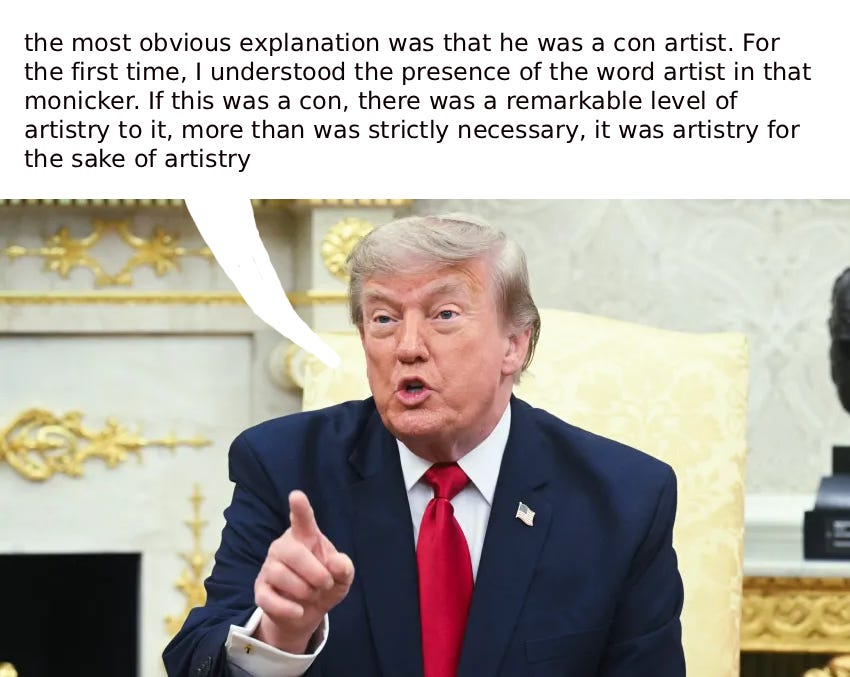
The words, words, words just wear me down. Instead of saying they “circled each other like prizefighters,” she says they “circled around each other in the manner of prizefighters, wary and in a posture of constant assessment”—like, yeah man, this is a pretty cliché comparison, we all know what you’re trying to get at, you don’t need to belabour it. “The mind […] reaches for the most obvious explanation, and in the way of Occam’s razor, the most obvious explanation is often also the correct one”—yeah, got it, thanks Katie, we know what Occam’s razor is. “It mattered, the vocabulary, the way a word circulated through society, the context and atmosphere that was created around it”—holy shit!
Sometimes it’s just like…
I have a feeling that there are some… personal limits on display here. I checked the book’s Wikipedia page and read this:
Kitamura came upon the idea for the novel in the 2010s, when she read the following headline: "A stranger told me he was my son." She was careful not to read the article that accompanied it, because she was "interested in the illogical nature of the headline. The two terms, 'a stranger' and 'my son', seemed diametrically opposed, even mutually exclusive. I didn't want the mystery of that opposition to be resolved."
…what? How is that illogical? What mystery? Surely we can imagine pretty easily what the headline is probably alluding to. A woman gave up her son, and the son found her. Yet the headline shook Kitamura to her core. The words to her “seemed diametrically opposed, even mutually exclusive”—wow, she just talks like that in real life, huh?
I assumed while reading the thing that Kitamura must be, like… twenty-five, or something, young enough that she hasn’t been writing very long and has maybe not spent enough time going to, idk, talk to bank tellers or something to pull off this kind of register. But no. Kitamura is nearly fifty-years-old. And she’s been publishing books since at least 2006. That is fucking crazy. Does this writing sound to you like someone who has been doing this for twenty years??? The book is, to put it mildly after ALL of that, amateurish. The only thing “literary” about it is the way that it performs “seriousness” by being wordy and boring and severe and repetitive. But I get why people like it! I didn’t even get into this in this review because I was… preoccupied, but the story at the heart of Audition is extremely disturbed and twisted in a way that legitimately got under my skin in a distinctly different way than the prose did. But the prose battled me the whole fucking way. It’s presently being adapted for film, a medium where I suspect the material could succeed far better than it did on the page.
Something that only really settled in as I was finishing the thing was how much my reception of the book was coloured by its marketing, because the book is so boldly marketed as what it’s not, which has simply been regurgitated by the outlets covering it. NPR called the book “a tightly wound family drama that reads like a psychological thriller.” But that’s not true. The book’s just a psychological thriller with familial themes that “reads like” pretentious literary fiction. This is part and parcel a result of the whole “literature trend” thing that I keep harping on about.
Reading is hip again because nobody can read anymore

Read a rather terrifying piece in GQ by Josiah Gogarty the other day, describing the Soho launch of something called The Toe Rag, an apparently hip London literary mag. The place sounds like it was positively stuffed to the brim with the Gentrification Vanguard.
There’s a premium now on capital-L Literature, and so now work is being shoehorned in that doesn’t really belong in there if there’s a sense it can be sold to the trend-mongering dipshit. This isn’t… really lit, is it? Maybe I should treat this as the thriller it is?
But I’m a “lit” guy, and this is being sold as “lit,” and this is a bad “lit.” The prose is overwrought and brutally stupid, and it would have done far better to drop the act and stop trying to be “respectable,” a charade worse than any of the performances in the book, which makes it nearly unreadable to me. The fact that it was selected by the Booker and Pulitzer judges would concern me about people’s ability to distinguish good writing if it weren’t for the fact that I already think those two in particular are just galleries for the hand-selected best-sellers that the publishers who submit them are seeking to advertise, and are likely far from competitions of merit. I don’t even think the judges read the books anymore outside of the press releases.
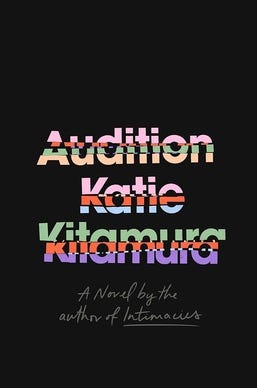
Audition
Fiction by Katie Kitamura
Assembly Press, 2025 (Publisher’s Site)
KITAMURA’S BOOK SURE SEEMS COMPLETELY UNEDITED. WHY NOT READ THIS ESSAY ON THE JOY OF BEING AN EDITOR?
Not a living, but maybe a life

As I once said to a young person who asked me how one gets a career in literature, “You probably can’t make a living in writing. But you can make a life.” And I’m living one.
She is here talking about regularly having breakfast together.
Physicists, do not @ me, I mean this in the colloquial sense.
You know what, I actually kinda fuck with this sentence.
One of my pet peeves is the use of the construction “my [quality], my [other quality or other word for the first quality].” Kitamura uses it a lot: “my hauteur, my arrogance,” “his story, his narrative,” “my skin was strangely mottled, my appearance repulsive,” “their mutual admiration, their curiosity,” etc. Often the sentence would either be better if you used an “and” instead of a comma. And if it’s the type of construction where you are really just repeating yourself or using a more specific word, then why didn’t you just use the second fucking word in the first place?
I'm not really sure "imperative," "discombobulated," and "entanglement" are $5 words ?
comparing a writer you don't like to an incel murderer for shock value (and to implicitly up the import of your review by linking it to The Big Issues) is hackery of the highest order. If you don't like something, just dislike it with your chest; you shouldn't need a bad-writing-is-evil frame to place around it that doesn't relate to or explicate the rest of the review at all. Now me personally I wouldn't trivialize anybody's extremely recent murder by using it as edgy-cutesy table setting for a review of a book that came out months ago but maybe that's why i'm not popular on substack