



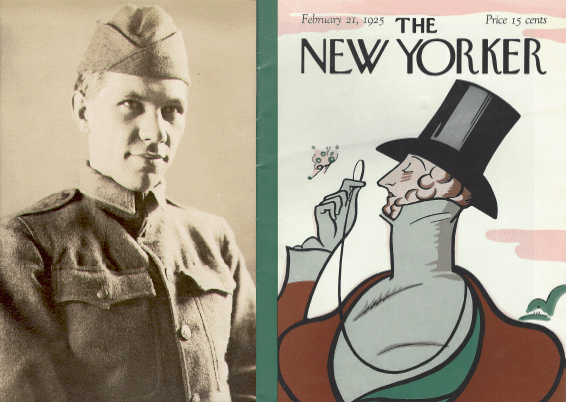
Exactly one century ago, Harold Ross founded The New Yorker with his wife, a magazine that he had declared in its announcement would not be “edited for the old lady in Dubuque”—that is to say that this was going to be a magazine for snooty, “coastal elite” assholes rather than “Middle Americans.” Ross had a lot going for him. A clear and precise vision. Years of experience in the publishing industry. A team of sharp-witted, sardonic writers who would define the metropolitan tone that would become indelibly synonymous with the magazine’s golden age. Oh, and a history of working closely with US military intelligence.
Ross had had a previous gig as the editor of the US army’s Stars and Stripes magazine during the First World War, a magazine for the troops commissioned by the American Expeditionary Forces. The G2-D division of the AEF’s intelligence apparatus, which dealt largely with what we would now call psychological operations against the enemy,1 recreated the Civil-War-era magazine as a means of controlling soldiers’ access to information and boosting morale. The man who supervised the publication, Walter C. Sweeney Sr., praised Stripes’ effectiveness as a propaganda tool, and described the necessary skills for success in his division as including an “understanding of publicity values, the psychology of people in the mass… and the immense value of broadcasting or releasing good news at the right time and in the right way.”
In the immediate aftermath of the conflict, post-war economic shocks, as well as grief at the war’s senseless imperial waste and outrage at government overreach in incidents such as the Palmer Raids in 1919, had, among other things, created a climate in “intellectual” magazines that was beginning to drift to the left, allowing some left-wing ideas to accrue cultural capital within the intellectual sphere. These developments made the American ruling class rather anxious, as such developments tend to do. Intellectuals were possible members of a radical ideological vanguard, and so the suppression of critical tendencies among their number was seen as essential to keeping a temperate political climate. The New Yorker, conveniently, was rather apolitical—smugly so, even. With its catty irony and sneering side-eyed perspective, The New Yorker, soon ascendant among college-educated Americans, could make personal involvement in political issues seem gauche and help create a trendy image of an urban sophisticate who was above such matters, which in turn contributed to the curtailed influence of magazines like The Nation. Dwight Macdonald summed it up in a 1937 polemic in Partisan Review:
The New Yorker owes its present dominance to the fact that it is the only important vehicle for the humor of the urban intelligentsia. From the Civil War to the World War, the dominant school of humor based itself on the small-town culture of the hinterland. Humorists like Artemus Ward and Bill Nye attacked the big bourgeoisie of the East in their cultural outworks at the same time as their political allies, the populists, attacked the East in its economic citadel: Wall Street… In the post-war Kulturkampf the provinces steadily lost ground to the intelligentsia of the big cities. Populist humor gave way to sophisticated humor.
That is to say that the aforementioned hypothetical reader in Dubuque was in possession of a sense of humour not so much parochial, as The New Yorker’s mission statement may have suggested, as it was often sharply at odds with the decadent urban aristocracy that in a few years would help plunge the country into the Great Depression.2 Macdonald’s critique does ring at least a little bit hollow, however, when we consider that before too long he himself would work for The New Yorker as a staff writer. Oh yeah—and that he simultaneously began well-documented work for the CIA.
It is awfully convenient the way The New Yorker so fortuitously prefigured the mechanisms of the Cold War cultural strategy of propagating political detachment. Ross’s proximity to military psychological operations and his demonstrated ability to manage moral attitudes among the troops must be seen as a formative influence. Was he acting under direct orders from elements of the government in a role similar to the part he had played during the war? It’s certainly not beyond belief. During Ross’s time working for the intelligence officers at G-2, military intelligence was changing dramatically. Ralph Van Deman, one of the heads of G-2, was working tirelessly to create a centralized intelligence apparatus for the United States, with a special eye toward the incorporation of journalists as spies—even culture journalists, as his division’s most valuable spy for years was the theater critic Marguerite Harrison.3 It wouldn’t be a stretch to imagine that Ross, who was already on the payroll, was likewise picked up for similar purposes.
Of course, The New Yorker’s foreign affairs attitudes have never been entirely uncritical of the United States. The famous “Hiroshima” issue in 1946, for instance, did a lot to challenge American perceptions about the ethical nature of the dropping of the atomic bombs, though these are notably criticisms after the fact. When war is on the horizon or in its early stages, The New Yorker is often quick to assure its “intellectual” readership that the coming war is justified, or, at least, “complicated” in that special way that liberals like to assess things. Take, for instance, A.J. Liebling’s coverage of the Korean War in 1950, which you can read all about on a page opposite an ad for Chanel’s Nazi perfume.4
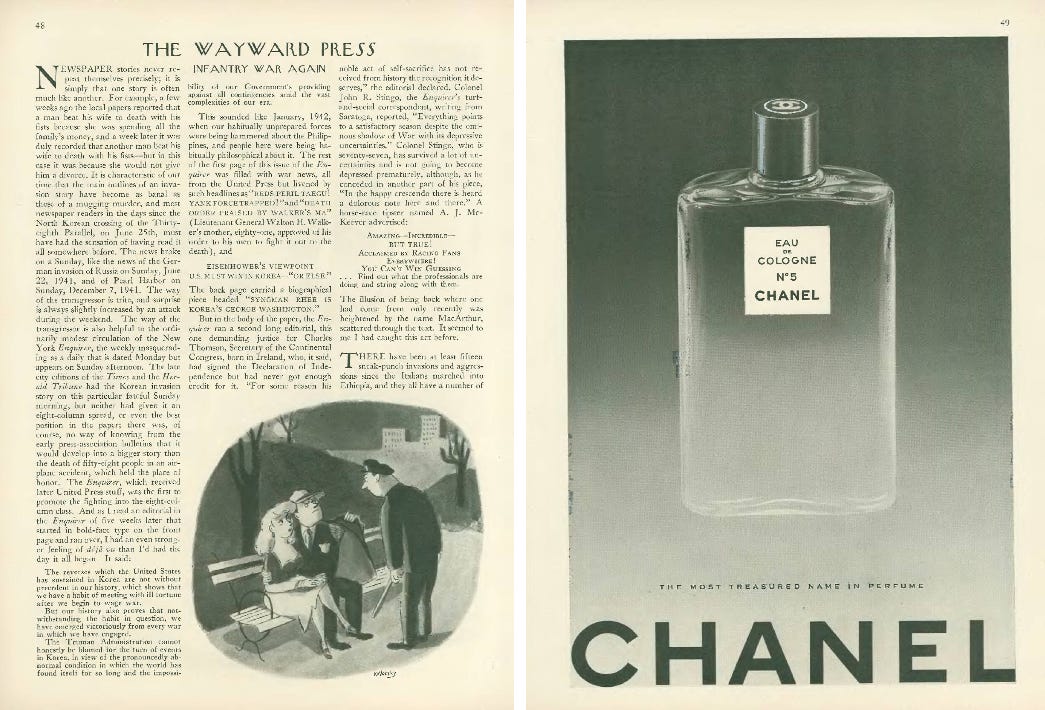
Liebling spends a significant amount of time dressing down journalists from The Daily Worker and The Daily Compass for their support for the North and those magazines’ suggestion that the Americans not get involved. Liebling balked at the idea that there could be any case to “liberate” South Korea from the grip of its psychopathic president Syngman Rhee and pointed to a single anecdote about some South Koreans helping American troops to prove that American involvement was popular and supported. The truth, of course, is that the US-installed Rhee was a tyrant fresh off of murdering hundreds of thousands of innocent civilians such as he did in the Bodo League mass executions and the Jeju massacre.
Funnily enough, Alan Winnington of The Daily Worker (the very same magazine Liebling attacked for its “biases”), would the following year, after actually visiting Korea, bravely report on the execution of 3,500 political prisoners at Taejon; torture of POWs at Koje-do; and the deliberate napalm bombing of North Korea’s delegate to armistice talks by the United States in order to try and prolong the fighting, all while Liebling sat snickering in his cozy New York office. Anyone with a lick of journalistic sense would have been able to tell that something was amiss about the war’s coverage, but western journalists failed in their duties to the public, and opinion columnists in the magazines of American letters like The New Yorker failed to hold them to account or to question any of it. Their ability to sweep that war under the rug is a big part of why to this day the Korean War is largely absent from the anti-war cultural imaginary, in spite of its catastrophic costs and Vietnam-tier war crimes. The Korean War was already underway when Liebling was writing, but had there been significant domestic opposition to the war—something journalists like Liebling could have worked to foment—had people actually known what was happening, American escalation could have been mitigated. Liebling’s advocacy for “objective reporting” (which you can read all about in his nauseating book of liberal fourth-estate-fellating, The Press) amounted largely (as it always does) to liberal elite consensus taken for granted as “the truth” because it happened to be the ideology of the milieu he ran with. This pursuit of “truth” required neither genuine investigative instinct or tenacity, just adherence to an impossible standard of “non-ideological” reportage, the mythic liberal journalistic concept of “the facts” informed by what Liebling already intuited to be objectively true.
By the time the Vietnam War rolled around, The New Yorker’s foreign policy perspective had grown somewhat more critical. The more uncritical role was now taken up by the mass-market general-interest magazines run by impressarios like Henry Luce—the media mogul who owned Time, Life, Fortune, and Sports Illustrated—himself an obedient CIA asset who worked very closely with the organization and arranged for agents to work directly for his magazines.5 The tone of those outlets can be fairly represented by Time’s infamous 1965 article “Viet Nam: The Right War at the Right Time,” which said such things as:
An insistent… chorus of criticism is heard, particularly on college campuses, from faculty as well as students. “Teach-ins,” petitions and picketing get headlines…
The pragmatic reasons add up to the notion that the U.S. either cannot win or need not win in order to safeguard its interests. The moral objections are often weakened by the fact that, while the critics condemn the use of force against North Viet Nam, they either condone or ignore it in other situations—such as Sukarno’s guerrilla war against Malaysia, Red China’s conquest of Tibet or, most important, the Viet Cong’s own terror against South Vietnamese peasants…6
Americans would only have to make another stand against Asian Communism later, under worse conditions and in less tenable locations. As Demosthenes said about expansionist Macedonia in the 4th century B.C.: “You will be wise to defend yourselves now, but if you let the opportunity pass, you will not be able to act even if you want to.”
No, The New Yorker was a magazine for people who held readers of magazines like Time in contempt,7 people who required complex “nuance” to flatter their “intellects.” After all, much of The New Yorker’s readership shared the same milieu as those professors that Time’s “Right War” article was at such pains to discredit. These readers required a more “moderating” “nuanced” voice that would “account for” the points raised by the anti-war movement’s critiques of US foreign policy (while nevertheless brushing said critiques under the rug in a furor of “it’s complicated”). Crucially though, they were never outright antagonistic toward the American part in the war, because that job was more the responsibility of magazines like the CIA-funded Partisan Review, which was carefully curated by the agency to ensure American dissidence stayed within the appropriate parameters (and where it could be helpfully combined with Anti-Soviet sentiments). These are the three sieves of covert media control: manufacture consent in the mass media, maintain an aura of chin-stroking “nuance” in more “refined” media, and then pollute outright dissent—something you can never truly squash—by making it largely politically unhelpful or marrying it to other positions (via the trust these outlets gain in you by making some “correct” critiques8). Each of these sieves works to divert more individuals from progressing to truly radical positions, with the “middle sieve” of “prestige” media like The New Yorker being of extreme import (the dissident camp can be controlled but it is still best kept as small as possible). A magazine like The New Yorker, to best fit the state’s goals in its role as the “middle sieve,” must engage with the criticisms but ultimately guide readers to conclusions more favourable to the state.
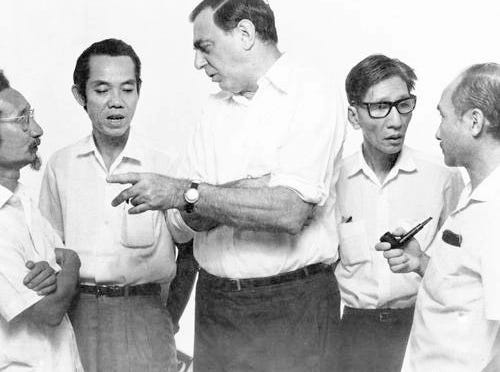
Case in point: in Robert Shaplen’s 1962 profile of Ngo Dinh Diem—in spite of detailing Diem’s messiah complex, morality laws, secret police, and total crackdown on dissent, Shaplen still nevertheless concludes that Diem “does appear honestly to want to introduce democracy.”
???
Even if that were “true,” what is “democracy” when it’s implemented only after one is done purging society of all dissidents and anyone willing to oppose your rule? The opinions of the Vietnamese themselves toward Diem are meanwhile left largely uninterrogated, hand-waved away as “blurred and unreal.” The New Yorker’s position on the war in Vietnam rapidly became more critical following Jonathan Schell’s 1967 landmark work of war reportage, “The Village of Ben Suc,” an account of American troops’ devastation of a Vietnamese village,9 but by then even Luce’s magazines were swinging in the same direction10—two years later, in 1969, Life would be the magazine to publish the colour prints of the My Lai massacre photographs. The magazines could not continue to so overtly deny reality and public opinion—lie too brazenly and you risk losing credibility in the eyes of the public you’re looking to continue to control. Not to say that The New Yorker is a stranger to particularly brazen lies—in the lead-up to the Iraq War, Jeffrey Goldberg (now best known for “leaking” the Trump admin Signal chats) would infamously write completely unhinged articles in the magazine espousing the Bush-era conspiracies that Saddam Hussein had access to nuclear weapons, was conspiring with Al-Qaeda, and was committing Holocaust-tier genocidal acts, positions no serious person should have been entertaining in 2002. As always, when that shit hit the fan, The New Yorker once again swerved into the lane of “nuanced” criticism.
We see the three sieve tactic today with the conflict in Gaza. The mainstream sieve tries its best to tread water within more overt Zionist lines; the “radical” sieve tries to rally the anti-Israel left to support individuals like former UK Foreign Office employee and anti-Assad activist Mahmoud Khalil; and in-between them The New Yorker’s moderate middle sieve serves the purposes of holding the J Street line. In an interview last October with the Israeli writer and liberal Zionist Yossi Klein Halevi, The New Yorker allowed the sicko the last word, in which he said the following:
What’s emerged on campuses in the last year is not a bunch of students criticizing Israel harshly. It’s a mass movement that denies Israel the right to exist. It is the transformation of much of liberal and progressive discourse on Israel from criticism, even harsh criticism, of Israel’s policies to rejection of Israel’s legitimacy. This is not a negligible issue for Israelis and even more so for American Jews. When I was growing up in the American Jewish community of the nineteen-sixties and seventies, there was a sense that America would accept us and that certainly we were safe in America, but we needed to tone down our Jewishness to be fully accepted. The great achievement of American Jewry in the last couple of decades has been the end of conditional acceptance. You could be any kind of Jew you wanted and you would be fully part of American society. Anti-Zionists are bringing back conditionality.
The article does “criticize” the popular conception amongst Israelis that “there are no innocents in Gaza” and does “criticize” Israel’s war crimes, but the conclusion, what the reader is left with at the end, is that the proper response to Israel’s actions is not to wake up to the farce of its very existence but rather to mourn for the “moderate” Israeli, to mourn the “innocence lost” of liberal Zionists, and for what this is doing to the “decorum” of American society should people start to think it’s okay to yell at a Jewish person “just because” they support the genocidal Matza Reich. The effect of this is to blunt outrage and neutralize action.
Whether you believe my thesis that this is all “part of the plan” or not, whether you believe that The New Yorker itself is a deliberate psyop factory, the fact of the matter remains that many other publications throughout the United States do have proven intelligence ties, from The Partisan Review, The Paris Review, and beyond. From a piece I cite often by Gabriel Rockhill:
The CIA also gained control of the American Newspaper Guild, and it became the owner of press services, magazines, and newspapers that it used as cover for its agents. It has placed officers in other press services, such as LATIN, Reuters, the Associated Press, and United Press International. William Schaap, an expert on governmental disinformation, testified that the CIA “owned or controlled some 2,500 media entities all over the world. In addition, it had its people, ranging from stringers to highly visible journalists and editors, in virtually every major media organization.”
Within or without these systems, that which is not overtly controlled nevertheless mimics in form and content that which is. There is a deep structural alignment of cultural production with imperial hegemony. The New Yorker inevitably “gets around” to acknowledging these horrors, but never in a way that delegitimizes the liberal project itself, never questioning the structures that made these horrors inevitable. In the case of “middle sieve” prestige media, the solution is, as always, more moderation, more nuance, more balance. And to what end? So that the sophomoric readers of these magazines may then continue to sit in their recliners, stroking their chins, while other people’s children die.
Is New Yorker film critic Richard Brody sundowning?

And just wait till we get to our assault on their cultish copy-editing department.
Targeting the Germans with propaganda by dropping leaflets describing superior American rations on their positions, for instance.
What’s rather funny (and enlightening) is that Ross was himself actually a miner’s son and grew up for a spell in the small village of Red Cliff, Colorado. His mother could very well have turned out an “old lady in Dubuque.”
Dudley Knox and John Russell were already pursuing such strategies in their contemporaneous reorganization of the US Office of Naval Intelligence, and the British SIS had been doing it for years.
I would like to take a moment to shit on one of the sources in that article I linked, fashion biographer Justine Picardie, who says this about Chanel’s Nazi past:
However Justine Picardie, whose Coco Chanel: The Legend and the Life was published in a new edition last year, and who has also written a biography of Catherine Dior called Miss Dior (2021), tells BBC Culture, "It's too easy to say Chanel was a Nazi."
You’re right, Picardie, it IS all too easy. But do go on.
Picardie believes Chanel was too much of an Anglophile and believed too strongly in freedom for her to embrace Nazism, even if she expeditiously used Nazi connections. Operation Modelhut, Picardie says, "is intriguing, but it doesn't really define her".
Calling Operation Modelhut, Coco Chanel’s 1944 plan to use her ties to British aristocracy to try to get the Brits to pull out of the war so that the Nazis could have a better chance at winning, “intriguing” is something only the most loathsome apologist could ever possibly say. As the article also explores, Chanel tried to use Nazi Aryan laws to expropriate property from Jews. Shove it in a Chanel flap bag, Picardie, you vapid fashion-poisoned bimbo. Chanel “believed in freedom” for one person alone: herself.
Libs hate “whataboutism” until they’re the ones doing it. Ironically I don’t think there’s any political tendency I hear it come from more than it does from liberals.
A funny (kind of) little aside: when they eventually made a film adaptation out of James Thurber’s “The Secret Life of Walter Mitty,” one of the most famous and beloved of The New Yorker’s stories from its early years (and a largely inconsequential little nothing burger built around a conceit that was much better utilized when it was later recycled in Raymond Queneau’s Loin de Rueil), the story involved a journalist working for a magazine, but in spite of the story being famously associated with The New Yorker, the magazine in question wound up being Life.
Many of these outlets and figures even go so far as to be “correct” about 95% of the time simply to get you to swallow the noxious 5%—see, for instance, sus MIT prof Noam Chomsky and his critiques of Lenin.
The expanded essay is available in print from the New York Review of Books and worth the read.
Of course it’s also worth noting that Luce himself died in 1967, the general cultural attitudes of the magazines had not radically shifted, and many CIA agents still rounded out their staffs.
Fascinating read.
The New Yorker was always at my house growing up, but my parents were vert political. I only read the cartoons as a kid.
When I started delving into articles, I only really enjoyed the Talk of the Town and the occasional long form article.
Though, I could never understand how they selected their poems and short stories.
Now, I get it.