

War profiteer kowtows to whining poets, gives them back their allowance
Welcoming back the Griffin Canadian Poetry Prize


In response to years of grumbling and occasionally impassioned Facebook posting from some of Canada’s most fiftysomething poets, news broke yesterday that the Griffin Trust will be reinstating its $65,000 Canadian poetry book prize. The Trust had dropped the prize in 2022 in favour of doubling the value of its international award to $130,000. At the time, funder Scott Griffin attempted to smooth the ruffled feathers of the nation’s poets1 by claiming that taking away their comfort blanket was actually a vote of confidence: “When we made these, the original changes to go to the international prize, we thought we were preparing an opportunity for Canadians to participate in that prize,” Griffin told CBC Books in a phone interview.
Yeah man! You think?
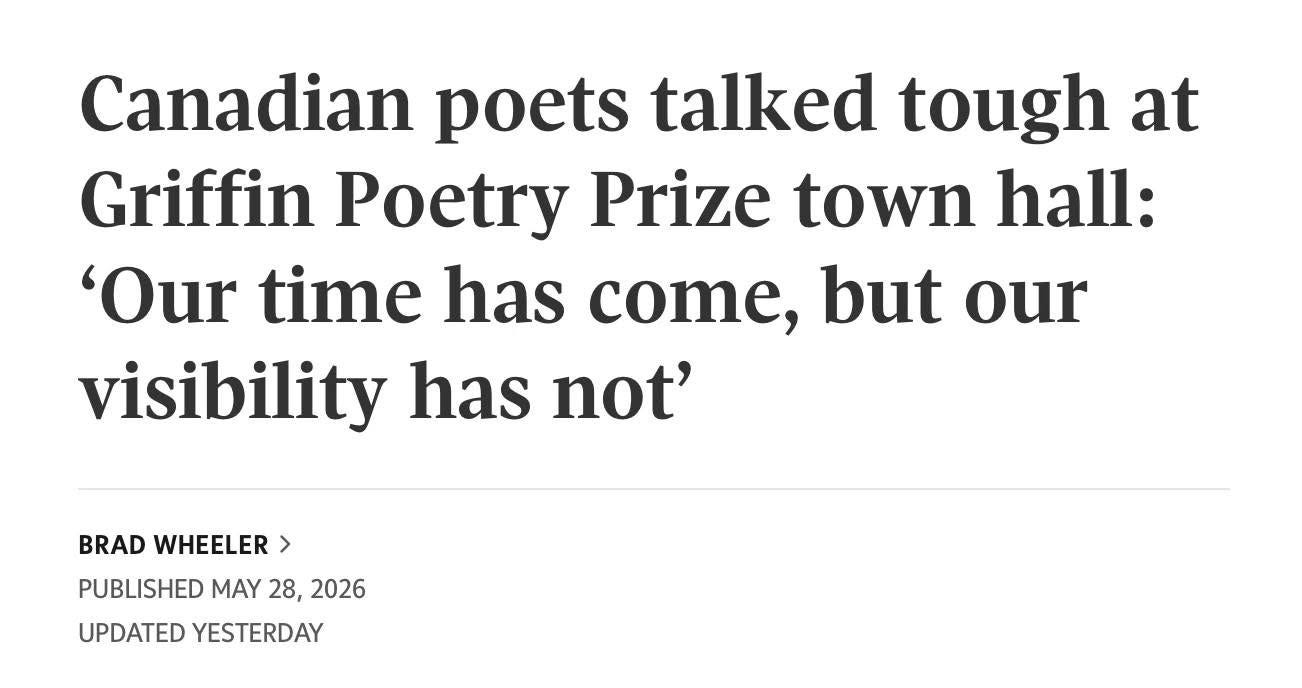
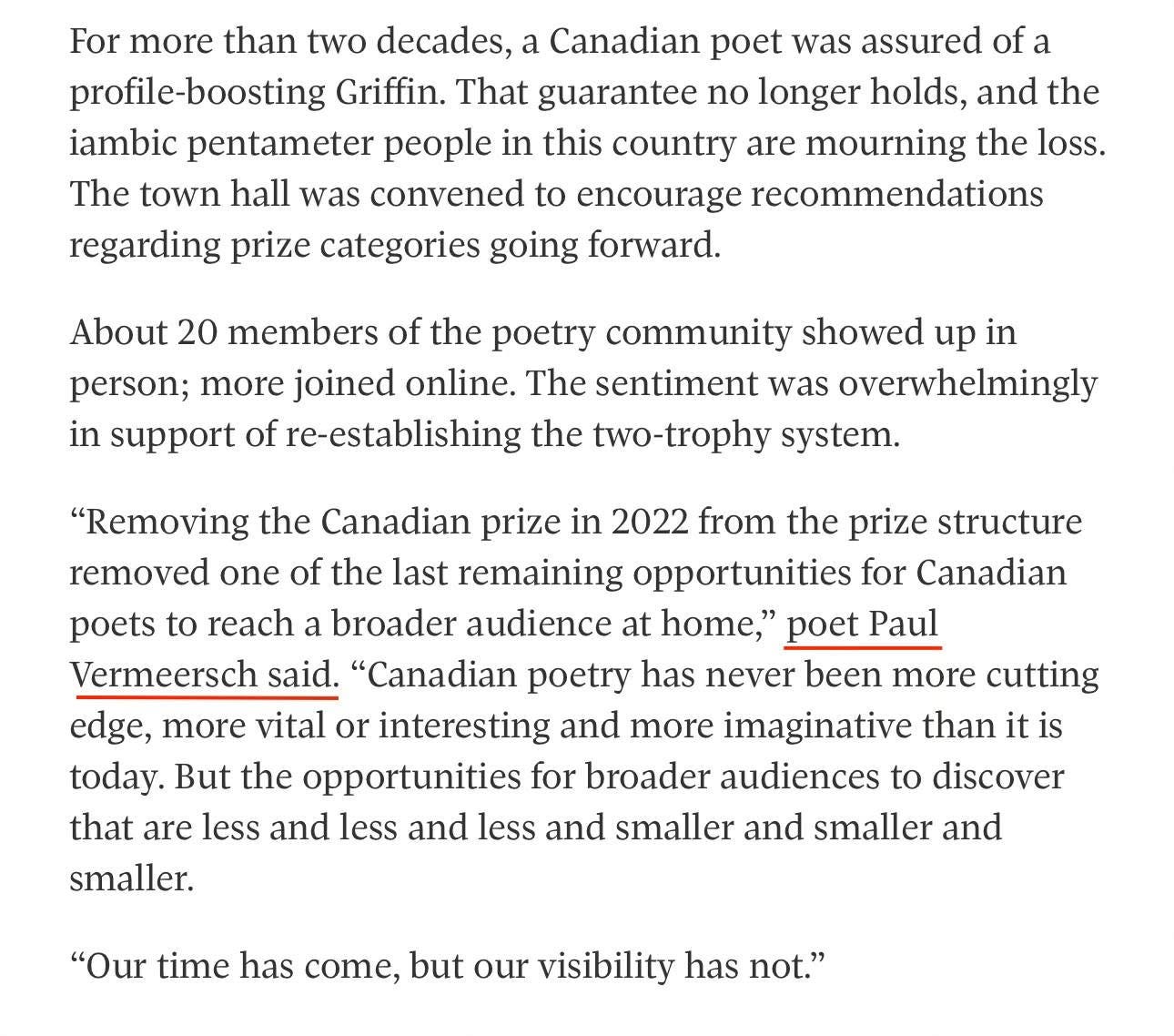
Look, Scott, there’s a reason a guy like Paul Vermeersch, who is quoted in the CBC story as one of the loudest of the complainants, was incensed. Not only are small presses like the one he edits at (Hamilton publisher Wolsak & Wynn) always happy with the modest boost in sales awards can provide, he’s also personally one of the most accomplished poets in the country who’s never won the thing. His odds of winning a Canadian Griffin at some point are like 1 in 9; his odds of winning the International Griffin, despite his considerable talents,2 are like 1 in 9,000. During the prizeless period Vermeersch put out his first selected poems, often a moment when judges take the opportunity to reward a body of work—on some level the guy must feel like $65,000 fell through a hole in his pocket. I would bet most of the 20 members of the poetry community who joined him at the town hall nurse similar hopes in their hearts, and even the obvious hacks among them have at least gotten to enjoy a few canapes at the annual Griffin gala (AKA “poetry prom”).
I covered the Griffins at length last year, and for those interested in catching up on the history of Scott Griffin and his Trust, and its relationship to the poetry community, that’s probably the place to start.
Griffins Dropping "Canadian Poetry" Prize Worst Thing to Happen to Canadian Poets Since "Being Canadian Poets"

The community’s rationale as to why it’s okay to stooge for Griffin (and therefore that it is not unbecoming to whine about which passports prizewinners hold) seems to be that, while he is not a perfect patron of the arts, he’s pretty close, and we need those wealthy patrons or Canadian poetry will wither away.
But for those on the go, the points can be summarized like so:
The Griffin Trust’s material contributions to Canadian literature are fairly minor, despite the eye-catching sum the prize bestows on one poet each year.
Griffin has nonetheless been able to purchase the reverence accorded to a patron quite cheaply for a man of his immense wealth, and effectively on spec: few directly benefit, but most pay homage either so as not to damage their own prospects or out of a genuine belief that his philanthropy is a great boon.
Though he’s got no meaningful gift for writing, he’s boorish enough to have named a prize after himself so his name can be stuck on the covers of the country’s and the world’s most acclaimed books of English-language poetry.
He made a substantial portion of his fortune from weapons manufacturing (specifically LAVs sold to the Saudis), and only knocked it off after critic and habitual boat-rocker Michael Lista took a very unpopular stand against him.
No amount of money can elide the fact that Scott Griffin is just another rich prick.
Unlike the recent successful boycott against the radioactively Zionist Giller Prize, the grumbling over how Griffin chose to operate his prize was fairly apolitical. It really did come down to these writers fretting that without the award’s anointing of a champion each year, the already fringe position of Canadian poetry will become fringier still. (This despite the dwindling but still robust infrastructure of government arts grants, as Emma Dollery recently explored.) It’s interesting that despite not having the sort of moral lever offered by the Gillers’ complicity in genocide (and who’s even going to notice if Canadian publishers boycott a version of the prize that seldom shortlists Canadians anyway?), Griffin was still sensitive enough that an awkward Zoom call was sufficient to get him to cough up another $65,000 to make them like him again. Did Margaret Atwood finally threaten to pull a Lysistrata on him?
So let’s say this. I don’t see many of the living writers I most admire ever seeming presentable enough to win this new old prize, but I will hope someone genuinely excellent who cleans up alright like Bardia Sinaee or Brandi Bird can snag the thing. As I noted in my previous article, I don’t really begrudge any writer who accepts money from the award (or from any of the Trust’s other tendrils). I would simply request they refuse to be thankful in their heart to the foundation and instead think of the money as their take from a lawsuit settlement against a poisonous oligarch, a bank error in their favour they’ve chosen to leave shrewdly unreported. Leave that ring unkissed! The fact that a particular artist is given that money absolves Griffin of nothing—I’ve had multiple Griffin winners and short-listers tell me privately that Griffin has been personally contemptuous and even insulting to them in person, and that they sensed that not only did he not really “get” their work3 but that he seemed resentful at having to cut them cheques for it. And even were he more sophisticated, we know where his wealth came from. What a fine benefactor we’ve got.
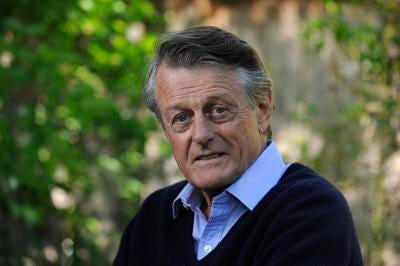
If there was any real risk of people really speaking their mind about the man in public, he’s likely put it to rest with the restoration of the Canadian prize. But the one thing that I hope this notoriously thin-skinned man knows is that everyone around him is wearing a mask whenever they encounter him and what most of them are actually thinking would freeze his pulse. From behind my own mask, I’ll speak some of the words: Scott Griffin is a churl. Given a pen, he is as likely to write a good poem as a llama with a trowel is to reconstruct Machu Pichu. Given a good book, he is as likely to be able to read and understand it without going cross-eyed as the aforementioned llama chewing on its trowel. In nearly every picture he has the cringing, imploring stare of a man who’s just pissed himself. Despite his hoard of blood money he couldn’t get a TED Talk, so he got his hapless PR flacks to get him booked for a TEDx Talk, “a TED-like experience” which is true in the way that putting your finger in your own butt is a sex-like experience. The Africans he claims to have helped fucking hated to see his plane coming. He’s stupid and I don’t like his hair. Nobody does.
RELATED


Not realizing a lot of them just look like that anyway.
The last few Canadian Griffin lists were heavy on experimental/theory-inflected collections, whereas Griffin is known to prefer more traditional narrative lyric poems.
Rockn. Thanks for being so consistently irreverent.