



Granta, the magazine which hosted the winner and runners-up of the Commonwealth Short Story Prize—three out of five of which may have been AI, and one of which, the winner, assuredly was (read our previous piece on that scandal here)—is run by a body called the Granta Trust, chaired by Sigrid Rausing, who bought control of the magazine in 2005, and whose grandfather started Tetra Pak, now the largest food packaging company in the world. You probably use their products daily, and once you recognize their look and feel you’ll start to recognize just how ubiquitous they are. In fact, this symbol is probably something you’re going to find eerily familiar from having looked at it unthinkingly so many times:

The Rausing family were, for quite a while, the richest family in the UK.
Sigrid Rausing herself is your classic sort of liberal-minded, pretentious capitalist buffoon, a higher order of pathetic loser for whom it isn’t enough that she owns all our asses: she expects us all to validate her “culturedness,” “intelligence,” and “morality” too.1 Sigrid has a rich person vanity PhD in the humanities, patronizes the arts, and engages in all manner of “altruism” (more on whether that “altruism” is truly “altruistic” later). Much like one of her Canadian counterparts, the loathsome arms profiteer and patron of letters Scott Griffin, who we’ve clowned on before, Sigrid’s vanity also led her to pen a shitty memoir. Rich people with literary pretensions love publishing shitty memoirs because it is ultimately not much of a challenge to matter-of-factly write the story of Things That Happened To You. Of course there are absolutely brilliant memoirs out there, sure, but most are awful and boring, because the bar for completing a memoir manuscript is so low, and because it is a process in which most of the more difficult literary skills are, while not necessarily absent, inessential. Autoslop is the refuge of the rich pseudo-artist because it is just so easy. Wealthy industrialists hate work—it’s why they exploit other people to do it for them—and so this is just about the best we can expect from them most of the time.
The epigraphs for rich people’s memoirs are often some of the most telling parts. Consider Spare by Prince Harry, which begins with a Faulkner quote, and then immediately undercuts that decision when Harry proudly announces that he has never heard of William Faulkner and found the quote while lazily searching BrainyQuote. Harry doesn’t even consider how vacuous this confession is. I need to take a minor detour here, because you do need to read this.
The past is never dead. It’s not even past. When I discovered that quotation not long ago on BrainyQuote.com, I was thunderstruck. I thought, Who the fook is Faulkner? And how’s he related to us Windsors?
Is it comforting to know that the British royal family has the mental life of a caricature of an English peasant from a movie about the 14th century?
Anyways—the epigraph for Sigrid’s memoir comes from Nineteen Eighty-Four, because of course it does, there’s no book more emblematic of her lower-end-of-middle-brow rich person tastes, a title most people experience as assigned reading in high school. (For what it’s worth, Sigrid’s book has better prose than Scott Griffin’s. But, for what it’s worth, that’s not worth much.)
And of course she had to buy Granta. Not just finance it, but outright buy it, and by the sounds of it she goes to editors meetings and helps make decisions on editorial matters, because…… well, I dunno, she was already a fake anthropologist, why not let her be a fake lit mag editor too? Buy Discordia, Sigrid! Buy me! I’ll let you pretend to be my wife (my real wife, unlike Sigrid, has a real PhD)! Sigrid even got to be a real fake editor after she tried to budget cut Granta to hell and a ton of her staff quit on her, forcing her to take on the top position herself. Her first order of business? An issue about big international issues.2 Stories about wars and humanitarian concerns, and about Iran, and China, and the “shadow” of the long-gone Soviet Union. Because Sigrid has a lot of important things to say. She’s not just Sigrid the chin-stroking “intellectual” and Sigrid the “literary figure,” heavens no, she’s also…
Sigrid the “Saint.”
As I mentioned above, Rausing likes to bill herself as an altruist, committing vast sums of money to philanthropic efforts. She’s all about that liberal human rights type stuff—you know, women’s rights, open democracies, press freedoms and all that jazz. Or, as we call it in my neck of the politics, “humanitarian imperialism.”
A lot of my readers, having brain worms like I do, will know what the National Endowment for Democracy is. In case you’re not a ‘noided nutcase like me, let me fill you in as succinctly as I can: in the 1970s the Church Committee wound up exposing a ton of extremely shady CIA and FBI dealings and brought the CIA under increased scrutiny. There were a lot of consequences of this, but one was the creation of the National Endowment for Democracy, a semi-autonomous NGO set up by the United States government, with the principal goal of taking a lot of the old underground foreign influence operations and laundering them through the façade of “respectable” “charitable” ventures. That’s to say that a lot of what they do today was done covertly over twenty-five years ago by the CIA. And in case you don’t believe me, here’s NED cofounder Allen Weinstein:
A lot of what we do today was done covertly twenty-five years ago by the CIA.
It has long been established that the NED’s goal is to help put a smiling face on regime change and influence peddling, existing somewhere between the US empire’s carrot (World Bank, IMF,3 USAID, etc.) and its stick (the CIA outright and the DoD).
The NED and Sigrid Rausing overlap a ton. Just how much is at least a little opaque (the NED will be the first to tell you that its actions and funding are not transparent), but basically wherever the Western bloc reaches an obstacle, there’s Sigrid Rausing to lend her weight (and the weight of her big, fat pockets) right alongside the NED. Whether it be Iraq, Afghanistan, Iran, Syria, Venezuela, China, Russia, and so on, Sigrid will be there to tell you about how horrible the situation is and how the people are suffering and about how we really have to do something about it, how they lack all those precious “freedoms” we take for granted, and she’ll funnel as much money as she can into “helping” them. Does she take her marching orders from the US State Department like the NED clearly does? Perhaps not directly, but the funding overlap does reveal quite a bit of ideological overlap.
One thing that both Sigrid and the NED love is the journalist collective Bellingcat, an outlet that I (and others) believe is just a press arm of the CIA and western intelligence. As Foreign Policy put it, “Bellingcat Can Say What U.S. Intelligence Can’t.” The CIA just loves Belingcat. Former CIA chiefs have gone on the record describing how helpful Bellingcat was to them, saying such things as “whenever we had to talk to our liaison partners about it, instead of trying to have things cleared or worry about classification issues, you could just reference their work” (don’t worry though, even though Bellingcat is explicitly funded by the CIA’s ostensible cover funding apparatus, the NED, and just so happens to do a lot of work the CIA relies on, when the same former official was pressed on whether the CIA controls Bellingcat, he said “we have no ties to them” lol). Sigrid and the NED also both fund “freedom of expression” organizations like Article 19, which also collects funds from the US State Department, USAID, and the Ford Foundation (itself an infamous CIA front), as well as organizations representing other Western national interests such as Global Affairs Canada, UK FCDO, the Swedish International Development Cooperation Agency, and so on. There are also “freedom of the press” organizations such as Reporters sans frontières (Reporters without Borders), which not only receives funding directly from Western powers but also receives funding from specific regime change outfits such as the completely psychotic Center for a Free Cuba,4 as well as financial institutions like Société Générale, which profits off of loans to Western arms manufacturers. Both Sigrid and the NED and a lot of the aforementioned interests fund “feminist” initiatives such as the Women’s Learning Partnership, a foundation which was created by Mahnaz Afkhami, who used to serve in the Shah’s government and goes on TV to tell lies about how the 1979 Iranian Revolution was “to a significant extent” a reaction to advancing women’s rights.5 Both Sigrid and the NED also fund the International Commission of Jurists, an organization that was literally proven to be created by the CIA for the purposes of international propaganda, and so on, and so forth. You get the picture. These are all groups that seek to promote “liberal freedoms” like “rule of law,” “freedom of the press,” and “freedom of expression,” but in effect are mostly just tools of the West to chip away at the foundations of their geopolitical rivals by either disproportionately focusing on their enemy’s “illiberal” qualities, deliberately misrepresenting or skewing understanding of those qualities, or, failing that, making some qualities up.
Rausing is a Western liberal internationalist—she supports world “cooperation” and “peace,” but on Western terms: specifically, terms that either don’t impact her own bottom line or terms that conveniently make her richer. The social and economic models of the West (including Western ownership) must be exported everywhere, whether the people there want it or not. In fact, we’ll pay some of the people over there to tell us publicly how much they do really want it, and then we’ll blow them the fuck up with our bombs. Libs like Sigrid, in spite of having done invaluable work in creating the moral foundations to allow us to drop bombs on these people, will then solemnly shake their heads. Sigrid decries violence. She’ll accept the boost to her stock portfolio, sure, but it’s icky. But wait, what’s that sound??? Sounds like yet another enemy of the West who lives under constant siege is doing something untoward in order to desperately hold together the nation as the US forcibly starves it with sanctions! My God—these people don’t even have McDonald’s! Sigrid Rausing to the rescue! And we’ll do it all over again.
In her writing and interviews, Sigrid is constantly dry-humping concepts of international rights and their related statutes, often while lambasting those damn illiberal Saracens and shifty Orientals. Like here, for instance:
The notion that human rights is a western concern is an argument often used in China and in authoritarian Muslim states. […] Human rights for all, as expressed in the Universal Declaration and its successive additions, is a progressive ideal which all countries active in the UN ought to strive for.
But does Sigrid actually love human rights statutes that much? Or is she a dreaded fake fan? If you want to see how much “human rights” actually mean to Sigrid, you can hear all about how quickly she pulled the plug on just about every organization her trust supported that voiced even an inkling of support for Palestine in a piece she wrote in The Times titled:
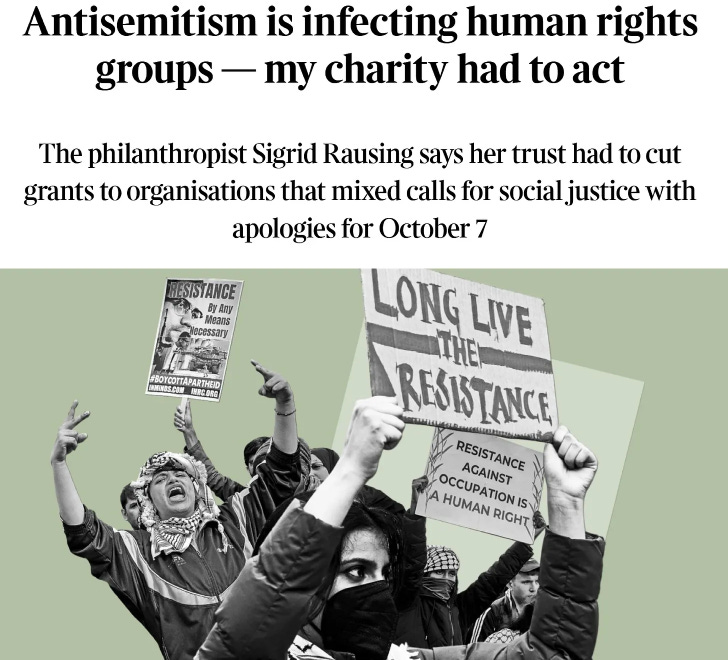
An article so Zionist that Bari Weiss re-published it in The Free Press two days later.
In it, she complains about such organizations as “a group in Canada” that
almost immediately termed Israel’s actions “genocidal”, and described the country as a “settler colonialist white-supremacist state.” The statement ended with an echo of a United Nations resolution; an affirmation of “the right of all oppressed peoples to self-determine their resistance.” It is a phrase which, given the context of the piece, we felt condoned the Hamas atrocities.
I would actually go further than the organization Sigrid is critiquing did and point out that the preamble of the United Nations’ Universal Declaration of Human Rights, Sigrid Rausing’s most favourite document evarrrrrrr ^ _ ^ (remember how she said the document is illustrative of “a progressive ideal which all countries active in the UN ought to strive for”????) says the following in its preamble:
it is essential, if man is not to be compelled to have recourse, as a last resort, to rebellion against tyranny and oppression, that human rights should be protected by the rule of law
Well, the rights of the Palestinians are not being protected by rule of law, which means, by the logic of the preamble to the Declaration—the preamble being the foundation of the foundation of international human rights law—the Palestinians have recourse to rebellion. I’m not going to pretend that international human rights law is perfect, but Sigrid certainly seems to think it is. So what does she make about the international courts finding Israel guilty of violating human rights? In her aforementioned essay, publishing in 2025—that’s right, 2025—Sigrid just dodges reckoning with that almost entirely. Instead she says, “The words settler/colonial/white supremacist don’t reflect reality, exactly—they are a slur.” Sure thing, Sigrid.6 Then she quotes Orwell yet again. Which is especially funny this time around, because, while I’m a noted Orwell Hater, the man was an anti-Zionist.
Then, out of nowhere she starts ranting and raving about the antisemitism of the Soviet Union and its anti-Zionism, and about how she knows all about this because of her aforementioned work for her vanity PhD in Estonia.
Yeah, anyways, about all that.
Sigrid the Scion.
I mentioned how Sigrid is an “anthropologist,” right?
Her PhD thesis, which was later published by Oxford University Press (geez, every PhD student’s dream, right? Shall we mention that the Rausings have donated hundreds of millions of pounds over the years to Oxford?), was on post-Soviet anthropology, drawing from her own field work while living in Estonia. Said work, and her later memoir documenting same (Everything is Wonderful: Memories of a Collective Farm in Estonia) largely concern the “evils” of collectivization. Rather than debate that subject with you, reader, which would make this blog post a lot longer, I would at least like to point out something that Sigrid doesn’t seem to mention in either work, which is her family’s “interesting” history with the Soviet Union and what it stood to gain from collectivization’s end.
Some of Tetra Pak’s first great successes lay in exports to the USSR, after Hans Rausing, Sigrid’s father, negotiated a deal with the Soviet government. “The early foothold in the Soviet market proved valuable as the company continued to ramp up its capabilities.” Tetra Pak’s early pyramid-shaped milk cartons are now as iconic a symbol of the Soviet era in Russian society as the Young Pioneers necktie and Sputnik.

The “emerging markets” in Russia after the collapse of the Soviet Union were a huge business opportunity, especially as Tetra Pak already had their foot in the door. This expansion eventually made Tetra Pak “the largest foreign employer” in post-Soviet Russia as Tetra Pak partnered with the emergent class of Russian robber barons, such as the oligarch David Yakobashvili’s Wimm-Bill-Dann Foods, which slowly took over Soviet dairy plants and once-collectivized farms. Of course Sigrid sees collectivization as a great “tragedy” and propagandizes to those ends—the end of such a system was a prerequisite for the privatization frenzy her family partook in to the extraordinary benefit of themselves and all the other vultures, stripping the nation for parts, and contributing to millions of deaths in the process.
The aforementioned Yakobashvili, an organized criminal with connections to the murderous Bauman syndicate, profited from a massive corrupt dilution of workers’ and pensioners’ shares in farms and scammed countless farmers out of their land, beating or killing those who resisted or protested. The Peasants’ Front took to the streets in opposition, with banners bearing slogans such as “to the peasants—to the people!” But never mind all that. Sigrid, living in POST-SOVIET Estonia just a year after her family’s deal with Yakobashvili, a place which was at the time facing the very same rapidly rising poverty and mortality rates as a direct result of these explored processes, can only focus on Soviet collectivization for some reason! Why’s that, Sigrid???
Here’s another episode in world history that perhaps is owed a closer look with particular scrutiny toward the Rausing clan: the assassination of Swedish prime minister Olof Palme in 1986. The potential of Sigrid’s father’s involvement in the killing was once put forward by Hans’s daughter-in-law, Eva Rausing, shortly before her sudden and untimely death in 2012, just before a planned meeting with Swedish prosecutors to give them more details. Eva was crazy, of course—and don’t take my word for it, take Sigrid’s! She wrote a whole memoir about the affair—as she so often does when her family might be implicated of wrong-doing!—titled Mayhem, though it should be titled Guys, My Dad Definitely Did Not Have A Hand in Killing the Prime Minister (and I Did Not Kill My Sister-in-Law).
Eva might not have known or remembered that by 1986—the year of Palme’s murder—the headquarters of Tetra Pak had already left Sweden. The reason for the move was the radical political plan to change the ownership of Swedish industry via union-controlled foundations. These trusts would hold shares that industries of a certain size would be compelled to issue on an annual basis, financed by up to 20 percent of revenue, until the union foundations would own 52 percent of the companies, giving them ownership control.
…
Eva’s idea, therefore, that Olof Palme had constituted a threat against the company may have been true in the 1970s, but by 1986 it certainly wasn’t true anymore. And every newspaper editor in Sweden knew that.
This is a massive lie by omission and Sigrid knows it. Firstly, Sigrid for some reason ignores the primary reason Tetra Pak left Sweden, which is repeated in the first, like, twenty sources I found on the subject, which is that the move was principally motivated by tax reasons. But also, as a family of Swedish billionaires, large chunks of the Rausings’ personal wealth were obviously still within Sweden, as well as non-insignificant portions of the company. Tetra Pak’s technological core remains in Sweden, as its R&D is still based out of Lund.
Ruben Rausing had emigrated to Lausanne in 1969, and in 1981, Tetra Pak followed, both relocations prompted by tax reasons [see there’s that tax thing again —Ed]. The R&D operations stayed behind, with Lund and Sweden remaining the intellectual heartland of the business.
Tetra Pak’s R&D is tied to industrial infrastructure based in Sweden. The embedded productive capacity maintained there, including all of the valuable intellectual labour they had cultivated which would have been more familiar with the entrenched system, and it would have been a lot harder to relocate all that than it would be to move some factories (and you’d still risk having a lot of your established R&D brainpower move to other companies). And, again, if you think the richest man in Sweden didn’t have substantial domestic investments beyond this, then I know some Hot MILFs in Your Area That Just Want To Fuck if you’ll just give me your credit card info.
Obviously the Rausings are innocent, otherwise why would Sigrid decide to misrepresent the facts so brazenly?
Yes, Eva was literally a crackhead, and on one hand this may lead one to think it’s possible Eva dreamed the whole thing up as a drug-addled delusion, but on the other hand we should consider that, if these allegations against the Rausings are true, it would take a particularly unhinged person, a particularly weak link in the chain holding in the Rausing secret, to crack and let the secret out—a mentally-unstable drug addict, for instance. Anyone who would put herself in such jeopardy by threatening to expose the secrets of a family she believes has already killed someone—someone far more important than her—to protect their interests would have to be at least a little bit crazy, if not a lot crazy. And ultimately what are the odds that a woman who had been abusing these drugs since 1983 would suddenly administer herself a fatal dose within a year of trying to make this information public? And why did her husband, Sigrid’s brother Hans Kristian, then hide her body from being discovered for two months? Because of Kristian’s deceit, the report that the death was “drug-related” would likely be largely inferential—there’s no way toxicology conducted on a body that has been sitting that long could provide results conclusive enough to suggest those ends.7
When Sigrid writes such things about the fate of Eva as
I see my complicity, my guilt. I see my tiredness, my hopelessness; my false moral superiority, my finger wagging, wagging. I regret everything.
…is it a Freudian slip? What is she really talking about here, hmm? Because so much of this bloated, pointless, repetitive memoir starts to make a lot more sense through a… certain lens. There’s a narrative that starts to emerge, one that Sigrid really wants to hammer home, which is that Eva, poor Eva, she was… suffering, you know? She had it really bad, this poor, suffering girl, so when you think about it, maybe she’s… better off now? Put that way, let’s say that there was someone complicit in or at least aware of Eva’s death as more than just an accident—could that person maybe find comfort in these thoughts? Maybe not so unlike someone who personally gained a lot from a process involving organized crime, asset stripping, mass privatization, and millions of deaths in the former Soviet Union finding comfort by retreating into a mind palace to imagine how much worse everything was before?
Anyways—obviously the Rausings had a lot to lose because of the Palme administration. Not to mention, after he died, they had a lot to gain! Sigrid neglects to mention that, since Palme’s death, Tetra Pak’s investments in Sweden have greatly been expanded, aided by the more moderate and neoliberal-friendly policies of Palme’s successors.
Sigrid the Synthetic.
Sigrid’s father sold his shares in Tetra Pak (at that point having vertically-integrated with Swedish food processing company Alfa Laval to become Tetra Laval) in the mid 1990s. He made a new food packaging company after the move, and to be honest I think the whole thing was a farce motivated by some European anti-monopoly shit Tetra Pak was facing and that this was a fake breakup, but that’s beside the point.
Hans’s kids now share his fortune as consolidated in investment companies such as Alta Advisers. Unlike their cousins, whose investments mostly remain in food supply chains, Sigrid’s side of the family favours more abstract and technological investments. You can see from Alta’s Form 13F that Sigrid Rausing and her siblings have significant investments in several companies developing AI, including NVIDIA, Microsoft, Meta, Google, and fucking Palantir—all of these investments having either been established or significantly grown since the AI boom and take up many of the largest investment slices in the portfolio—as well as investment companies such as Vanguard Scottsdale, which is itself heavily-invested in AI.8
Hey. Wait a second. AI. Sigrid Rausing. Sigrid Rausing whose magazine, Granta, as mentioned in our previous piece, is at the center of an AI scandal.
Did awards judges use AI to give an award to an AI story?

Granta, the UK’s most prominent journal of new writing, published five short stories chosen by the judges of the Commonwealth Short Story Prize as their finalists representing five Commonwealth regions. The winner, “The Serpent in the Garden” by Trinidad and Tobago’s Jamir Nazir, got flagged for being the result of a large language model, or LLM.
Sigrid wrote a now widely-circulated (and widely-mocked) open letter about how “we’ll simply never know for sure :)” whether the winning story used AI or not. As I explored in the previous piece, while false positives are certainly possible, we actually have a pretty reasonable basis to make the claim because there is a ton of evidence outside of the story itself, derived from my research into the alleged author himself. But to list them in brief:
The author’s LinkedIn page in which he posts about his use of AI and opines on AI’s utility.
The author’s submitted author photo, which is obviously heavily-modified from his actual appearance, likely using AI to do so.
The fact that his Facebook page features literally thousands of poems allegedly written by him, which all feature the same AI hallmarks and all trigger AI detectors.
His countless aforementioned LinkedIn essays trigger the same AI detectors.
What is Sigrid’s evidence? Why, she asked AI, of course! And AI told her there were no issues.
You know who else is heavily-invested in AI? The Commonwealth Secretariat, the economic sister organization to the Commonwealth Foundation which gave the prize in question.9

In fact, the Secretariat partnered with Intel not long ago to create an “AI-driven policy toolkit” called StrategusAI.
The cost of developing one government policy or strategy can range from US$250,000 to US$1.5 million in consulting fees, and development can take from six months up to a year, not including implementation phases. This investment will be more cost-effective and efficient with StrategusAI.
Intel already partners with the Secretariat on a joint digital learning programme to demystify AI among senior officials across the Commonwealth and raise awareness of its potential applications in various sectors
Having AI formulate policy decisions raises concerns on its own, but consider also that an AI developed by the Commonwealth Secretariat and Intel could be given “subtle” biases which lead it to recommend policy solutions that are in the interests of a neoliberal organization like the former and corporate interests like the latter. What is embedded and unseen, whether intentionally or not, can make certain lines of inquiry basically fruitless.
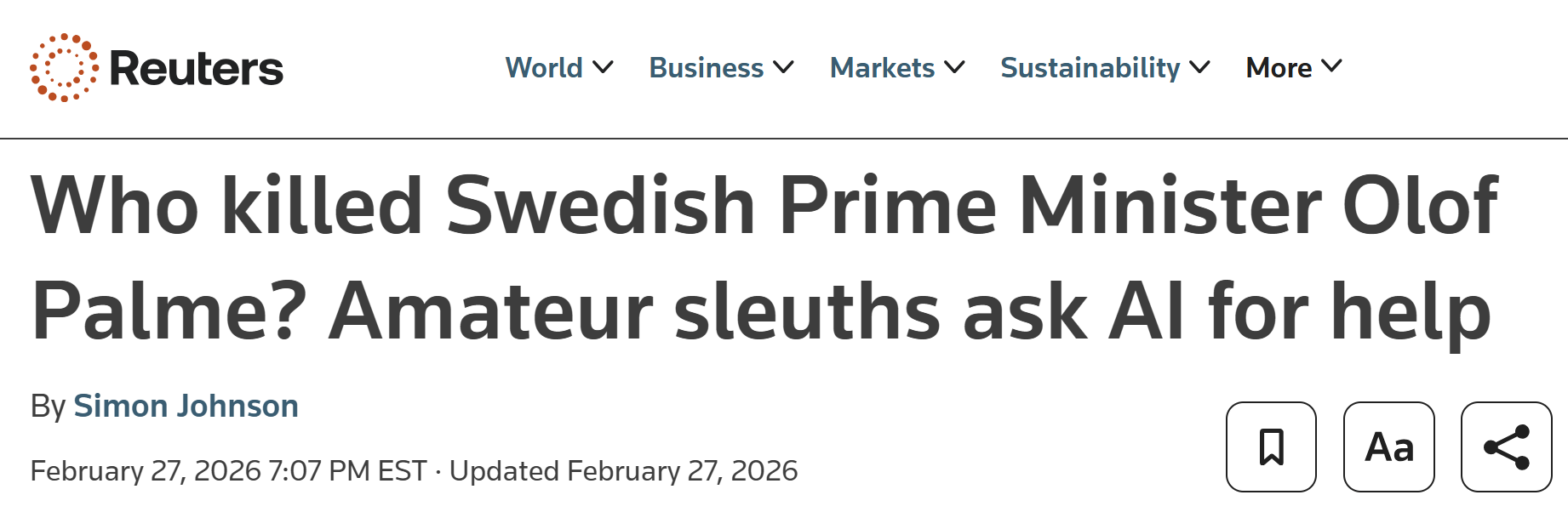
But who would ever trust an AI to make such policy decisions? Many would be cautious to implement such toolkits, especially as, in spite of the cold market rationale of the neoliberalism embraced by so many of the states this stuff is peddled to, these ultimate conclusions are still considered to be broadly “human.” But what if you could demystify that “human” quality? What if you could convince people that distinctly “human” features are just a bunch of idealistic nonsense? What if you could “prove” that the most fundamental expressions of the “human” soul could be entirely accomplished without the “human” part at all? For instance… writing an award-winning short story?
I’m not here to debate the merits or lack thereof of AI-assisted art, but this is a preoccupation of most AI companies, and why people like Sam Altman (barely human themselves) are constantly trying to “prove” that AI can write short stories. Undermine people’s preciousness about these creative acts, and you can break the humanistic will and subordinate it to a Silicon-Valley-driven AI technocracy:
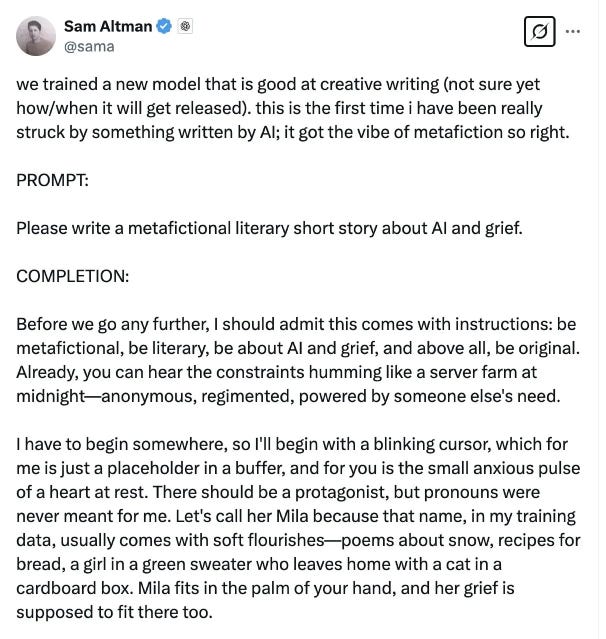
Whether AI will ever be able to do all this isn’t really the point. Perhaps it will! But the point is how we perceive it. If people continue to broadly see value in the “human” in the “humanities,” then this process of AI technocratic normalization is a lot more difficult.
An AI-invested organization gave an obviously AI-generated short story a prize—I even made the claim in my previous piece, which I think is pretty clear, that one of the judges who judged the competition used AI to do so—and an AI-invested billionaire hosted the AI winner in her vanity magazine. There is an obvious benefit for those invested in AI to have people become cynical about whether or not “human” outputs are really at all more valuable than machine ones. You understand the question I am posing. Was this result the entire point? Consider these words from D.W. Wilson’s post about the scandal in The Walrus:
in light of this crisis, I don’t know if I believe myself anymore. My students lost out to AI-generated text; they see those texts under Granta’s venerable masthead. And nobody with any clout seems willing to call this out as bullshit. Can I look these young writers in the eye with confidence and tell them they’ll get there if they keep on keeping on? Writing is hard. AI promises to make it easier. That allure is strong. And here before them: evidence that it works too.
What if creeping fatalism like this is the intended effect?
A major hitch in all this theorizing is that Rausing doesn’t just like to support initiatives that are good for the imperialist bourgeoisie such as herself; she also likes to support initiatives that flatter her. Rausing would certainly like to feel like an inspiring humanist, and “AI” seems contrary to that goal—ultimately, if something was too difficult to reconcile with Rausing’s pride, she would probably make it secondary. However, as I have also demonstrated, Rausing is a master of fabricating an elaborate tapestry of the self, and it isn’t beyond reason to consider that she could find a place in this tableau for Sigrid the Synthetic, Sigrid the Futurist, Sigrid the forward-thinking maverick who saw what humanity needed before they did. The rest of us, cautious as we are about AI’s development, don’t see the big picture—we don’t understand what’s best for us. Ultimately, that’s the underlying principle of being a “philanthropist” in the first place, right? Believing that you have a better sense of which causes are important than anyone else in the world. You have the money by accident, yet you deserve to shape the world with it to what you think is right. Olof Palme’s plan to democratize the corporations of Sweden could have changed the world, but “someone” had him killed. “Someone” thought they knew better. Freaks like Sigrid Rausing and her family think of themselves as “humanists” but they’re nothing of the sort. Her incomprehensible mountains of money keep her from ever knowing one pebble of what real “humanity” is. She “cares” about the rest of us the way she “cares” for her lawn with the blades of her servants’ lawnmowers.
Sigrid is having a massive temper tantrum because not only did the result of the Granta controversy not go the way she’d expected: a lot less “well I’ll be! guess we all ought to rethink this whole ‘being human’ thing, huh?” and a lot more “HAHA! FUCKING MORONS!” Then she wrote her smug little yesmen-approved open letter and was evidently shocked when everyone savagely mocked her instead of seriously considering the “deep wisdom” she thinks she’s in possession of because she throws money at “benevolent” regime change fronts. Now, wiping the egg from her face, she is storming out of the ruckus in the hen house entirely. She has thrown the Commonwealth Foundation under the bus, and has had Granta announce that THEY ARE NEVER PARTNERING WITH THE COMMONWEALTH FOUNDATION AGAIN, OR ANY OTHER THIRD PARTY!!!!
The 2026 selection of the regional winners of the Commonwealth prize caused a great deal of controversy, based on the speculation that one or more of the stories may have been at least partially AI-generated, accusations that were strongly rejected by the authors.
For the sake of our own editorial integrity, the Granta Trust board has now taken the decision that we will no longer engage in external publishing partnerships. We will keep the Commonwealth prize shortlisted stories on our website in the public interest, and wish our former partner, the Commonwealth Foundation, all the best in its work.
It’s very possible imo that this tantrum may end with Sigrid deciding FUCK ALL OF YOU!!!!! and pull support for Granta entirely. Only time will tell!
So ends this chapter in the AI Lit Wars saga.
WHAT CAN CHALLENGE THIS AI FATALISM? IS IT… A NEW ROMANTICISM????
About this whole "New Romantic" thing

Who are these alleged “New Romantics”? Is this movement just literary vaporware?
mariah barden jones did a good and brief bit about this phenomenon in the very wealthy in a recent Zona Motel gossip roundup, particularly regarding the pathetic attempts by former Lehman Brothers private equity guy John Lippman to get himself “into the scene,” something that more and more of these idiots seem to be intent on. This dovetails rather nicely with the phenomenon I was describing here:
Reading is hip again because nobody can read anymore

Read a rather terrifying piece in GQ by Josiah Gogarty the other day, describing the Soho launch of something called The Toe Rag, an apparently hip London literary mag. The place sounds like it was positively stuffed to the brim with the Gentrification Vanguard. As Gogarty puts it:
Granta 125: “After the War.”
inb4 some Reddit commenter hits me with “mmm but the World Bank and IMF aren’t the US, they’re the UN.” No, they’re not. The US has is the only nation with single-vote veto control of both organizations and it has a massive amount of influence on what they do. They call it the “Washington consensus” for a reason.
Who in recent years even went so far as to try to implicate Cuba in October 7th.
inb4 the usual suspects get mad about this comment—I don’t care about your opinion on the Revolution or the successive government, that claim is just 100% false and obscures just how horrible the Shah really was.
Little aside, but an organization in Denmark once attempted to kidnap Sigrid’s cousin in solidarity with the Popular Front for the Liberation of Palestine. Weird story!
A sidenote about Eva Rausing that doesn’t sit right with me. Eva Rausing met Hans Kristian Rausing “in rehab” in the 80s, which would seem serendipitous, but is it any coincidence that Eva was an heiress to PepsiCo, when one considers that, other than Tetra Pak, they were the other most famous foreign business active in the Soviet Union? Or what about the fact that the aforementioned Wimm-Bill-Dann Foods is now owned by PepsiCo? Something is missing here.
This is to say nothing of the investments of other investment companies owned by the Rausings, such as Generation Four Ltd, whose investments remain opaque.
Coincidentally, the Commonwealth Secretariat was just in Trinidad and Tobago right before the award scandal to hold events pertaining to AI, and the controversial winner of the prize was from Trinidad and Tobago. The events in question had more to do with safeguards against AI in elections though so I think it’s merely a coincidence.
What a rollercoaster. I was not aware of Sigrid before but now I am a Sigrid hater.
I love this